

Igneous dike dated
at 66 million years
Rocks of
Tertiary age
Rocks of
Cretaceous
age
Rocks of
Jurassic
age
Wa satc h For mat ion
Mes aver de Form ation
Ma nco s Sh ale
Da kot a Sa nds ton e
Vol can ic ash bed dat ed at 160 mil lion yea rs
Su mm er vil le Fo un da tio n
M or ris on Fo rm ati on
457
Difficulties in Dating the Geologic Time Scale
“historic” name and is given no official
status on the ICS version of the time scale.
Many time scales still contain references to
the Tertiary period, including Figure 18.21.
One reason for this is that a great deal of
past (and some current) geological
literature uses this name.
For those who study historical
geology, it is important to realize that the
geologic time scale is a dynamic tool
that continues to be refined as our
knowledge and understanding of Earth
history evolves.
C O N C E P T C H E C K 1 8 . 6
List the four basic units that make up the
geologic time scale.
Why is “zoic” part of so many names on
the geologic time scale?
What term applies to all of geologic time
prior to the Phanerozoic eon? Why is this
span not divided into as many smaller time
units as the Phanerozoic eon?
Difficulties in Dating
the Geologic
Time Scale
Although reasonably accurate numerical
dates have been worked out for the
periods of the geologic time scale (see
Figure 18.21), the task is not without
difficulty. The primary problem in assigning
numerical dates to units of time is the fact
that not all rocks can be dated by radiometric methods. Recall that for a radiometric
date to be useful, all minerals in the rock
must have formed at about the same time.
For this reason, radioactive isotopes can be
used to determine when minerals in an
igneous rock crystallized and when pres3
2
1
sure and heat created new minerals in a
metamorphic rock.
However, samples of sedimentary
rock can only rarely be dated directly by
radiometric means. A sedimentary rock
might include particles that contain
radioactive isotopes, but the rock’ s age
cannot be accurately determined,
because the grains making up the rock are
not the same age as the rock in which they
occur. Rather, the sediments have been
weathered from rocks of diverse ages.
(FIGURE 18.22).
Radiometric dates obtained from
metamorphic rocks might also be difficult
to interpret because the age of a particular
mineral in a metamorphic rock does not
necessarily represent the time when the
rock initially formed. Instead, the date
could indicate any one of a number of
subsequent metamorphic phases.
If samples of sedimentary rocks rarely
yield reliable radiometric ages, how can
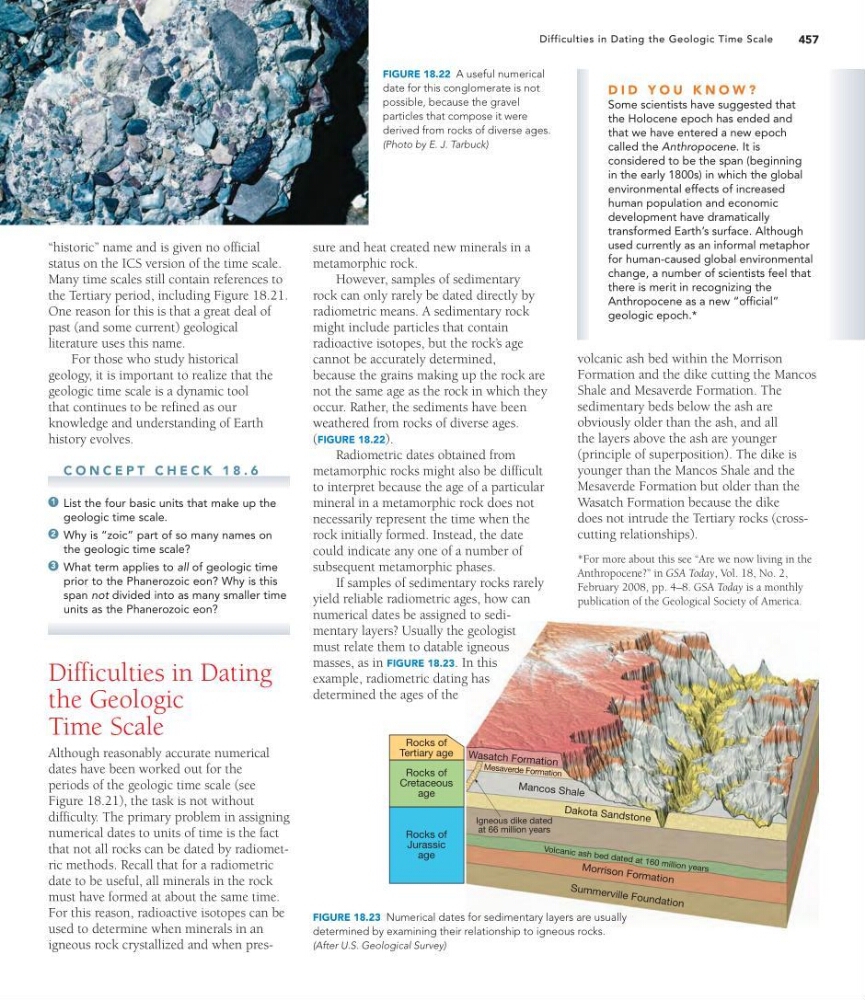
numerical dates be assigned to sedimentary layers? Usually the geologist
must relate them to datable igneous
masses, as in FIGURE 18.23. In this
example, radiometric dating has
determined the ages of the
D I D Y O U K N O W ?
Some scientists have suggested that
the Holocene epoch has ended and
that we have entered a new epoch
called the Anthropocene. It is
considered to be the span (beginning
in the early 1800s) in which the global
environmental effects of increased
human population and economic
development have dramatically
transformed Earth’s surface. Although
used currently as an informal metaphor
for human-caused global environmental
change, a number of scientists feel that
there is merit in recognizing the
Anthropocene as a new “official”
geologic epoch.*
*For more about this see “Are we now living in the
Anthropocene?” in GSA Today, Vol. 18, No. 2,
February 2008, pp. 4–8. GSA Today is a monthly
publication of the Geological Society of America.
FIGURE 18.22 A useful numerical
date for this conglomerate is not
possible, because the gravel
particles that compose it were
derived from rocks of diverse ages.
(Photo by E. J. Tarbuck)
FIGURE 18.23 Numerical dates for sedimentary layers are usually
determined by examining their relationship to igneous rocks.
(After U.S. Geological Survey)
volcanic ash bed within the Morrison
Formation and the dike cutting the Mancos
Shale and Mesaverde Formation. The
sedimentary beds below the ash are
obviously older than the ash, and all
the layers above the ash are younger
(principle of superposition). The dike is
younger than the Mancos Shale and the
Mesaverde Formation but older than the
Wasatch Formation because the dike
does not intrude the Tertiary rocks (crosscutting relationships).
at 66 million years
Rocks of
Tertiary age
Rocks of
Cretaceous
age
Rocks of
Jurassic
age
Wa satc h For mat ion
Mes aver de Form ation
Ma nco s Sh ale
Da kot a Sa nds ton e
Vol can ic ash bed dat ed at 160 mil lion yea rs
Su mm er vil le Fo un da tio n
M or ris on Fo rm ati on
457
Difficulties in Dating the Geologic Time Scale
“historic” name and is given no official
status on the ICS version of the time scale.
Many time scales still contain references to
the Tertiary period, including Figure 18.21.
One reason for this is that a great deal of
past (and some current) geological
literature uses this name.
For those who study historical
geology, it is important to realize that the
geologic time scale is a dynamic tool
that continues to be refined as our
knowledge and understanding of Earth
history evolves.
C O N C E P T C H E C K 1 8 . 6
List the four basic units that make up the
geologic time scale.
Why is “zoic” part of so many names on
the geologic time scale?
What term applies to all of geologic time
prior to the Phanerozoic eon? Why is this
span not divided into as many smaller time
units as the Phanerozoic eon?
Difficulties in Dating
the Geologic
Time Scale
Although reasonably accurate numerical
dates have been worked out for the
periods of the geologic time scale (see
Figure 18.21), the task is not without
difficulty. The primary problem in assigning
numerical dates to units of time is the fact
that not all rocks can be dated by radiometric methods. Recall that for a radiometric
date to be useful, all minerals in the rock
must have formed at about the same time.
For this reason, radioactive isotopes can be
used to determine when minerals in an
igneous rock crystallized and when pres3
2
1
sure and heat created new minerals in a
metamorphic rock.
However, samples of sedimentary
rock can only rarely be dated directly by
radiometric means. A sedimentary rock
might include particles that contain
radioactive isotopes, but the rock’ s age
cannot be accurately determined,
because the grains making up the rock are
not the same age as the rock in which they
occur. Rather, the sediments have been
weathered from rocks of diverse ages.
(FIGURE 18.22).
Radiometric dates obtained from
metamorphic rocks might also be difficult
to interpret because the age of a particular
mineral in a metamorphic rock does not
necessarily represent the time when the
rock initially formed. Instead, the date
could indicate any one of a number of
subsequent metamorphic phases.
If samples of sedimentary rocks rarely
yield reliable radiometric ages, how can
numerical dates be assigned to sedimentary layers? Usually the geologist
must relate them to datable igneous
masses, as in FIGURE 18.23. In this
example, radiometric dating has
determined the ages of the
D I D Y O U K N O W ?
Some scientists have suggested that
the Holocene epoch has ended and
that we have entered a new epoch
called the Anthropocene. It is
considered to be the span (beginning
in the early 1800s) in which the global
environmental effects of increased
human population and economic
development have dramatically
transformed Earth’s surface. Although
used currently as an informal metaphor
for human-caused global environmental
change, a number of scientists feel that
there is merit in recognizing the
Anthropocene as a new “official”
geologic epoch.*
*For more about this see “Are we now living in the
Anthropocene?” in GSA Today, Vol. 18, No. 2,
February 2008, pp. 4–8. GSA Today is a monthly
publication of the Geological Society of America.
FIGURE 18.22 A useful numerical
date for this conglomerate is not
possible, because the gravel
particles that compose it were
derived from rocks of diverse ages.
(Photo by E. J. Tarbuck)
FIGURE 18.23 Numerical dates for sedimentary layers are usually
determined by examining their relationship to igneous rocks.
(After U.S. Geological Survey)
volcanic ash bed within the Morrison
Formation and the dike cutting the Mancos
Shale and Mesaverde Formation. The
sedimentary beds below the ash are
obviously older than the ash, and all
the layers above the ash are younger
(principle of superposition). The dike is
younger than the Mancos Shale and the
Mesaverde Formation but older than the
Wasatch Formation because the dike
does not intrude the Tertiary rocks (crosscutting relationships).