

CHAPTER 18 Geologic Time
438
Geology Needs
a Time Scale
In the late 18th century, James Hutton
recognized the immensity of Earth history
and the importance of time as a component
in all geological processes. In the 19th century, others effectively demonstrated that
Earth had experienced many episodes of
mountain building and erosion, which
must have required great spans of geologic
time. Although these pioneering scientists
understood that Earth was very old, they
had no way of knowing its true age. Was it
tens of millions, hundreds of millions, or
even billions of years old? Rather, a
geologic time scale was developed that
showed the sequence of events based on
relative dating principles. What are these
principles? What part do fossils play?
With the discovery of radioactivity and
radiometric dating techniques, geologists
can now assign fairly accurate dates to
many of the events in Earth history. What
is radioactivity? Why is it a good “clock”
for dating the geologic past?
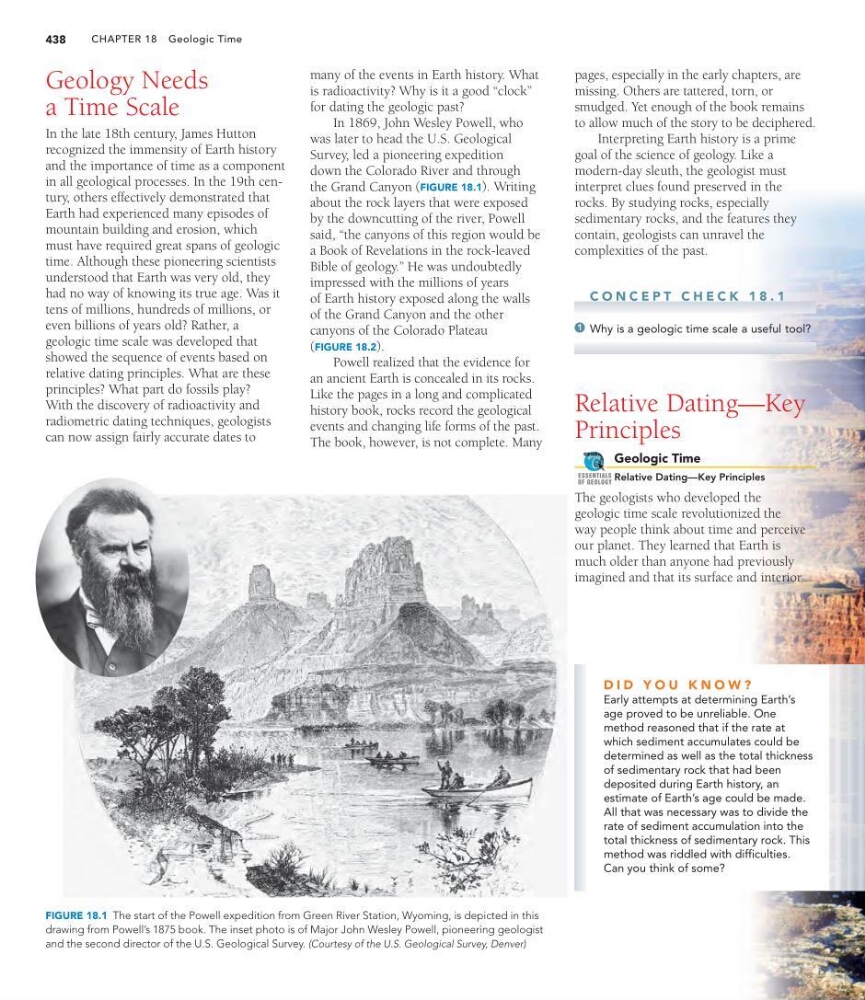
In 1869, John Wesley Powell, who
was later to head the U.S. Geological
Survey, led a pioneering expedition
down the Colorado River and through
the Grand Canyon (FIGURE 18.1). Writing
about the rock layers that were exposed
by the downcutting of the river, Powell
said, “the canyons of this region would be
a Book of Revelations in the rock-leaved
Bible of geology.” He was undoubtedly
impressed with the millions of years
of Earth history exposed along the walls
of the Grand Canyon and the other
canyons of the Colorado Plateau
(FIGURE 18.2).
Powell realized that the evidence for
an ancient Earth is concealed in its rocks.
Like the pages in a long and complicated
history book, rocks record the geological
events and changing life forms of the past.
The book, however, is not complete. Many
pages, especially in the early chapters, are
missing. Others are tattered, torn, or
smudged. Yet enough of the book remains
to allow much of the story to be deciphered.
Interpreting Earth history is a prime
goal of the science of geology. Like a
modern-day sleuth, the geologist must
interpret clues found preserved in the
rocks. By studying rocks, especially
sedimentary rocks, and the features they
contain, geologists can unravel the
complexities of the past.
C O N C E P T C H E C K 1 8 . 1
Why is a geologic time scale a useful tool?
Relative Dating—Key
Principles
Geologic Time
Relative Dating—Key Principles
The geologists who developed the
geologic time scale revolutionized the
way people think about time and perceive
our planet. They learned that Earth is
much older than anyone had previously
imagined and that its surface and interior
GEODe
ESSENTIALS
OF GEOLOGY
1
FIGURE 18.1 The start of the Powell expedition from Green River Station, Wyoming, is depicted in this
drawing from Powell’s 1875 book. The inset photo is of Major John Wesley Powell, pioneering geologist
and the second director of the U.S. Geological Survey. (Courtesy of the U.S. Geological Survey, Denver)
D I D Y O U K N O W ?
Early attempts at determining Earth’s
age proved to be unreliable. One
method reasoned that if the rate at
which sediment accumulates could be
determined as well as the total thickness
of sedimentary rock that had been
deposited during Earth history, an
estimate of Earth’s age could be made.
All that was necessary was to divide the
rate of sediment accumulation into the
total thickness of sedimentary rock. This
method was riddled with difficulties.
Can you think of some?
438
Geology Needs
a Time Scale
In the late 18th century, James Hutton
recognized the immensity of Earth history
and the importance of time as a component
in all geological processes. In the 19th century, others effectively demonstrated that
Earth had experienced many episodes of
mountain building and erosion, which
must have required great spans of geologic
time. Although these pioneering scientists
understood that Earth was very old, they
had no way of knowing its true age. Was it
tens of millions, hundreds of millions, or
even billions of years old? Rather, a
geologic time scale was developed that
showed the sequence of events based on
relative dating principles. What are these
principles? What part do fossils play?
With the discovery of radioactivity and
radiometric dating techniques, geologists
can now assign fairly accurate dates to
many of the events in Earth history. What
is radioactivity? Why is it a good “clock”
for dating the geologic past?
In 1869, John Wesley Powell, who
was later to head the U.S. Geological
Survey, led a pioneering expedition
down the Colorado River and through
the Grand Canyon (FIGURE 18.1). Writing
about the rock layers that were exposed
by the downcutting of the river, Powell
said, “the canyons of this region would be
a Book of Revelations in the rock-leaved
Bible of geology.” He was undoubtedly
impressed with the millions of years
of Earth history exposed along the walls
of the Grand Canyon and the other
canyons of the Colorado Plateau
(FIGURE 18.2).
Powell realized that the evidence for
an ancient Earth is concealed in its rocks.
Like the pages in a long and complicated
history book, rocks record the geological
events and changing life forms of the past.
The book, however, is not complete. Many
pages, especially in the early chapters, are
missing. Others are tattered, torn, or
smudged. Yet enough of the book remains
to allow much of the story to be deciphered.
Interpreting Earth history is a prime
goal of the science of geology. Like a
modern-day sleuth, the geologist must
interpret clues found preserved in the
rocks. By studying rocks, especially
sedimentary rocks, and the features they
contain, geologists can unravel the
complexities of the past.
C O N C E P T C H E C K 1 8 . 1
Why is a geologic time scale a useful tool?
Relative Dating—Key
Principles
Geologic Time
Relative Dating—Key Principles
The geologists who developed the
geologic time scale revolutionized the
way people think about time and perceive
our planet. They learned that Earth is
much older than anyone had previously
imagined and that its surface and interior
GEODe
ESSENTIALS
OF GEOLOGY
1
FIGURE 18.1 The start of the Powell expedition from Green River Station, Wyoming, is depicted in this
drawing from Powell’s 1875 book. The inset photo is of Major John Wesley Powell, pioneering geologist
and the second director of the U.S. Geological Survey. (Courtesy of the U.S. Geological Survey, Denver)
D I D Y O U K N O W ?
Early attempts at determining Earth’s
age proved to be unreliable. One
method reasoned that if the rate at
which sediment accumulates could be
determined as well as the total thickness
of sedimentary rock that had been
deposited during Earth history, an
estimate of Earth’s age could be made.
All that was necessary was to divide the
rate of sediment accumulation into the
total thickness of sedimentary rock. This
method was riddled with difficulties.
Can you think of some?