

G
EOLOGICAL EVENTS BY
THEMSELVES HAVE
LITTLE MEANING
until they are put into a time
perspective. Studying history,
whether it be the Civil War or the
Age of Dinosaurs, requires a
calendar. Among geology’ s major
contributions to human knowledge
is the geologic time scale and the
discovery that Earth history is
exceedingly long.
F O C U S O N C O N C E P T S
To assist you in learning
the important concepts in this
chapter, focus on the following
questions:
What are the two types of dates
used by geologists to interpret
Earth history?
What are the laws, principles,
and techniques used to establish
relative dates?
What are fossils? What are the
conditions that favor the
preservation of organisms as
fossils?
How are fossils used to correlate
rocks of similar ages that are in
different places?
What is radioactivity, and how
are radioactive isotopes used in
radiometric dating?
What is the geologic time scale,
and what are its principal
subdivisions?
Why is it difficult to assign
reliable numerical dates to
samples of sedimentary rock?
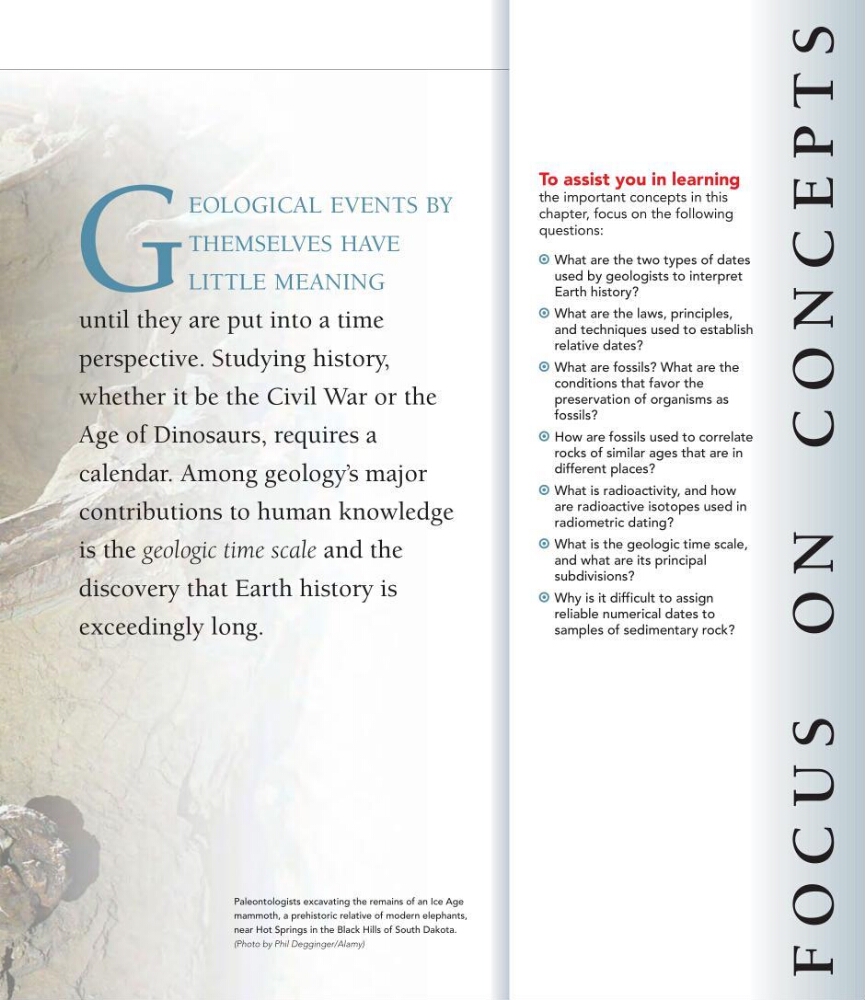
Paleontologists excavating the remains of an Ice Age
mammoth, a prehistoric relative of modern elephants,
near Hot Springs in the Black Hills of South Dakota.
(Photo by Phil Degginger/Alamy)
EOLOGICAL EVENTS BY
THEMSELVES HAVE
LITTLE MEANING
until they are put into a time
perspective. Studying history,
whether it be the Civil War or the
Age of Dinosaurs, requires a
calendar. Among geology’ s major
contributions to human knowledge
is the geologic time scale and the
discovery that Earth history is
exceedingly long.
F O C U S O N C O N C E P T S
To assist you in learning
the important concepts in this
chapter, focus on the following
questions:
What are the two types of dates
used by geologists to interpret
Earth history?
What are the laws, principles,
and techniques used to establish
relative dates?
What are fossils? What are the
conditions that favor the
preservation of organisms as
fossils?
How are fossils used to correlate
rocks of similar ages that are in
different places?
What is radioactivity, and how
are radioactive isotopes used in
radiometric dating?
What is the geologic time scale,
and what are its principal
subdivisions?
Why is it difficult to assign
reliable numerical dates to
samples of sedimentary rock?
Paleontologists excavating the remains of an Ice Age
mammoth, a prehistoric relative of modern elephants,
near Hot Springs in the Black Hills of South Dakota.
(Photo by Phil Degginger/Alamy)