

D I D Y O U K N O W ?
Since the first successful ascent to the summit of Mount
Everest in 1953, thousands have set out to match this feat.
Unfortunately, more than 100 people have perished in their
effort. In addition, debris has become a major problem
because waste, such as empty oxygen bottles, does not
disintegrate at high altitudes and is impossible to bury.
A.
Young mountain range
Oceanic
crust
B.
Continental
crust
Erosion
T
I
M
E
Uplift
Deposition
C.
Old mountain remnant
Continental crust
Deposition
Sinking
Continental
crust
433
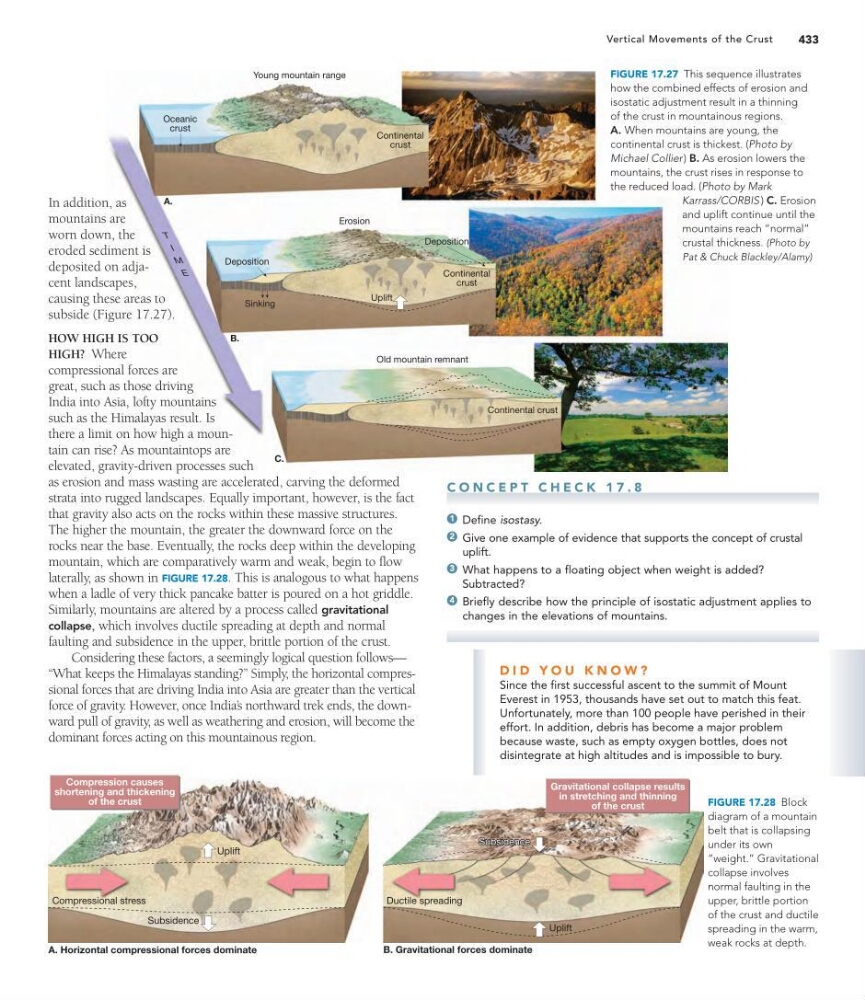
In addition, as
mountains are
worn down, the
eroded sediment is
deposited on adjacent landscapes,
causing these areas to
subside (Figure 17.27).
HOW HIGH IS TOO
HIGH? Where
compressional forces are
great, such as those driving
India into Asia, lofty mountains
such as the Himalayas result. Is
there a limit on how high a mountain can rise? As mountaintops are
elevated, gravity-driven processes such
as erosion and mass wasting are accelerated, carving the deformed
strata into rugged landscapes. Equally important, however, is the fact
that gravity also acts on the rocks within these massive structures.
The higher the mountain, the greater the downward force on the
rocks near the base. Eventually, the rocks deep within the developing
mountain, which are comparatively warm and weak, begin to flow
laterally, as shown in FIGURE 17.28. This is analogous to what happens
when a ladle of very thick pancake batter is poured on a hot griddle.
Similarly, mountains are altered by a process called gravitational
collapse, which involves ductile spreading at depth and normal
faulting and subsidence in the upper, brittle portion of the crust.
Considering these factors, a seemingly logical question follows—
“What keeps the Himalayas standing?” Simply, the horizontal compressional forces that are driving India into Asia are greater than the vertical
force of gravity. However, once India’ s northward trek ends, the downward pull of gravity, as well as weathering and erosion, will become the
dominant forces acting on this mountainous region.
FIGURE 17.27 This sequence illustrates
how the combined effects of erosion and
isostatic adjustment result in a thinning
of the crust in mountainous regions.
A. When mountains are young, the
continental crust is thickest. (Photo by
Michael Collier) B. As erosion lowers the
mountains, the crust rises in response to
the reduced load. (Photo by Mark
Karrass/CORBIS ) C. Erosion
and uplift continue until the
mountains reach “normal”
crustal thickness. (Photo by
Pat & Chuck Blackley/Alamy)
C O N C E P T C H E C K 1 7 . 8
Define isostasy.
Give one example of evidence that supports the concept of crustal
uplift.
What happens to a floating object when weight is added?
Subtracted?
Briefly describe how the principle of isostatic adjustment applies to
changes in the elevations of mountains.
4
3
2
1
Vertical Movements of the Crust
A. Horizontal compressional forces dominate
B. Gravitational forces dominate
Ductile spreading
Compressional stress
Compression causes
shortening and thickening
of the crust
Gravitational collapse results
in stretching and thinning
of the crust
Uplift
Subsidence
Subsidence Subsidence Subsidence
Uplift
FIGURE 17.28 Block
diagram of a mountain
belt that is collapsing
under its own
“weight.” Gravitational
collapse involves
normal faulting in the
upper, brittle portion
of the crust and ductile
spreading in the warm,
weak rocks at depth.
Since the first successful ascent to the summit of Mount
Everest in 1953, thousands have set out to match this feat.
Unfortunately, more than 100 people have perished in their
effort. In addition, debris has become a major problem
because waste, such as empty oxygen bottles, does not
disintegrate at high altitudes and is impossible to bury.
A.
Young mountain range
Oceanic
crust
B.
Continental
crust
Erosion
T
I
M
E
Uplift
Deposition
C.
Old mountain remnant
Continental crust
Deposition
Sinking
Continental
crust
433
In addition, as
mountains are
worn down, the
eroded sediment is
deposited on adjacent landscapes,
causing these areas to
subside (Figure 17.27).
HOW HIGH IS TOO
HIGH? Where
compressional forces are
great, such as those driving
India into Asia, lofty mountains
such as the Himalayas result. Is
there a limit on how high a mountain can rise? As mountaintops are
elevated, gravity-driven processes such
as erosion and mass wasting are accelerated, carving the deformed
strata into rugged landscapes. Equally important, however, is the fact
that gravity also acts on the rocks within these massive structures.
The higher the mountain, the greater the downward force on the
rocks near the base. Eventually, the rocks deep within the developing
mountain, which are comparatively warm and weak, begin to flow
laterally, as shown in FIGURE 17.28. This is analogous to what happens
when a ladle of very thick pancake batter is poured on a hot griddle.
Similarly, mountains are altered by a process called gravitational
collapse, which involves ductile spreading at depth and normal
faulting and subsidence in the upper, brittle portion of the crust.
Considering these factors, a seemingly logical question follows—
“What keeps the Himalayas standing?” Simply, the horizontal compressional forces that are driving India into Asia are greater than the vertical
force of gravity. However, once India’ s northward trek ends, the downward pull of gravity, as well as weathering and erosion, will become the
dominant forces acting on this mountainous region.
FIGURE 17.27 This sequence illustrates
how the combined effects of erosion and
isostatic adjustment result in a thinning
of the crust in mountainous regions.
A. When mountains are young, the
continental crust is thickest. (Photo by
Michael Collier) B. As erosion lowers the
mountains, the crust rises in response to
the reduced load. (Photo by Mark
Karrass/CORBIS ) C. Erosion
and uplift continue until the
mountains reach “normal”
crustal thickness. (Photo by
Pat & Chuck Blackley/Alamy)
C O N C E P T C H E C K 1 7 . 8
Define isostasy.
Give one example of evidence that supports the concept of crustal
uplift.
What happens to a floating object when weight is added?
Subtracted?
Briefly describe how the principle of isostatic adjustment applies to
changes in the elevations of mountains.
4
3
2
1
Vertical Movements of the Crust
A. Horizontal compressional forces dominate
B. Gravitational forces dominate
Ductile spreading
Compressional stress
Compression causes
shortening and thickening
of the crust
Gravitational collapse results
in stretching and thinning
of the crust
Uplift
Subsidence
Subsidence Subsidence Subsidence
Uplift
FIGURE 17.28 Block
diagram of a mountain
belt that is collapsing
under its own
“weight.” Gravitational
collapse involves
normal faulting in the
upper, brittle portion
of the crust and ductile
spreading in the warm,
weak rocks at depth.