

15
Earth as a System
organic matter from decayed plant and
animal life (biosphere). The decomposed
and disintegrated rock debris is the product
of weathering processes that require air
(atmosphere) and water (hydrosphere).
Air and water also occupy the open spaces
between the solid particles and are considered important soil components.
C O N C E P T C H E C K 1 . 6
List and briefly describe Earth’s four
spheres.
Earth as a System
Anyone who studies Earth soon learns that
our planet is a dynamic body with many
separate but interacting parts or spheres.
The hydrosphere, atmosphere, biosphere,
and geosphere and all of their components
can be studied separately. However, the
parts are not isolated. Each is related in
some way to the others to produce a
complex and continuously interacting
whole that we call the Earth system.
Earth System Science
A simple example of the interactions among
different parts of the Earth system occurs
1
every winter as moisture evaporates from the
Pacific Ocean and subsequently falls as rain
in the hills of southern California, triggering
destructive landslides. A case study in
Chapter 8 explores such an event (see
p. 204). The processes that move water from
the hydrosphere to the atmosphere and then
to the solid Earth have a profound impact
on the plants and animals (including
humans) that inhabit the affected regions.
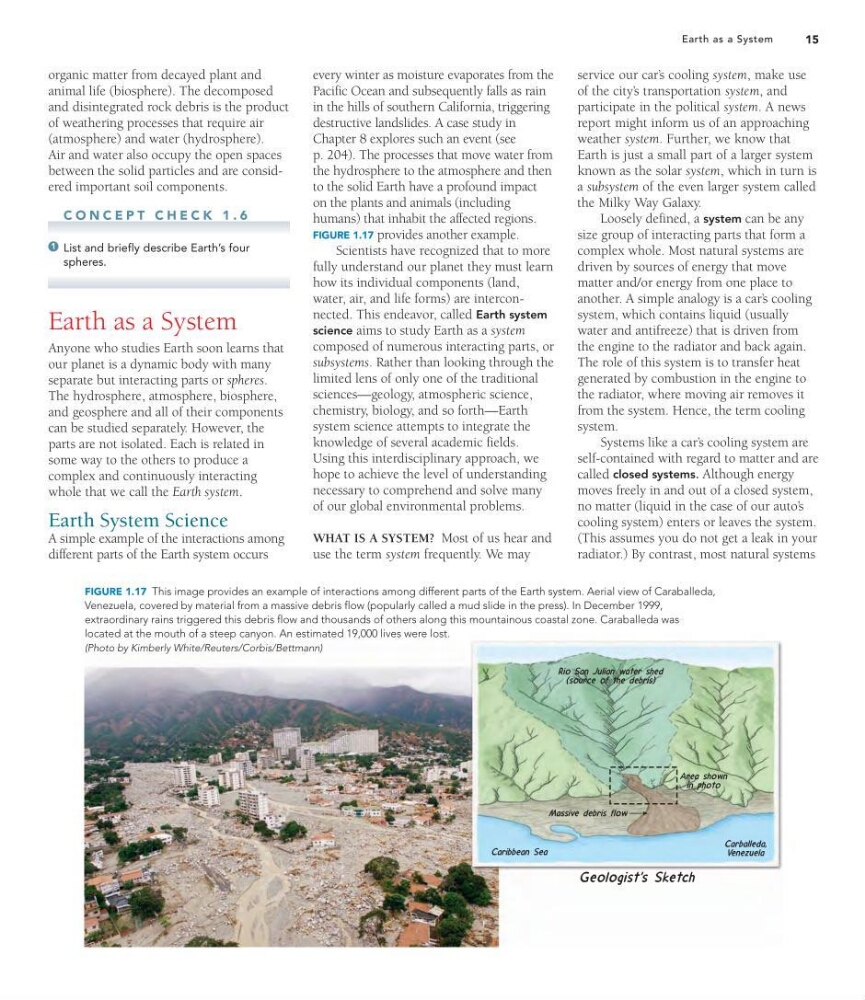
FIGURE 1.17 provides another example.
Scientists have recognized that to more
fully understand our planet they must learn
how its individual components (land,
water, air, and life forms) are interconnected. This endeavor, called Earth system
science aims to study Earth as a system
composed of numerous interacting parts, or
subsystems. Rather than looking through the
limited lens of only one of the traditional
sciences—geology, atmospheric science,
chemistry, biology, and so forth—Earth
system science attempts to integrate the
knowledge of several academic fields.
Using this interdisciplinary approach, we
hope to achieve the level of understanding
necessary to comprehend and solve many
of our global environmental problems.
WHAT IS A SYSTEM? Most of us hear and
use the term system frequently. We may
service our car’ s cooling system, make use
of the city’ s transportation system, and
participate in the political system. A news
report might inform us of an approaching
weather system. Further, we know that
Earth is just a small part of a larger system
known as the solar system, which in turn is
a subsystem of the even larger system called
the Milky Way Galaxy.
Loosely defined, a system can be any
size group of interacting parts that form a
complex whole. Most natural systems are
driven by sources of energy that move
matter and/or energy from one place to
another. A simple analogy is a car’ s cooling
system, which contains liquid (usually
water and antifreeze) that is driven from
the engine to the radiator and back again.
The role of this system is to transfer heat
generated by combustion in the engine to
the radiator, where moving air removes it
from the system. Hence, the term cooling
system.
Systems like a car’ s cooling system are
self-contained with regard to matter and are
called closed systems. Although energy
moves freely in and out of a closed system,
no matter (liquid in the case of our auto’ s
cooling system) enters or leaves the system.
(This assumes you do not get a leak in your
radiator.) By contrast, most natural systems
FIGURE 1.17 This image provides an example of interactions among different parts of the Earth system. Aerial view of Caraballeda,
Venezuela, covered by material from a massive debris flow (popularly called a mud slide in the press). In December 1999,
extraordinary rains triggered this debris flow and thousands of others along this mountainous coastal zone. Caraballeda was
located at the mouth of a steep canyon. An estimated 19,000 lives were lost.
(Photo by Kimberly White/Reuters/Corbis/Bettmann)
Earth as a System
organic matter from decayed plant and
animal life (biosphere). The decomposed
and disintegrated rock debris is the product
of weathering processes that require air
(atmosphere) and water (hydrosphere).
Air and water also occupy the open spaces
between the solid particles and are considered important soil components.
C O N C E P T C H E C K 1 . 6
List and briefly describe Earth’s four
spheres.
Earth as a System
Anyone who studies Earth soon learns that
our planet is a dynamic body with many
separate but interacting parts or spheres.
The hydrosphere, atmosphere, biosphere,
and geosphere and all of their components
can be studied separately. However, the
parts are not isolated. Each is related in
some way to the others to produce a
complex and continuously interacting
whole that we call the Earth system.
Earth System Science
A simple example of the interactions among
different parts of the Earth system occurs
1
every winter as moisture evaporates from the
Pacific Ocean and subsequently falls as rain
in the hills of southern California, triggering
destructive landslides. A case study in
Chapter 8 explores such an event (see
p. 204). The processes that move water from
the hydrosphere to the atmosphere and then
to the solid Earth have a profound impact
on the plants and animals (including
humans) that inhabit the affected regions.
FIGURE 1.17 provides another example.
Scientists have recognized that to more
fully understand our planet they must learn
how its individual components (land,
water, air, and life forms) are interconnected. This endeavor, called Earth system
science aims to study Earth as a system
composed of numerous interacting parts, or
subsystems. Rather than looking through the
limited lens of only one of the traditional
sciences—geology, atmospheric science,
chemistry, biology, and so forth—Earth
system science attempts to integrate the
knowledge of several academic fields.
Using this interdisciplinary approach, we
hope to achieve the level of understanding
necessary to comprehend and solve many
of our global environmental problems.
WHAT IS A SYSTEM? Most of us hear and
use the term system frequently. We may
service our car’ s cooling system, make use
of the city’ s transportation system, and
participate in the political system. A news
report might inform us of an approaching
weather system. Further, we know that
Earth is just a small part of a larger system
known as the solar system, which in turn is
a subsystem of the even larger system called
the Milky Way Galaxy.
Loosely defined, a system can be any
size group of interacting parts that form a
complex whole. Most natural systems are
driven by sources of energy that move
matter and/or energy from one place to
another. A simple analogy is a car’ s cooling
system, which contains liquid (usually
water and antifreeze) that is driven from
the engine to the radiator and back again.
The role of this system is to transfer heat
generated by combustion in the engine to
the radiator, where moving air removes it
from the system. Hence, the term cooling
system.
Systems like a car’ s cooling system are
self-contained with regard to matter and are
called closed systems. Although energy
moves freely in and out of a closed system,
no matter (liquid in the case of our auto’ s
cooling system) enters or leaves the system.
(This assumes you do not get a leak in your
radiator.) By contrast, most natural systems
FIGURE 1.17 This image provides an example of interactions among different parts of the Earth system. Aerial view of Caraballeda,
Venezuela, covered by material from a massive debris flow (popularly called a mud slide in the press). In December 1999,
extraordinary rains triggered this debris flow and thousands of others along this mountainous coastal zone. Caraballeda was
located at the mouth of a steep canyon. An estimated 19,000 lives were lost.
(Photo by Kimberly White/Reuters/Corbis/Bettmann)