

Tidal
flats
Tidal
delta
Barrier
island
Lagoon
Full moon
Solar tide
New moon
To Sun
To Sun
Lunar tide
A. Spring tide
First quarter
moon
Solar tide
Lunar tide
Third quarter
moon
B. Neap tide
is much farther away, its effect is considerably less. In fact, the Sun’ s tidegenerating effect is only about 46 percent that of the Moon’ s.
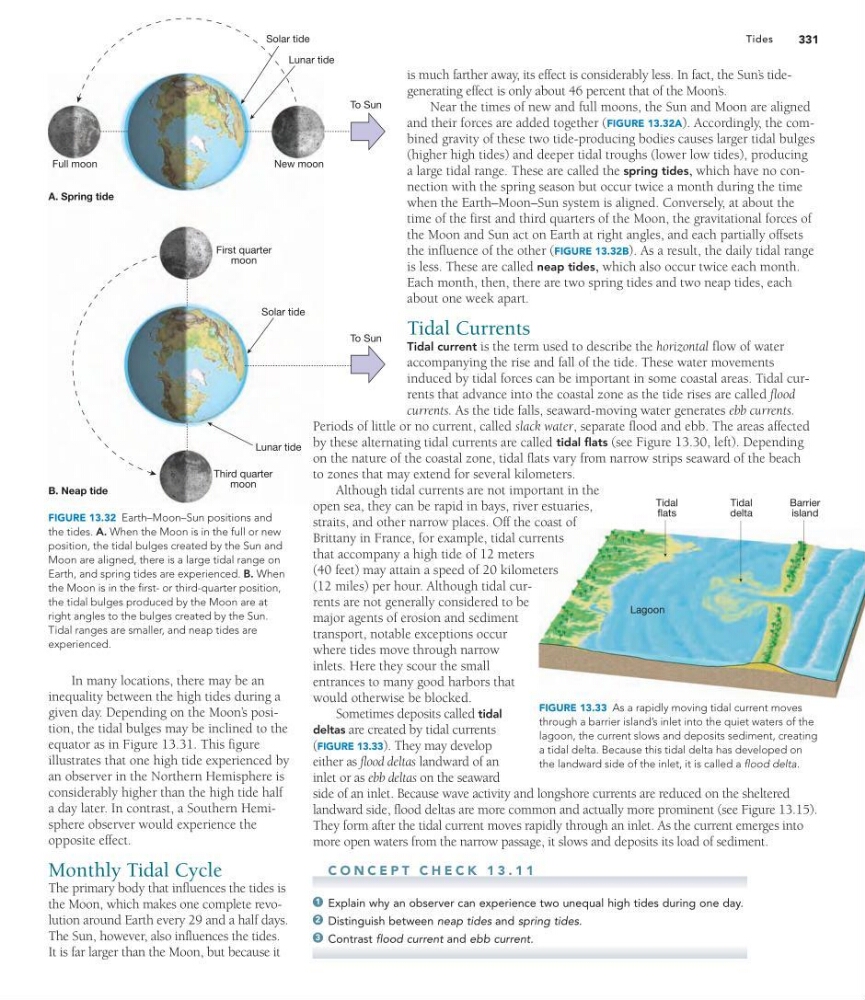
Near the times of new and full moons, the Sun and Moon are aligned
and their forces are added together (FIGURE 13.32A). Accordingly, the combined gravity of these two tide-producing bodies causes larger tidal bulges
(higher high tides) and deeper tidal troughs (lower low tides), producing
a large tidal range. These are called the spring tides, which have no connection with the spring season but occur twice a month during the time
when the Earth–Moon–Sun system is aligned. Conversely, at about the
time of the first and third quarters of the Moon, the gravitational forces of
the Moon and Sun act on Earth at right angles, and each partially offsets
the influence of the other (FIGURE 13.32B). As a result, the daily tidal range
is less. These are called neap tides, which also occur twice each month.
Each month, then, there are two spring tides and two neap tides, each
about one week apart.
Tidal Currents
Tidal current is the term used to describe the horizontal flow of water
accompanying the rise and fall of the tide. These water movements
induced by tidal forces can be important in some coastal areas. Tidal currents that advance into the coastal zone as the tide rises are called flood
currents. As the tide falls, seaward-moving water generates ebb currents.
Periods of little or no current, called slack water, separate flood and ebb. The areas affected
by these alternating tidal currents are called tidal flats (see Figure 13.30, left). Depending
on the nature of the coastal zone, tidal flats vary from narrow strips seaward of the beach
to zones that may extend for several kilometers.
Although tidal currents are not important in the
open sea, they can be rapid in bays, river estuaries,
straits, and other narrow places. Off the coast of
Brittany in France, for example, tidal currents
that accompany a high tide of 12 meters
(40 feet) may attain a speed of 20 kilometers
(12 miles) per hour. Although tidal currents are not generally considered to be
major agents of erosion and sediment
transport, notable exceptions occur
where tides move through narrow
inlets. Here they scour the small
entrances to many good harbors that
would otherwise be blocked.
Sometimes deposits called tidal
deltas are created by tidal currents
(FIGURE 13.33). They may develop
either as flood deltas landward of an
inlet or as ebb deltas on the seaward
side of an inlet. Because wave activity and longshore currents are reduced on the sheltered
landward side, flood deltas are more common and actually more prominent (see Figure 13.15).
They form after the tidal current moves rapidly through an inlet. As the current emerges into
more open waters from the narrow passage, it slows and deposits its load of sediment.
C O N C E P T C H E C K 1 3 . 1 1
Explain why an observer can experience two unequal high tides during one day.
Distinguish between neap tides and spring tides.
Contrast flood current and ebb current.
3
2
1
331
Tides
FIGURE 13.32 Earth–Moon–Sun positions and
the tides. A. When the Moon is in the full or new
position, the tidal bulges created by the Sun and
Moon are aligned, there is a large tidal range on
Earth, and spring tides are experienced. B. When
the Moon is in the first- or third-quarter position,
the tidal bulges produced by the Moon are at
right angles to the bulges created by the Sun.
Tidal ranges are smaller, and neap tides are
experienced.
In many locations, there may be an
inequality between the high tides during a
given day. Depending on the Moon’ s position, the tidal bulges may be inclined to the
equator as in Figure 13.31. This figure
illustrates that one high tide experienced by
an observer in the Northern Hemisphere is
considerably higher than the high tide half
a day later. In contrast, a Southern Hemisphere observer would experience the
opposite effect.
Monthly Tidal Cycle
The primary body that influences the tides is
the Moon, which makes one complete revolution around Earth every 29 and a half days.
The Sun, however, also influences the tides.
It is far larger than the Moon, but because it
FIGURE 13.33 As a rapidly moving tidal current moves
through a barrier island’s inlet into the quiet waters of the
lagoon, the current slows and deposits sediment, creating
a tidal delta. Because this tidal delta has developed on
the landward side of the inlet, it is called a flood delta.
flats
Tidal
delta
Barrier
island
Lagoon
Full moon
Solar tide
New moon
To Sun
To Sun
Lunar tide
A. Spring tide
First quarter
moon
Solar tide
Lunar tide
Third quarter
moon
B. Neap tide
is much farther away, its effect is considerably less. In fact, the Sun’ s tidegenerating effect is only about 46 percent that of the Moon’ s.
Near the times of new and full moons, the Sun and Moon are aligned
and their forces are added together (FIGURE 13.32A). Accordingly, the combined gravity of these two tide-producing bodies causes larger tidal bulges
(higher high tides) and deeper tidal troughs (lower low tides), producing
a large tidal range. These are called the spring tides, which have no connection with the spring season but occur twice a month during the time
when the Earth–Moon–Sun system is aligned. Conversely, at about the
time of the first and third quarters of the Moon, the gravitational forces of
the Moon and Sun act on Earth at right angles, and each partially offsets
the influence of the other (FIGURE 13.32B). As a result, the daily tidal range
is less. These are called neap tides, which also occur twice each month.
Each month, then, there are two spring tides and two neap tides, each
about one week apart.
Tidal Currents
Tidal current is the term used to describe the horizontal flow of water
accompanying the rise and fall of the tide. These water movements
induced by tidal forces can be important in some coastal areas. Tidal currents that advance into the coastal zone as the tide rises are called flood
currents. As the tide falls, seaward-moving water generates ebb currents.
Periods of little or no current, called slack water, separate flood and ebb. The areas affected
by these alternating tidal currents are called tidal flats (see Figure 13.30, left). Depending
on the nature of the coastal zone, tidal flats vary from narrow strips seaward of the beach
to zones that may extend for several kilometers.
Although tidal currents are not important in the
open sea, they can be rapid in bays, river estuaries,
straits, and other narrow places. Off the coast of
Brittany in France, for example, tidal currents
that accompany a high tide of 12 meters
(40 feet) may attain a speed of 20 kilometers
(12 miles) per hour. Although tidal currents are not generally considered to be
major agents of erosion and sediment
transport, notable exceptions occur
where tides move through narrow
inlets. Here they scour the small
entrances to many good harbors that
would otherwise be blocked.
Sometimes deposits called tidal
deltas are created by tidal currents
(FIGURE 13.33). They may develop
either as flood deltas landward of an
inlet or as ebb deltas on the seaward
side of an inlet. Because wave activity and longshore currents are reduced on the sheltered
landward side, flood deltas are more common and actually more prominent (see Figure 13.15).
They form after the tidal current moves rapidly through an inlet. As the current emerges into
more open waters from the narrow passage, it slows and deposits its load of sediment.
C O N C E P T C H E C K 1 3 . 1 1
Explain why an observer can experience two unequal high tides during one day.
Distinguish between neap tides and spring tides.
Contrast flood current and ebb current.
3
2
1
331
Tides
FIGURE 13.32 Earth–Moon–Sun positions and
the tides. A. When the Moon is in the full or new
position, the tidal bulges created by the Sun and
Moon are aligned, there is a large tidal range on
Earth, and spring tides are experienced. B. When
the Moon is in the first- or third-quarter position,
the tidal bulges produced by the Moon are at
right angles to the bulges created by the Sun.
Tidal ranges are smaller, and neap tides are
experienced.
In many locations, there may be an
inequality between the high tides during a
given day. Depending on the Moon’ s position, the tidal bulges may be inclined to the
equator as in Figure 13.31. This figure
illustrates that one high tide experienced by
an observer in the Northern Hemisphere is
considerably higher than the high tide half
a day later. In contrast, a Southern Hemisphere observer would experience the
opposite effect.
Monthly Tidal Cycle
The primary body that influences the tides is
the Moon, which makes one complete revolution around Earth every 29 and a half days.
The Sun, however, also influences the tides.
It is far larger than the Moon, but because it
FIGURE 13.33 As a rapidly moving tidal current moves
through a barrier island’s inlet into the quiet waters of the
lagoon, the current slows and deposits sediment, creating
a tidal delta. Because this tidal delta has developed on
the landward side of the inlet, it is called a flood delta.