

11
Earth’s Spheres
Earth’ s Spheres
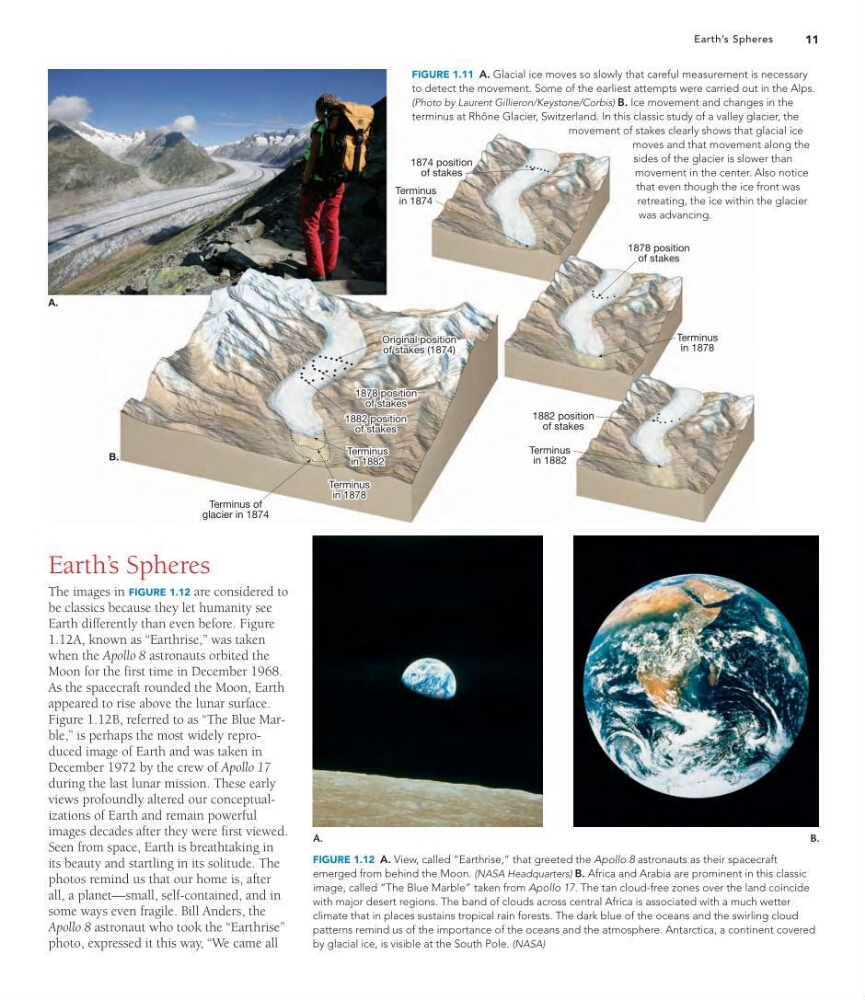
The images in FIGURE 1.12 are considered to
be classics because they let humanity see
Earth differently than even before. Figure
1.12A, known as “Earthrise,” was taken
when the Apollo 8 astronauts orbited the
Moon for the first time in December 1968.
As the spacecraft rounded the Moon, Earth
appeared to rise above the lunar surface.
Figure 1.12B, referred to as “The Blue Marble,” is perhaps the most widely reproduced image of Earth and was taken in
December 1972 by the crew of Apollo 17
during the last lunar mission. These early
views profoundly altered our conceptualizations of Earth and remain powerful
images decades after they were first viewed.
Seen from space, Earth is breathtaking in
its beauty and startling in its solitude. The
photos remind us that our home is, after
all, a planet—small, self-contained, and in
some ways even fragile. Bill Anders, the
Apollo 8 astronaut who took the “Earthrise”
photo, expressed it this way, “We came all
Terminus of
glacier in 1874
A.
B.
Terminus
in 1874
Terminus Terminus
in 1878
in 1878
Terminus
in 1878
Terminus
in 1878
Terminus Terminus
in 1882
in 1882
1878 position
1878 position
of stakes
of stakes
1882 position
1882 position
of stakes
of stakes
Terminus
in 1882
Terminus
in 1882
Original position
Original position
of stakes (1874)
of stakes (1874)
Original position
of stakes (1874)
1878 position
of stakes
1878 position
of stakes
1882 position
of stakes
1882 position
of stakes
1874 position
of stakes
FIGURE 1.11 A. Glacial ice moves so slowly that careful measurement is necessary
to detect the movement. Some of the earliest attempts were carried out in the Alps.
(Photo by Laurent Gillieron/Keystone/Corbis) B. Ice movement and changes in the
terminus at Rhône Glacier, Switzerland. In this classic study of a valley glacier, the
movement of stakes clearly shows that glacial ice
moves and that movement along the
sides of the glacier is slower than
movement in the center. Also notice
that even though the ice front was
retreating, the ice within the glacier
was advancing.
A.
B.
FIGURE 1.12 A. View, called “Earthrise,” that greeted the Apollo 8 astronauts as their spacecraft
emerged from behind the Moon. (NASA Headquarters) B. Africa and Arabia are prominent in this classic
image, called “The Blue Marble” taken from Apollo 17. The tan cloud-free zones over the land coincide
with major desert regions. The band of clouds across central Africa is associated with a much wetter
climate that in places sustains tropical rain forests. The dark blue of the oceans and the swirling cloud
patterns remind us of the importance of the oceans and the atmosphere. Antarctica, a continent covered
by glacial ice, is visible at the South Pole. (NASA)
Earth’s Spheres
Earth’ s Spheres
The images in FIGURE 1.12 are considered to
be classics because they let humanity see
Earth differently than even before. Figure
1.12A, known as “Earthrise,” was taken
when the Apollo 8 astronauts orbited the
Moon for the first time in December 1968.
As the spacecraft rounded the Moon, Earth
appeared to rise above the lunar surface.
Figure 1.12B, referred to as “The Blue Marble,” is perhaps the most widely reproduced image of Earth and was taken in
December 1972 by the crew of Apollo 17
during the last lunar mission. These early
views profoundly altered our conceptualizations of Earth and remain powerful
images decades after they were first viewed.
Seen from space, Earth is breathtaking in
its beauty and startling in its solitude. The
photos remind us that our home is, after
all, a planet—small, self-contained, and in
some ways even fragile. Bill Anders, the
Apollo 8 astronaut who took the “Earthrise”
photo, expressed it this way, “We came all
Terminus of
glacier in 1874
A.
B.
Terminus
in 1874
Terminus Terminus
in 1878
in 1878
Terminus
in 1878
Terminus
in 1878
Terminus Terminus
in 1882
in 1882
1878 position
1878 position
of stakes
of stakes
1882 position
1882 position
of stakes
of stakes
Terminus
in 1882
Terminus
in 1882
Original position
Original position
of stakes (1874)
of stakes (1874)
Original position
of stakes (1874)
1878 position
of stakes
1878 position
of stakes
1882 position
of stakes
1882 position
of stakes
1874 position
of stakes
FIGURE 1.11 A. Glacial ice moves so slowly that careful measurement is necessary
to detect the movement. Some of the earliest attempts were carried out in the Alps.
(Photo by Laurent Gillieron/Keystone/Corbis) B. Ice movement and changes in the
terminus at Rhône Glacier, Switzerland. In this classic study of a valley glacier, the
movement of stakes clearly shows that glacial ice
moves and that movement along the
sides of the glacier is slower than
movement in the center. Also notice
that even though the ice front was
retreating, the ice within the glacier
was advancing.
A.
B.
FIGURE 1.12 A. View, called “Earthrise,” that greeted the Apollo 8 astronauts as their spacecraft
emerged from behind the Moon. (NASA Headquarters) B. Africa and Arabia are prominent in this classic
image, called “The Blue Marble” taken from Apollo 17. The tan cloud-free zones over the land coincide
with major desert regions. The band of clouds across central Africa is associated with a much wetter
climate that in places sustains tropical rain forests. The dark blue of the oceans and the swirling cloud
patterns remind us of the importance of the oceans and the atmosphere. Antarctica, a continent covered
by glacial ice, is visible at the South Pole. (NASA)