

CHAPTER 13 Shorelines
314
A.
B.
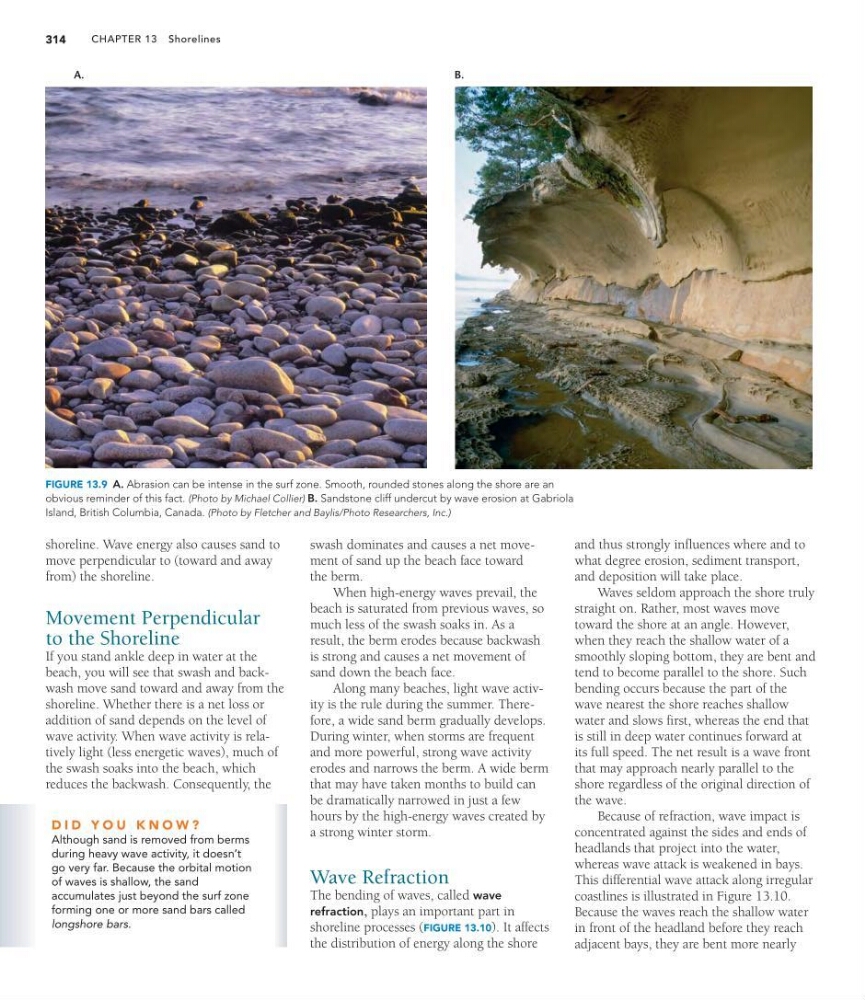
FIGURE 13.9 A. Abrasion can be intense in the surf zone. Smooth, rounded stones along the shore are an
obvious reminder of this fact. (Photo by Michael Collier) B. Sandstone cliff undercut by wave erosion at Gabriola
Island, British Columbia, Canada. (Photo by Fletcher and Baylis/Photo Researchers, Inc.)
D I D Y O U K N O W ?
Although sand is removed from berms
during heavy wave activity, it doesn’t
go very far. Because the orbital motion
of waves is shallow, the sand
accumulates just beyond the surf zone
forming one or more sand bars called
longshore bars.
shoreline. Wave energy also causes sand to
move perpendicular to (toward and away
from) the shoreline.
Movement Perpendicular
to the Shoreline
If you stand ankle deep in water at the
beach, you will see that swash and backwash move sand toward and away from the
shoreline. Whether there is a net loss or
addition of sand depends on the level of
wave activity. When wave activity is relatively light (less energetic waves), much of
the swash soaks into the beach, which
reduces the backwash. Consequently, the
swash dominates and causes a net movement of sand up the beach face toward
the berm.
When high-energy waves prevail, the
beach is saturated from previous waves, so
much less of the swash soaks in. As a
result, the berm erodes because backwash
is strong and causes a net movement of
sand down the beach face.
Along many beaches, light wave activity is the rule during the summer. Therefore, a wide sand berm gradually develops.
During winter, when storms are frequent
and more powerful, strong wave activity
erodes and narrows the berm. A wide berm
that may have taken months to build can
be dramatically narrowed in just a few
hours by the high-energy waves created by
a strong winter storm.
Wave Refraction
The bending of waves, called wave
refraction, plays an important part in
shoreline processes (FIGURE 13.10). It affects
the distribution of energy along the shore
and thus strongly influences where and to
what degree erosion, sediment transport,
and deposition will take place.
Waves seldom approach the shore truly
straight on. Rather, most waves move
toward the shore at an angle. However,
when they reach the shallow water of a
smoothly sloping bottom, they are bent and
tend to become parallel to the shore. Such
bending occurs because the part of the
wave nearest the shore reaches shallow
water and slows first, whereas the end that
is still in deep water continues forward at
its full speed. The net result is a wave front
that may approach nearly parallel to the
shore regardless of the original direction of
the wave.
Because of refraction, wave impact is
concentrated against the sides and ends of
headlands that project into the water,
whereas wave attack is weakened in bays.
This differential wave attack along irregular
coastlines is illustrated in Figure 13.10.
Because the waves reach the shallow water
in front of the headland before they reach
adjacent bays, they are bent more nearly
314
A.
B.
FIGURE 13.9 A. Abrasion can be intense in the surf zone. Smooth, rounded stones along the shore are an
obvious reminder of this fact. (Photo by Michael Collier) B. Sandstone cliff undercut by wave erosion at Gabriola
Island, British Columbia, Canada. (Photo by Fletcher and Baylis/Photo Researchers, Inc.)
D I D Y O U K N O W ?
Although sand is removed from berms
during heavy wave activity, it doesn’t
go very far. Because the orbital motion
of waves is shallow, the sand
accumulates just beyond the surf zone
forming one or more sand bars called
longshore bars.
shoreline. Wave energy also causes sand to
move perpendicular to (toward and away
from) the shoreline.
Movement Perpendicular
to the Shoreline
If you stand ankle deep in water at the
beach, you will see that swash and backwash move sand toward and away from the
shoreline. Whether there is a net loss or
addition of sand depends on the level of
wave activity. When wave activity is relatively light (less energetic waves), much of
the swash soaks into the beach, which
reduces the backwash. Consequently, the
swash dominates and causes a net movement of sand up the beach face toward
the berm.
When high-energy waves prevail, the
beach is saturated from previous waves, so
much less of the swash soaks in. As a
result, the berm erodes because backwash
is strong and causes a net movement of
sand down the beach face.
Along many beaches, light wave activity is the rule during the summer. Therefore, a wide sand berm gradually develops.
During winter, when storms are frequent
and more powerful, strong wave activity
erodes and narrows the berm. A wide berm
that may have taken months to build can
be dramatically narrowed in just a few
hours by the high-energy waves created by
a strong winter storm.
Wave Refraction
The bending of waves, called wave
refraction, plays an important part in
shoreline processes (FIGURE 13.10). It affects
the distribution of energy along the shore
and thus strongly influences where and to
what degree erosion, sediment transport,
and deposition will take place.
Waves seldom approach the shore truly
straight on. Rather, most waves move
toward the shore at an angle. However,
when they reach the shallow water of a
smoothly sloping bottom, they are bent and
tend to become parallel to the shore. Such
bending occurs because the part of the
wave nearest the shore reaches shallow
water and slows first, whereas the end that
is still in deep water continues forward at
its full speed. The net result is a wave front
that may approach nearly parallel to the
shore regardless of the original direction of
the wave.
Because of refraction, wave impact is
concentrated against the sides and ends of
headlands that project into the water,
whereas wave attack is weakened in bays.
This differential wave attack along irregular
coastlines is illustrated in Figure 13.10.
Because the waves reach the shallow water
in front of the headland before they reach
adjacent bays, they are bent more nearly