

T
HE RESTLESS WATERS
OF THE OCEAN ARE
CONSTANTLY IN MOTION.
Winds generate surface currents,
gravity of the Moon and Sun
produces tides, and density
differences create deep-ocean
circulation. Further, waves carry
the energy from storms to distant
shores, where their impact erodes
the land.
F O C U S O N C O N C E P T S
To assist you in learning
the important concepts in this
chapter, focus on the following
questions:
Why is the shoreline considered
a dynamic interface?
What are the various parts of
the coastal zone?
What factors influence the
height, length, and period of
a wave?
What is the motion of water
particles within a wave?
How do waves erode?
What are some typical features
produced by wave erosion and
from sediment deposited by
beach drift and longshore
currents?
What are the local factors that
influence shoreline erosion, and
what are some basic responses
to shoreline erosion problems?
How do emergent and
submergent coasts differ in their
formation and characteristic
features?
How are tides produced?
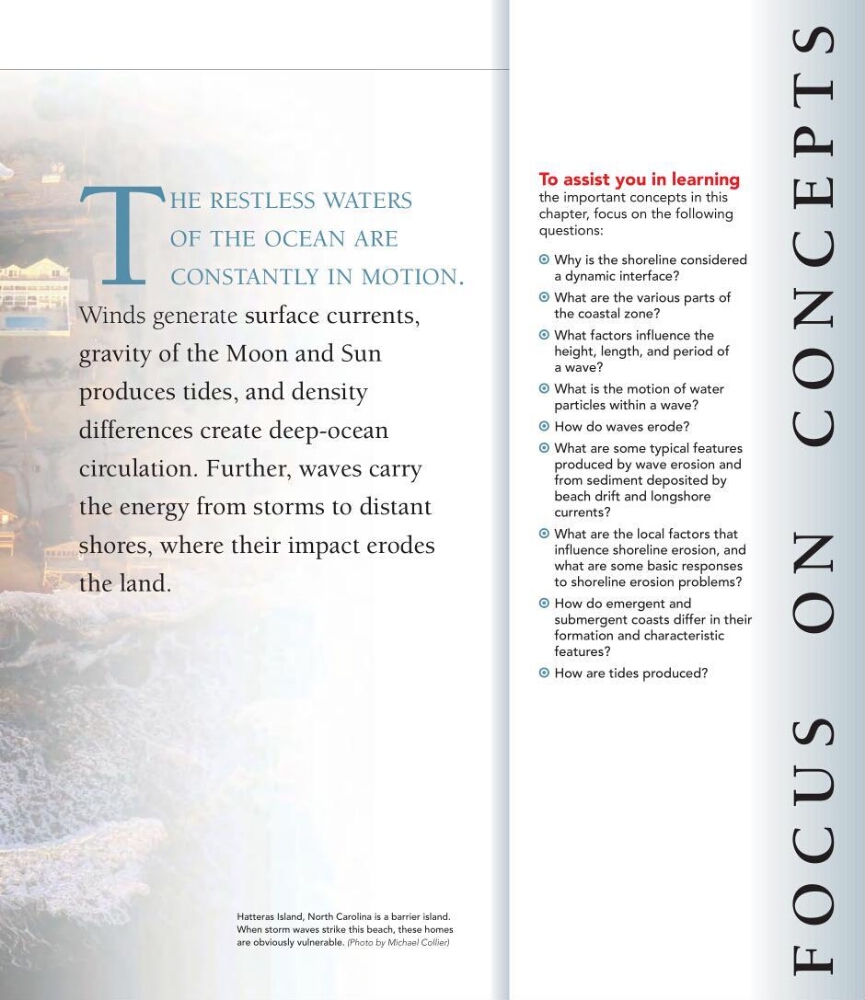
Hatteras Island, North Carolina is a barrier island.
When storm waves strike this beach, these homes
are obviously vulnerable. (Photo by Michael Collier)
HE RESTLESS WATERS
OF THE OCEAN ARE
CONSTANTLY IN MOTION.
Winds generate surface currents,
gravity of the Moon and Sun
produces tides, and density
differences create deep-ocean
circulation. Further, waves carry
the energy from storms to distant
shores, where their impact erodes
the land.
F O C U S O N C O N C E P T S
To assist you in learning
the important concepts in this
chapter, focus on the following
questions:
Why is the shoreline considered
a dynamic interface?
What are the various parts of
the coastal zone?
What factors influence the
height, length, and period of
a wave?
What is the motion of water
particles within a wave?
How do waves erode?
What are some typical features
produced by wave erosion and
from sediment deposited by
beach drift and longshore
currents?
What are the local factors that
influence shoreline erosion, and
what are some basic responses
to shoreline erosion problems?
How do emergent and
submergent coasts differ in their
formation and characteristic
features?
How are tides produced?
Hatteras Island, North Carolina is a barrier island.
When storm waves strike this beach, these homes
are obviously vulnerable. (Photo by Michael Collier)