

Water
table
Sinking
stream
Water
table
A.
B.
Sink
holes
Sinking
stream
Collapse
sink
C.
Sink holes
Sink holes
Water
table
Sinking
stream
Springs
Solution
valley
Limestone
T
I
M
E
By contrast, sinkholes can also form abruptly and without warning
when the roof of a cavern collapses under its own weight. Typically,
the depressions created in this manner are steep-sided and deep.
When they form in populous areas, they may represent a serious
geologic hazard.
In addition to a surface pockmarked by sinkholes, karst
regions characteristically show a striking lack of surface
drainage (streams). Following a rainfall, the runoff is
quickly funneled below ground through the sinks. It
then flows through caverns until it finally reaches
the water table. Where streams do exist at the
surface, their paths are usually short. The names
of such streams often give a clue to their fate.
In the Mammoth Cave area of Kentucky, for
example, there is Sinking Creek, Little Sinking
Creek, and Sinking Branch. Other sinkholes
become plugged with clay and debris to create
small lakes or ponds.
Some regions of karst development
exhibit landscapes that look very different
from the sinkhole-studded terrain depicted
in Figure 10.24. One striking example is an
extensive region in southern China that is
described as exhibiting tower karst. This area
is pictured in the chapter-opening photo
(p. 238). The term tower is appropriate
because the landscape consists of a maze of
isolated steepsided hills that rise abruptly
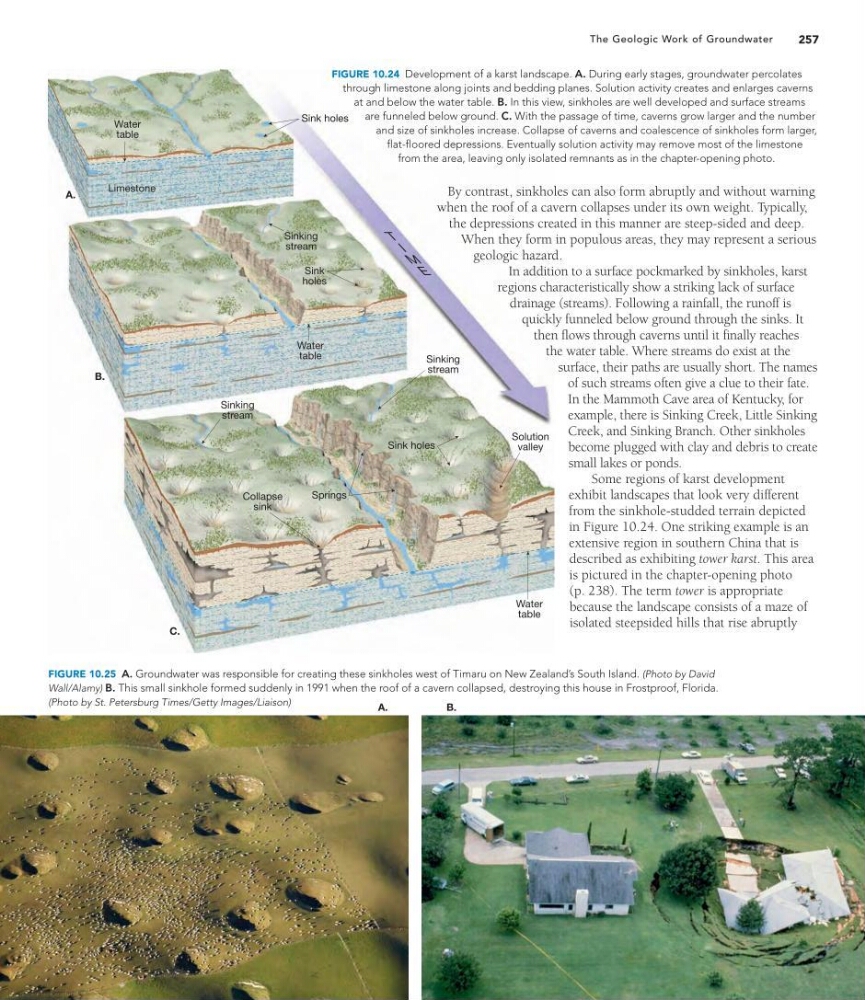
FIGURE 10.24 Development of a karst landscape. A. During early stages, groundwater percolates
through limestone along joints and bedding planes. Solution activity creates and enlarges caverns
at and below the water table. B. In this view, sinkholes are well developed and surface streams
are funneled below ground. C. With the passage of time, caverns grow larger and the number
and size of sinkholes increase. Collapse of caverns and coalescence of sinkholes form larger,
flat-floored depressions. Eventually solution activity may remove most of the limestone
from the area, leaving only isolated remnants as in the chapter-opening photo.
257
The Geologic Work of Groundwater
B.
A.
FIGURE 10.25 A. Groundwater was responsible for creating these sinkholes west of Timaru on New Zealand’s South Island. (Photo by David
Wall/Alamy) B. This small sinkhole formed suddenly in 1991 when the roof of a cavern collapsed, destroying this house in Frostproof, Florida.
(Photo by St. Petersburg Times/Getty Images/Liaison)
table
Sinking
stream
Water
table
A.
B.
Sink
holes
Sinking
stream
Collapse
sink
C.
Sink holes
Sink holes
Water
table
Sinking
stream
Springs
Solution
valley
Limestone
T
I
M
E
By contrast, sinkholes can also form abruptly and without warning
when the roof of a cavern collapses under its own weight. Typically,
the depressions created in this manner are steep-sided and deep.
When they form in populous areas, they may represent a serious
geologic hazard.
In addition to a surface pockmarked by sinkholes, karst
regions characteristically show a striking lack of surface
drainage (streams). Following a rainfall, the runoff is
quickly funneled below ground through the sinks. It
then flows through caverns until it finally reaches
the water table. Where streams do exist at the
surface, their paths are usually short. The names
of such streams often give a clue to their fate.
In the Mammoth Cave area of Kentucky, for
example, there is Sinking Creek, Little Sinking
Creek, and Sinking Branch. Other sinkholes
become plugged with clay and debris to create
small lakes or ponds.
Some regions of karst development
exhibit landscapes that look very different
from the sinkhole-studded terrain depicted
in Figure 10.24. One striking example is an
extensive region in southern China that is
described as exhibiting tower karst. This area
is pictured in the chapter-opening photo
(p. 238). The term tower is appropriate
because the landscape consists of a maze of
isolated steepsided hills that rise abruptly
FIGURE 10.24 Development of a karst landscape. A. During early stages, groundwater percolates
through limestone along joints and bedding planes. Solution activity creates and enlarges caverns
at and below the water table. B. In this view, sinkholes are well developed and surface streams
are funneled below ground. C. With the passage of time, caverns grow larger and the number
and size of sinkholes increase. Collapse of caverns and coalescence of sinkholes form larger,
flat-floored depressions. Eventually solution activity may remove most of the limestone
from the area, leaving only isolated remnants as in the chapter-opening photo.
257
The Geologic Work of Groundwater
B.
A.
FIGURE 10.25 A. Groundwater was responsible for creating these sinkholes west of Timaru on New Zealand’s South Island. (Photo by David
Wall/Alamy) B. This small sinkhole formed suddenly in 1991 when the roof of a cavern collapsed, destroying this house in Frostproof, Florida.
(Photo by St. Petersburg Times/Getty Images/Liaison)