

CHAPTER 10 Groundwater
248
Dry well
Dry well
Water table
Site of new
high-capacity
well
Lowered water table
Well
Well
Before heavy
pumping
After heavy
pumping
Well drilling rig
C o n e o f
d e p r e s s io n
D I D Y O U K N O W ?
According to the National
Groundwater Association, there are
about 16 million water wells for all
purposes in the United States. Private
household wells constitute the largest
share—more than 13 million. About
500,000 new residential wells are
drilled each year.
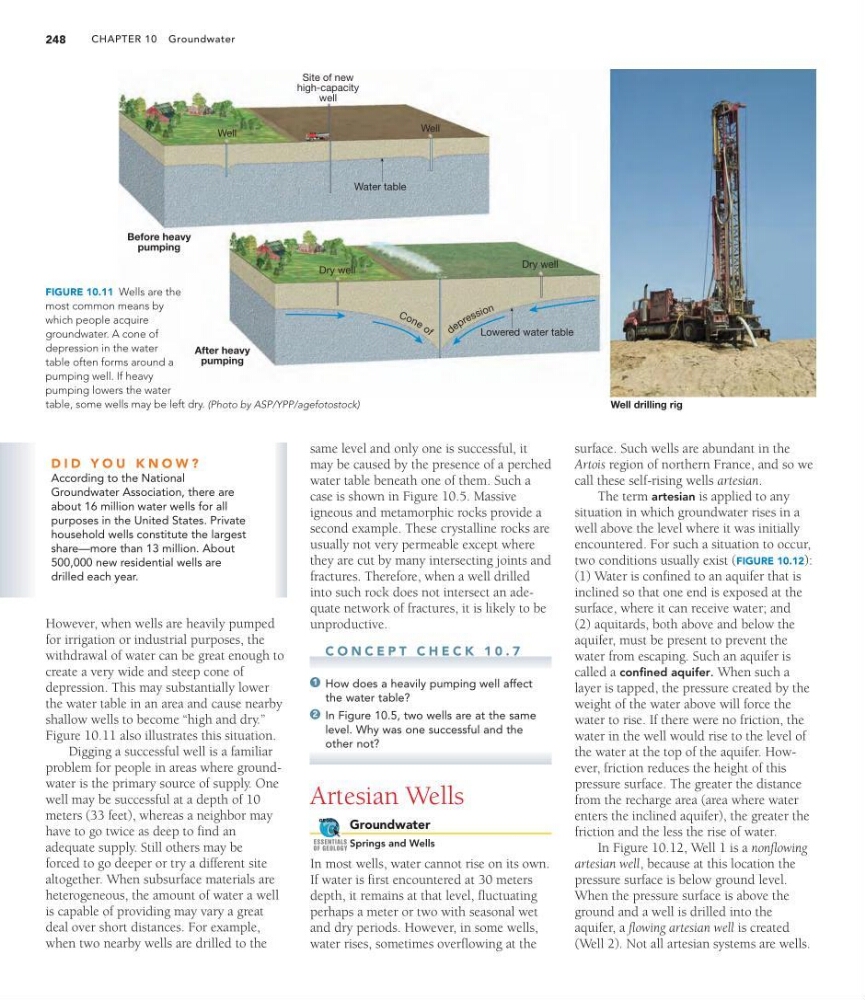
FIGURE 10.11 Wells are the
most common means by
which people acquire
groundwater. A cone of
depression in the water
table often forms around a
pumping well. If heavy
pumping lowers the water
table, some wells may be left dry. (Photo by ASP/YPP/agefotostock)
However, when wells are heavily pumped
for irrigation or industrial purposes, the
withdrawal of water can be great enough to
create a very wide and steep cone of
depression. This may substantially lower
the water table in an area and cause nearby
shallow wells to become “high and dry.”
Figure 10.11 also illustrates this situation.
Digging a successful well is a familiar
problem for people in areas where groundwater is the primary source of supply. One
well may be successful at a depth of 10
meters (33 feet), whereas a neighbor may
have to go twice as deep to find an
adequate supply. Still others may be
forced to go deeper or try a different site
altogether. When subsurface materials are
heterogeneous, the amount of water a well
is capable of providing may vary a great
deal over short distances. For example,
when two nearby wells are drilled to the
same level and only one is successful, it
may be caused by the presence of a perched
water table beneath one of them. Such a
case is shown in Figure 10.5. Massive
igneous and metamorphic rocks provide a
second example. These crystalline rocks are
usually not very permeable except where
they are cut by many intersecting joints and
fractures. Therefore, when a well drilled
into such rock does not intersect an adequate network of fractures, it is likely to be
unproductive.
C O N C E P T C H E C K 1 0 . 7
How does a heavily pumping well affect
the water table?
In Figure 10.5, two wells are at the same
level. Why was one successful and the
other not?
Artesian Wells
Groundwater
Springs and Wells
In most wells, water cannot rise on its own.
If water is first encountered at 30 meters
depth, it remains at that level, fluctuating
perhaps a meter or two with seasonal wet
and dry periods. However, in some wells,
water rises, sometimes overflowing at the
GEODe
ESSENTIALS
OF GEOLOGY
2
1
surface. Such wells are abundant in the
Artois region of northern France, and so we
call these self-rising wells artesian.
The term artesian is applied to any
situation in which groundwater rises in a
well above the level where it was initially
encountered. For such a situation to occur,
two conditions usually exist (FIGURE 10.12):
(1) Water is confined to an aquifer that is
inclined so that one end is exposed at the
surface, where it can receive water; and
(2) aquitards, both above and below the
aquifer, must be present to prevent the
water from escaping. Such an aquifer is
called a confined aquifer. When such a
layer is tapped, the pressure created by the
weight of the water above will force the
water to rise. If there were no friction, the
water in the well would rise to the level of
the water at the top of the aquifer. However, friction reduces the height of this
pressure surface. The greater the distance
from the recharge area (area where water
enters the inclined aquifer), the greater the
friction and the less the rise of water.
In Figure 10.12, Well 1 is a nonflowing
artesian well, because at this location the
pressure surface is below ground level.
When the pressure surface is above the
ground and a well is drilled into the
aquifer, a flowing artesian well is created
(Well 2). Not all artesian systems are wells.
248
Dry well
Dry well
Water table
Site of new
high-capacity
well
Lowered water table
Well
Well
Before heavy
pumping
After heavy
pumping
Well drilling rig
C o n e o f
d e p r e s s io n
D I D Y O U K N O W ?
According to the National
Groundwater Association, there are
about 16 million water wells for all
purposes in the United States. Private
household wells constitute the largest
share—more than 13 million. About
500,000 new residential wells are
drilled each year.
FIGURE 10.11 Wells are the
most common means by
which people acquire
groundwater. A cone of
depression in the water
table often forms around a
pumping well. If heavy
pumping lowers the water
table, some wells may be left dry. (Photo by ASP/YPP/agefotostock)
However, when wells are heavily pumped
for irrigation or industrial purposes, the
withdrawal of water can be great enough to
create a very wide and steep cone of
depression. This may substantially lower
the water table in an area and cause nearby
shallow wells to become “high and dry.”
Figure 10.11 also illustrates this situation.
Digging a successful well is a familiar
problem for people in areas where groundwater is the primary source of supply. One
well may be successful at a depth of 10
meters (33 feet), whereas a neighbor may
have to go twice as deep to find an
adequate supply. Still others may be
forced to go deeper or try a different site
altogether. When subsurface materials are
heterogeneous, the amount of water a well
is capable of providing may vary a great
deal over short distances. For example,
when two nearby wells are drilled to the
same level and only one is successful, it
may be caused by the presence of a perched
water table beneath one of them. Such a
case is shown in Figure 10.5. Massive
igneous and metamorphic rocks provide a
second example. These crystalline rocks are
usually not very permeable except where
they are cut by many intersecting joints and
fractures. Therefore, when a well drilled
into such rock does not intersect an adequate network of fractures, it is likely to be
unproductive.
C O N C E P T C H E C K 1 0 . 7
How does a heavily pumping well affect
the water table?
In Figure 10.5, two wells are at the same
level. Why was one successful and the
other not?
Artesian Wells
Groundwater
Springs and Wells
In most wells, water cannot rise on its own.
If water is first encountered at 30 meters
depth, it remains at that level, fluctuating
perhaps a meter or two with seasonal wet
and dry periods. However, in some wells,
water rises, sometimes overflowing at the
GEODe
ESSENTIALS
OF GEOLOGY
2
1
surface. Such wells are abundant in the
Artois region of northern France, and so we
call these self-rising wells artesian.
The term artesian is applied to any
situation in which groundwater rises in a
well above the level where it was initially
encountered. For such a situation to occur,
two conditions usually exist (FIGURE 10.12):
(1) Water is confined to an aquifer that is
inclined so that one end is exposed at the
surface, where it can receive water; and
(2) aquitards, both above and below the
aquifer, must be present to prevent the
water from escaping. Such an aquifer is
called a confined aquifer. When such a
layer is tapped, the pressure created by the
weight of the water above will force the
water to rise. If there were no friction, the
water in the well would rise to the level of
the water at the top of the aquifer. However, friction reduces the height of this
pressure surface. The greater the distance
from the recharge area (area where water
enters the inclined aquifer), the greater the
friction and the less the rise of water.
In Figure 10.12, Well 1 is a nonflowing
artesian well, because at this location the
pressure surface is below ground level.
When the pressure surface is above the
ground and a well is drilled into the
aquifer, a flowing artesian well is created
(Well 2). Not all artesian systems are wells.