

3
Geology, People, and the Environment
changes are rapid and violent, as when
landslides or volcanic eruptions occur. Just
as often, change takes place so slowly that
it goes unnoticed during a lifetime. Scales
of size and space also vary greatly among
the phenomena that geologists study.
Sometimes they must focus on phenomena
that are submicroscopic, and at other times
they must deal with features that are continental or global in scale.
Geology is perceived as a science that is
done in the out of doors, and rightly so. A
great deal of geology is based on measurements, observations, and experiments conducted in the field. But geology is also done
in the laboratory where, for example, the
study of various Earth materials provides
insights into many basic processes. Moreover, the development of sophisticated
computer models allows for the simulation
of many of our planet’ s complex systems.
Frequently, geology requires an understanding and application of knowledge
and principles from physics, chemistry, and
biology. Geology is a science that seeks to
expand our knowledge of the natural
world and our place in it.
C O N C E P T C H E C K 1 . 1
Name and distinguish between the two
broad subdivisions of geology.
1
Geology, People,
and the Environment
The primary focus of this book is to develop an
understanding of basic geological principles, but
along the way we will explore numerous important
relationships between people and the natural
environment. Many of the problems and issues
addressed by geology are of practical value to
people.
Natural hazards are a part of living on Earth.
Every day they adversely affect millions of people
worldwide and are responsible for staggering damages. Among the hazardous Earth processes studied
by geologists are volcanoes, floods, earthquakes, and
landslides. Of course, geologic hazards are simply
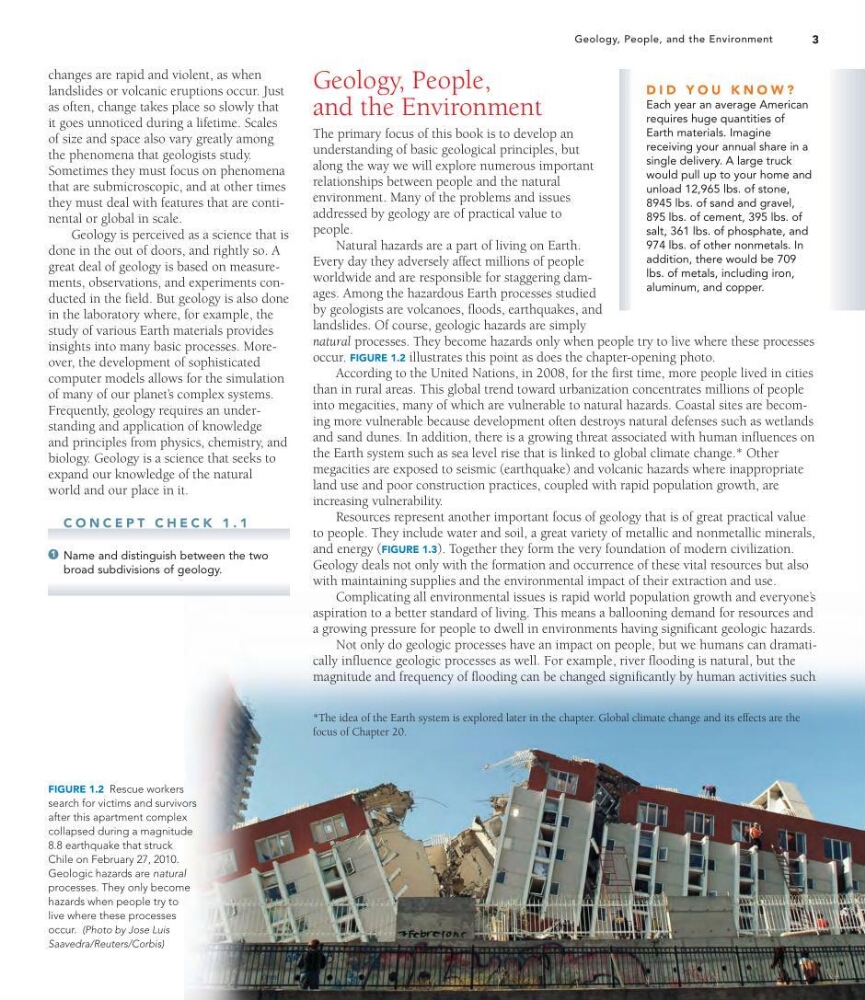
natural processes. They become hazards only when people try to live where these processes
occur. FIGURE 1.2 illustrates this point as does the chapter-opening photo.
According to the United Nations, in 2008, for the first time, more people lived in cities
than in rural areas. This global trend toward urbanization concentrates millions of people
into megacities, many of which are vulnerable to natural hazards. Coastal sites are becoming more vulnerable because development often destroys natural defenses such as wetlands
and sand dunes. In addition, there is a growing threat associated with human influences on
the Earth system such as sea level rise that is linked to global climate change.* Other
megacities are exposed to seismic (earthquake) and volcanic hazards where inappropriate
land use and poor construction practices, coupled with rapid population growth, are
increasing vulnerability.
Resources represent another important focus of geology that is of great practical value
to people. They include water and soil, a great variety of metallic and nonmetallic minerals,
and energy (FIGURE 1.3). Together they form the very foundation of modern civilization.
Geology deals not only with the formation and occurrence of these vital resources but also
with maintaining supplies and the environmental impact of their extraction and use.
Complicating all environmental issues is rapid world population growth and everyone’ s
aspiration to a better standard of living. This means a ballooning demand for resources and
a growing pressure for people to dwell in environments having significant geologic hazards.
Not only do geologic processes have an impact on people, but we humans can dramatically influence geologic processes as well. For example, river flooding is natural, but the
magnitude and frequency of flooding can be changed significantly by human activities such
FIGURE 1.2 Rescue workers
search for victims and survivors
after this apartment complex
collapsed during a magnitude
8.8 earthquake that struck
Chile on February 27, 2010.
Geologic hazards are natural
processes. They only become
hazards when people try to
live where these processes
occur. (Photo by Jose Luis
Saavedra/Reuters/Corbis)
*The idea of the Earth system is explored later in the chapter. Global climate change and its effects are the
focus of Chapter 20.
D I D Y O U K N O W ?
Each year an average American
requires huge quantities of
Earth materials. Imagine
receiving your annual share in a
single delivery. A large truck
would pull up to your home and
unload 12,965 lbs. of stone,
8945 lbs. of sand and gravel,
895 lbs. of cement, 395 lbs. of
salt, 361 lbs. of phosphate, and
974 lbs. of other nonmetals. In
addition, there would be 709
lbs. of metals, including iron,
aluminum, and copper.
Geology, People, and the Environment
changes are rapid and violent, as when
landslides or volcanic eruptions occur. Just
as often, change takes place so slowly that
it goes unnoticed during a lifetime. Scales
of size and space also vary greatly among
the phenomena that geologists study.
Sometimes they must focus on phenomena
that are submicroscopic, and at other times
they must deal with features that are continental or global in scale.
Geology is perceived as a science that is
done in the out of doors, and rightly so. A
great deal of geology is based on measurements, observations, and experiments conducted in the field. But geology is also done
in the laboratory where, for example, the
study of various Earth materials provides
insights into many basic processes. Moreover, the development of sophisticated
computer models allows for the simulation
of many of our planet’ s complex systems.
Frequently, geology requires an understanding and application of knowledge
and principles from physics, chemistry, and
biology. Geology is a science that seeks to
expand our knowledge of the natural
world and our place in it.
C O N C E P T C H E C K 1 . 1
Name and distinguish between the two
broad subdivisions of geology.
1
Geology, People,
and the Environment
The primary focus of this book is to develop an
understanding of basic geological principles, but
along the way we will explore numerous important
relationships between people and the natural
environment. Many of the problems and issues
addressed by geology are of practical value to
people.
Natural hazards are a part of living on Earth.
Every day they adversely affect millions of people
worldwide and are responsible for staggering damages. Among the hazardous Earth processes studied
by geologists are volcanoes, floods, earthquakes, and
landslides. Of course, geologic hazards are simply
natural processes. They become hazards only when people try to live where these processes
occur. FIGURE 1.2 illustrates this point as does the chapter-opening photo.
According to the United Nations, in 2008, for the first time, more people lived in cities
than in rural areas. This global trend toward urbanization concentrates millions of people
into megacities, many of which are vulnerable to natural hazards. Coastal sites are becoming more vulnerable because development often destroys natural defenses such as wetlands
and sand dunes. In addition, there is a growing threat associated with human influences on
the Earth system such as sea level rise that is linked to global climate change.* Other
megacities are exposed to seismic (earthquake) and volcanic hazards where inappropriate
land use and poor construction practices, coupled with rapid population growth, are
increasing vulnerability.
Resources represent another important focus of geology that is of great practical value
to people. They include water and soil, a great variety of metallic and nonmetallic minerals,
and energy (FIGURE 1.3). Together they form the very foundation of modern civilization.
Geology deals not only with the formation and occurrence of these vital resources but also
with maintaining supplies and the environmental impact of their extraction and use.
Complicating all environmental issues is rapid world population growth and everyone’ s
aspiration to a better standard of living. This means a ballooning demand for resources and
a growing pressure for people to dwell in environments having significant geologic hazards.
Not only do geologic processes have an impact on people, but we humans can dramatically influence geologic processes as well. For example, river flooding is natural, but the
magnitude and frequency of flooding can be changed significantly by human activities such
FIGURE 1.2 Rescue workers
search for victims and survivors
after this apartment complex
collapsed during a magnitude
8.8 earthquake that struck
Chile on February 27, 2010.
Geologic hazards are natural
processes. They only become
hazards when people try to
live where these processes
occur. (Photo by Jose Luis
Saavedra/Reuters/Corbis)
*The idea of the Earth system is explored later in the chapter. Global climate change and its effects are the
focus of Chapter 20.
D I D Y O U K N O W ?
Each year an average American
requires huge quantities of
Earth materials. Imagine
receiving your annual share in a
single delivery. A large truck
would pull up to your home and
unload 12,965 lbs. of stone,
8945 lbs. of sand and gravel,
895 lbs. of cement, 395 lbs. of
salt, 361 lbs. of phosphate, and
974 lbs. of other nonmetals. In
addition, there would be 709
lbs. of metals, including iron,
aluminum, and copper.