

C
ONSIDER THE
BITTERSWEET
RELATIONSHIP WE HAVE
with rivers.They are vital economic
tools—used as highways to move
goods, sources of water for irrigation
and energy—as well as prime locations
for sport and recreation. When
considered as part of the Earth system,
rivers and streams represent a
fundamental link in the constant
cycling of our planet’ s water. Running
water is the dominant agent of
landscape alteration, eroding more
terrain and transporting more sediment
than any other process. However,
because human populations gravitate
toward rivers, flooding in these
otherwise valuable valleys represents
enormous potential for destruction.
F O C U S O N C O N C E P T S
To assist you in learning
the important concepts in this
chapter, focus on the following
questions:
What is the hydrologic cycle?
What is the source of energy
that powers the cycle?
What are the three main zones
of a river system?
What is stream discharge, and
how is it measured?
What are the factors that
determine the velocity of water
in a stream?
The work of a stream includes
what three processes?
What are the two general types
of stream valleys and some
features associated with each?
In what way is base level related
to a stream’s ability to erode?
How are deltas, natural levees,
and alluvial fans similar? How
are they different?
What are the common drainage
patterns produced by streams?
Why do floods occur? What are
some basic flood-control
strategies?
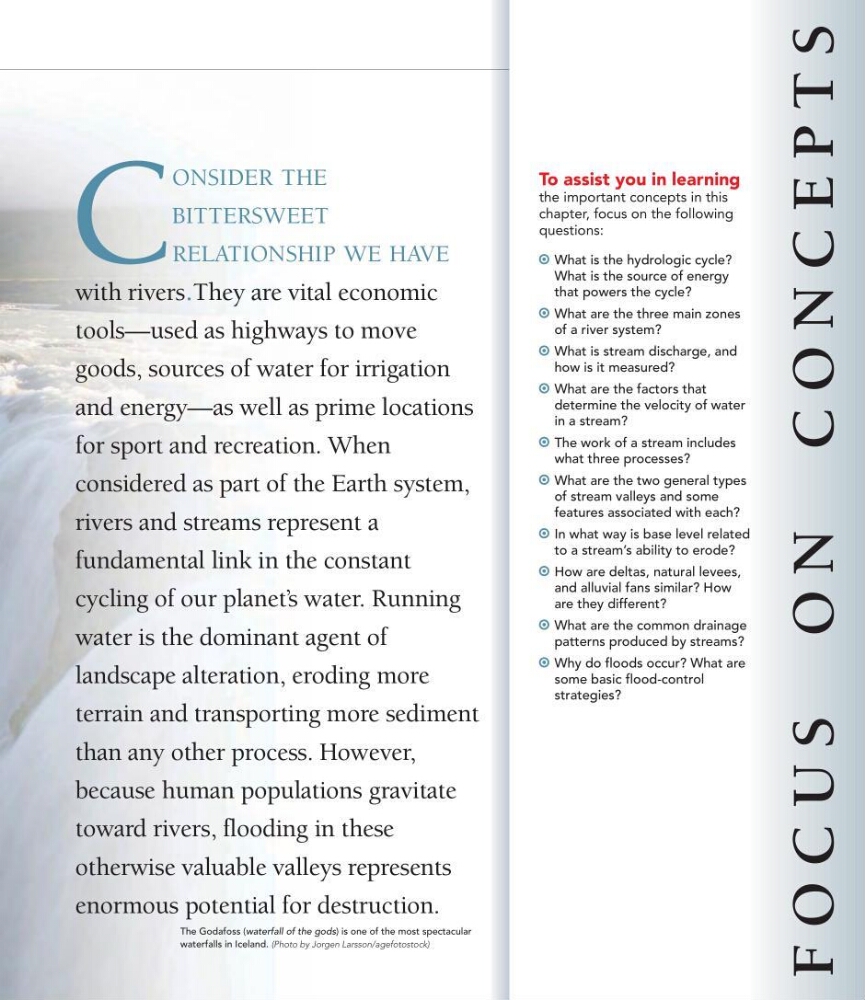
The Godafoss (waterfall of the gods) is one of the most spectacular
waterfalls in Iceland. (Photo by Jorgen Larsson/agefotostock)
ONSIDER THE
BITTERSWEET
RELATIONSHIP WE HAVE
with rivers.They are vital economic
tools—used as highways to move
goods, sources of water for irrigation
and energy—as well as prime locations
for sport and recreation. When
considered as part of the Earth system,
rivers and streams represent a
fundamental link in the constant
cycling of our planet’ s water. Running
water is the dominant agent of
landscape alteration, eroding more
terrain and transporting more sediment
than any other process. However,
because human populations gravitate
toward rivers, flooding in these
otherwise valuable valleys represents
enormous potential for destruction.
F O C U S O N C O N C E P T S
To assist you in learning
the important concepts in this
chapter, focus on the following
questions:
What is the hydrologic cycle?
What is the source of energy
that powers the cycle?
What are the three main zones
of a river system?
What is stream discharge, and
how is it measured?
What are the factors that
determine the velocity of water
in a stream?
The work of a stream includes
what three processes?
What are the two general types
of stream valleys and some
features associated with each?
In what way is base level related
to a stream’s ability to erode?
How are deltas, natural levees,
and alluvial fans similar? How
are they different?
What are the common drainage
patterns produced by streams?
Why do floods occur? What are
some basic flood-control
strategies?
The Godafoss (waterfall of the gods) is one of the most spectacular
waterfalls in Iceland. (Photo by Jorgen Larsson/agefotostock)