

CHAPTER 8 Mass Wasting: The Work of Gravity
200
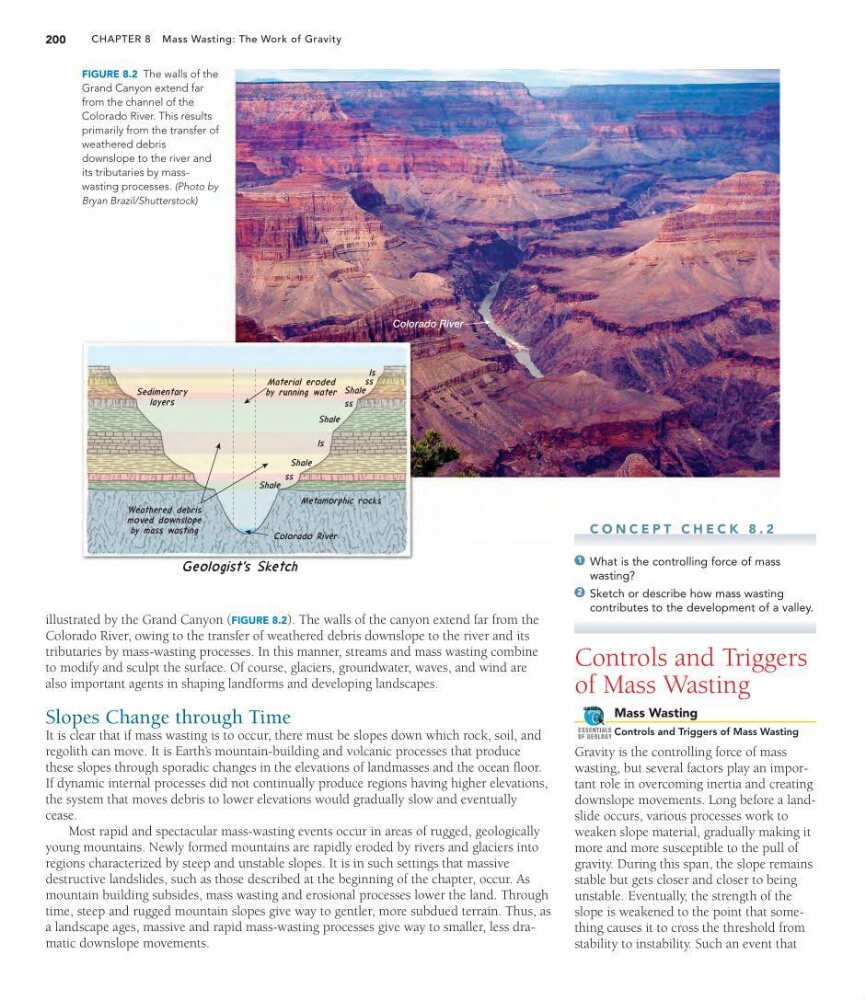
illustrated by the Grand Canyon (FIGURE 8.2). The walls of the canyon extend far from the
Colorado River, owing to the transfer of weathered debris downslope to the river and its
tributaries by mass-wasting processes. In this manner, streams and mass wasting combine
to modify and sculpt the surface. Of course, glaciers, groundwater, waves, and wind are
also important agents in shaping landforms and developing landscapes.
Slopes Change through Time
It is clear that if mass wasting is to occur, there must be slopes down which rock, soil, and
regolith can move. It is Earth’ s mountain-building and volcanic processes that produce
these slopes through sporadic changes in the elevations of landmasses and the ocean floor.
If dynamic internal processes did not continually produce regions having higher elevations,
the system that moves debris to lower elevations would gradually slow and eventually
cease.
Most rapid and spectacular mass-wasting events occur in areas of rugged, geologically
young mountains. Newly formed mountains are rapidly eroded by rivers and glaciers into
regions characterized by steep and unstable slopes. It is in such settings that massive
destructive landslides, such as those described at the beginning of the chapter, occur. As
mountain building subsides, mass wasting and erosional processes lower the land. Through
time, steep and rugged mountain slopes give way to gentler, more subdued terrain. Thus, as
a landscape ages, massive and rapid mass-wasting processes give way to smaller, less dramatic downslope movements.
Colorado River
FIGURE 8.2 The walls of the
Grand Canyon extend far
from the channel of the
Colorado River. This results
primarily from the transfer of
weathered debris
downslope to the river and
its tributaries by masswasting processes. (Photo by
Bryan Brazil/Shutterstock)
C O N C E P T C H E C K 8 . 2
What is the controlling force of mass
wasting?
Sketch or describe how mass wasting
contributes to the development of a valley.
Controls and Triggers
of Mass Wasting
Mass Wasting
Controls and Triggers of Mass Wasting
Gravity is the controlling force of mass
wasting, but several factors play an important role in overcoming inertia and creating
downslope movements. Long before a landslide occurs, various processes work to
weaken slope material, gradually making it
more and more susceptible to the pull of
gravity. During this span, the slope remains
stable but gets closer and closer to being
unstable. Eventually, the strength of the
slope is weakened to the point that something causes it to cross the threshold from
stability to instability. Such an event that
GEODe
ESSENTIALS
OF GEOLOGY
2
1
200
illustrated by the Grand Canyon (FIGURE 8.2). The walls of the canyon extend far from the
Colorado River, owing to the transfer of weathered debris downslope to the river and its
tributaries by mass-wasting processes. In this manner, streams and mass wasting combine
to modify and sculpt the surface. Of course, glaciers, groundwater, waves, and wind are
also important agents in shaping landforms and developing landscapes.
Slopes Change through Time
It is clear that if mass wasting is to occur, there must be slopes down which rock, soil, and
regolith can move. It is Earth’ s mountain-building and volcanic processes that produce
these slopes through sporadic changes in the elevations of landmasses and the ocean floor.
If dynamic internal processes did not continually produce regions having higher elevations,
the system that moves debris to lower elevations would gradually slow and eventually
cease.
Most rapid and spectacular mass-wasting events occur in areas of rugged, geologically
young mountains. Newly formed mountains are rapidly eroded by rivers and glaciers into
regions characterized by steep and unstable slopes. It is in such settings that massive
destructive landslides, such as those described at the beginning of the chapter, occur. As
mountain building subsides, mass wasting and erosional processes lower the land. Through
time, steep and rugged mountain slopes give way to gentler, more subdued terrain. Thus, as
a landscape ages, massive and rapid mass-wasting processes give way to smaller, less dramatic downslope movements.
Colorado River
FIGURE 8.2 The walls of the
Grand Canyon extend far
from the channel of the
Colorado River. This results
primarily from the transfer of
weathered debris
downslope to the river and
its tributaries by masswasting processes. (Photo by
Bryan Brazil/Shutterstock)
C O N C E P T C H E C K 8 . 2
What is the controlling force of mass
wasting?
Sketch or describe how mass wasting
contributes to the development of a valley.
Controls and Triggers
of Mass Wasting
Mass Wasting
Controls and Triggers of Mass Wasting
Gravity is the controlling force of mass
wasting, but several factors play an important role in overcoming inertia and creating
downslope movements. Long before a landslide occurs, various processes work to
weaken slope material, gradually making it
more and more susceptible to the pull of
gravity. During this span, the slope remains
stable but gets closer and closer to being
unstable. Eventually, the strength of the
slope is weakened to the point that something causes it to cross the threshold from
stability to instability. Such an event that
GEODe
ESSENTIALS
OF GEOLOGY
2
1