

CHAPTER 6 Sedimentary Rocks
166
Sedimentary Structures
In addition to variations in grain size, mineral composition, and texture, sediments exhibit
a variety of structures. Some, such as graded beds, are created when sediments are accumulating and are a reflection of the transporting medium. Others, such as mud cracks, form
after the materials have been deposited and result from processes occurring in the environment. When present, sedimentary structures provide additional information that can be
useful in the interpretation of Earth history.
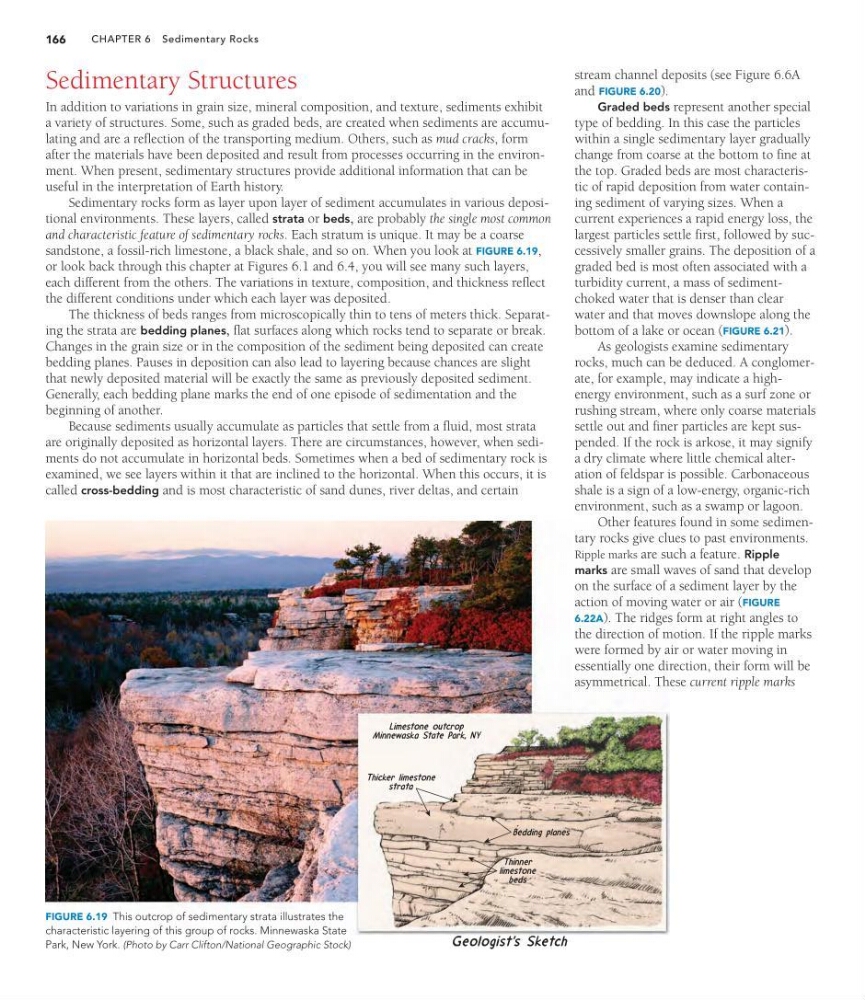
Sedimentary rocks form as layer upon layer of sediment accumulates in various depositional environments. These layers, called strata or beds, are probably the single most common
and characteristic feature of sedimentary rocks. Each stratum is unique. It may be a coarse
sandstone, a fossil-rich limestone, a black shale, and so on. When you look at FIGURE 6.19,
or look back through this chapter at Figures 6.1 and 6.4, you will see many such layers,
each different from the others. The variations in texture, composition, and thickness reflect
the different conditions under which each layer was deposited.
The thickness of beds ranges from microscopically thin to tens of meters thick. Separating the strata are bedding planes, flat surfaces along which rocks tend to separate or break.
Changes in the grain size or in the composition of the sediment being deposited can create
bedding planes. Pauses in deposition can also lead to layering because chances are slight
that newly deposited material will be exactly the same as previously deposited sediment.
Generally, each bedding plane marks the end of one episode of sedimentation and the
beginning of another.
Because sediments usually accumulate as particles that settle from a fluid, most strata
are originally deposited as horizontal layers. There are circumstances, however, when sediments do not accumulate in horizontal beds. Sometimes when a bed of sedimentary rock is
examined, we see layers within it that are inclined to the horizontal. When this occurs, it is
called cross-bedding and is most characteristic of sand dunes, river deltas, and certain
FIGURE 6.19 This outcrop of sedimentary strata illustrates the
characteristic layering of this group of rocks. Minnewaska State
Park, New York. (Photo by Carr Clifton/National Geographic Stock)
stream channel deposits (see Figure 6.6A
and FIGURE 6.20).
Graded beds represent another special
type of bedding. In this case the particles
within a single sedimentary layer gradually
change from coarse at the bottom to fine at
the top. Graded beds are most characteristic of rapid deposition from water containing sediment of varying sizes. When a
current experiences a rapid energy loss, the
largest particles settle first, followed by successively smaller grains. The deposition of a
graded bed is most often associated with a
turbidity current, a mass of sedimentchoked water that is denser than clear
water and that moves downslope along the
bottom of a lake or ocean (FIGURE 6.21).
As geologists examine sedimentary
rocks, much can be deduced. A conglomerate, for example, may indicate a highenergy environment, such as a surf zone or
rushing stream, where only coarse materials
settle out and finer particles are kept suspended. If the rock is arkose, it may signify
a dry climate where little chemical alteration of feldspar is possible. Carbonaceous
shale is a sign of a low-energy, organic-rich
environment, such as a swamp or lagoon.
Other features found in some sedimentary rocks give clues to past environments.
Ripple marks are such a feature. Ripple
marks are small waves of sand that develop
on the surface of a sediment layer by the
action of moving water or air (FIGURE
6.22A). The ridges form at right angles to
the direction of motion. If the ripple marks
were formed by air or water moving in
essentially one direction, their form will be
asymmetrical. These current ripple marks
166
Sedimentary Structures
In addition to variations in grain size, mineral composition, and texture, sediments exhibit
a variety of structures. Some, such as graded beds, are created when sediments are accumulating and are a reflection of the transporting medium. Others, such as mud cracks, form
after the materials have been deposited and result from processes occurring in the environment. When present, sedimentary structures provide additional information that can be
useful in the interpretation of Earth history.
Sedimentary rocks form as layer upon layer of sediment accumulates in various depositional environments. These layers, called strata or beds, are probably the single most common
and characteristic feature of sedimentary rocks. Each stratum is unique. It may be a coarse
sandstone, a fossil-rich limestone, a black shale, and so on. When you look at FIGURE 6.19,
or look back through this chapter at Figures 6.1 and 6.4, you will see many such layers,
each different from the others. The variations in texture, composition, and thickness reflect
the different conditions under which each layer was deposited.
The thickness of beds ranges from microscopically thin to tens of meters thick. Separating the strata are bedding planes, flat surfaces along which rocks tend to separate or break.
Changes in the grain size or in the composition of the sediment being deposited can create
bedding planes. Pauses in deposition can also lead to layering because chances are slight
that newly deposited material will be exactly the same as previously deposited sediment.
Generally, each bedding plane marks the end of one episode of sedimentation and the
beginning of another.
Because sediments usually accumulate as particles that settle from a fluid, most strata
are originally deposited as horizontal layers. There are circumstances, however, when sediments do not accumulate in horizontal beds. Sometimes when a bed of sedimentary rock is
examined, we see layers within it that are inclined to the horizontal. When this occurs, it is
called cross-bedding and is most characteristic of sand dunes, river deltas, and certain
FIGURE 6.19 This outcrop of sedimentary strata illustrates the
characteristic layering of this group of rocks. Minnewaska State
Park, New York. (Photo by Carr Clifton/National Geographic Stock)
stream channel deposits (see Figure 6.6A
and FIGURE 6.20).
Graded beds represent another special
type of bedding. In this case the particles
within a single sedimentary layer gradually
change from coarse at the bottom to fine at
the top. Graded beds are most characteristic of rapid deposition from water containing sediment of varying sizes. When a
current experiences a rapid energy loss, the
largest particles settle first, followed by successively smaller grains. The deposition of a
graded bed is most often associated with a
turbidity current, a mass of sedimentchoked water that is denser than clear
water and that moves downslope along the
bottom of a lake or ocean (FIGURE 6.21).
As geologists examine sedimentary
rocks, much can be deduced. A conglomerate, for example, may indicate a highenergy environment, such as a surf zone or
rushing stream, where only coarse materials
settle out and finer particles are kept suspended. If the rock is arkose, it may signify
a dry climate where little chemical alteration of feldspar is possible. Carbonaceous
shale is a sign of a low-energy, organic-rich
environment, such as a swamp or lagoon.
Other features found in some sedimentary rocks give clues to past environments.
Ripple marks are such a feature. Ripple
marks are small waves of sand that develop
on the surface of a sediment layer by the
action of moving water or air (FIGURE
6.22A). The ridges form at right angles to
the direction of motion. If the ripple marks
were formed by air or water moving in
essentially one direction, their form will be
asymmetrical. These current ripple marks