

Close up
163
Sedimentary Rocks Represent Past Environments
these openings are rarely filled
completely. All detrital rocks
have a clastic texture. In addition, some chemical sedimentary
rocks exhibit this texture. For
example, coquina, the limestone
composed of shells and shell fragments, is obviously as clastic as conglomerate or sandstone. The same applies
for some varieties of oolitic limestone.
Some chemical sedimentary rocks have
a nonclastic or crystalline texture in which
the minerals form a pattern of interlocking
crystals. The crystals may be microscopically small or large enough to be visible
without magnification. Common examples
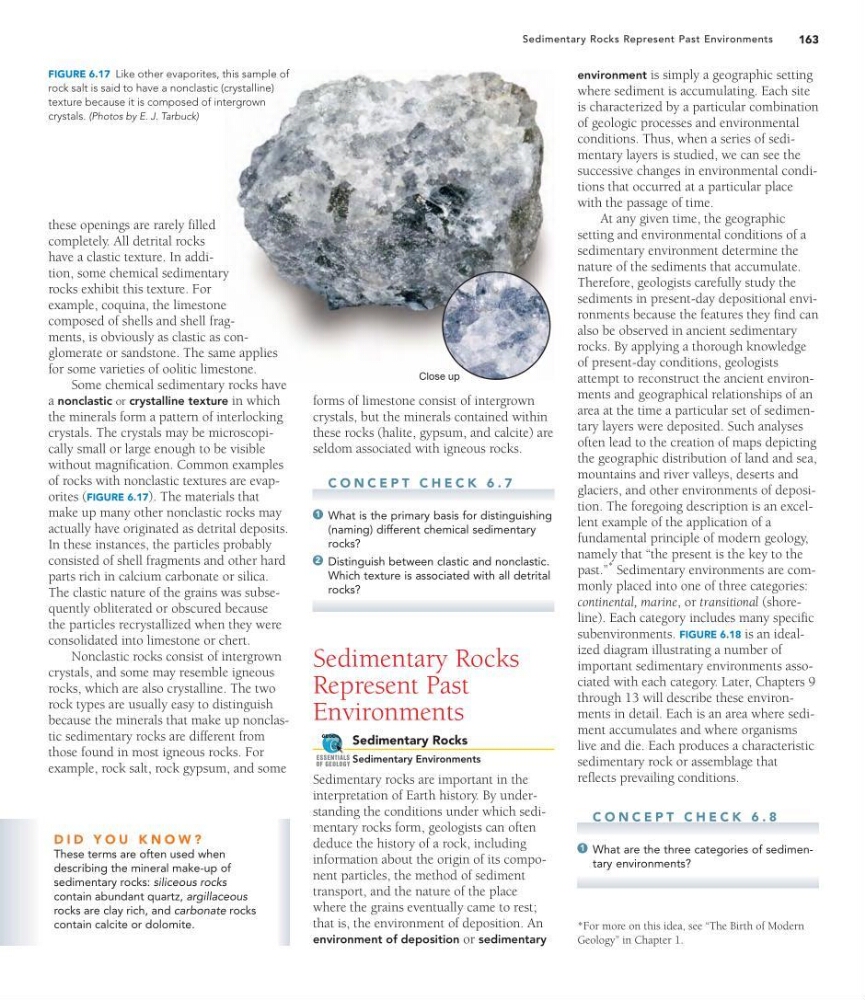
of rocks with nonclastic textures are evaporites (FIGURE 6.17). The materials that
make up many other nonclastic rocks may
actually have originated as detrital deposits.
In these instances, the particles probably
consisted of shell fragments and other hard
parts rich in calcium carbonate or silica.
The clastic nature of the grains was subsequently obliterated or obscured because
the particles recrystallized when they were
consolidated into limestone or chert.
Nonclastic rocks consist of intergrown
crystals, and some may resemble igneous
rocks, which are also crystalline. The two
rock types are usually easy to distinguish
because the minerals that make up nonclastic sedimentary rocks are different from
those found in most igneous rocks. For
example, rock salt, rock gypsum, and some
forms of limestone consist of intergrown
crystals, but the minerals contained within
these rocks (halite, gypsum, and calcite) are
seldom associated with igneous rocks.
C O N C E P T C H E C K 6 . 7
What is the primary basis for distinguishing
(naming) different chemical sedimentary
rocks?
Distinguish between clastic and nonclastic.
Which texture is associated with all detrital
rocks?
Sedimentary Rocks
Represent Past
Environments
Sedimentary Rocks
Sedimentary Environments
Sedimentary rocks are important in the
interpretation of Earth history. By understanding the conditions under which sedimentary rocks form, geologists can often
deduce the history of a rock, including
information about the origin of its component particles, the method of sediment
transport, and the nature of the place
where the grains eventually came to rest;
that is, the environment of deposition. An
environment of deposition or sedimentary
GEODe
ESSENTIALS
OF GEOLOGY
2
1
FIGURE 6.17 Like other evaporites, this sample of
rock salt is said to have a nonclastic (crystalline)
texture because it is composed of intergrown
crystals. (Photos by E. J. Tarbuck)
D I D Y O U K N O W ?
These terms are often used when
describing the mineral make-up of
sedimentary rocks: siliceous rocks
contain abundant quartz, argillaceous
rocks are clay rich, and carbonate rocks
contain calcite or dolomite.
environment is simply a geographic setting
where sediment is accumulating. Each site
is characterized by a particular combination
of geologic processes and environmental
conditions. Thus, when a series of sedimentary layers is studied, we can see the
successive changes in environmental conditions that occurred at a particular place
with the passage of time.
At any given time, the geographic
setting and environmental conditions of a
sedimentary environment determine the
nature of the sediments that accumulate.
Therefore, geologists carefully study the
sediments in present-day depositional environments because the features they find can
also be observed in ancient sedimentary
rocks. By applying a thorough knowledge
of present-day conditions, geologists
attempt to reconstruct the ancient environments and geographical relationships of an
area at the time a particular set of sedimentary layers were deposited. Such analyses
often lead to the creation of maps depicting
the geographic distribution of land and sea,
mountains and river valleys, deserts and
glaciers, and other environments of deposition. The foregoing description is an excellent example of the application of a
fundamental principle of modern geology,
namely that “the present is the key to the
past.”
* Sedimentary environments are commonly placed into one of three categories:
continental, marine, or transitional (shoreline). Each category includes many specific
subenvironments. FIGURE 6.18 is an idealized diagram illustrating a number of
important sedimentary environments associated with each category. Later, Chapters 9
through 13 will describe these environments in detail. Each is an area where sediment accumulates and where organisms
live and die. Each produces a characteristic
sedimentary rock or assemblage that
reflects prevailing conditions.
C O N C E P T C H E C K 6 . 8
What are the three categories of sedimentary environments?
1
*For more on this idea, see “The Birth of Modern
Geology” in Chapter 1.
163
Sedimentary Rocks Represent Past Environments
these openings are rarely filled
completely. All detrital rocks
have a clastic texture. In addition, some chemical sedimentary
rocks exhibit this texture. For
example, coquina, the limestone
composed of shells and shell fragments, is obviously as clastic as conglomerate or sandstone. The same applies
for some varieties of oolitic limestone.
Some chemical sedimentary rocks have
a nonclastic or crystalline texture in which
the minerals form a pattern of interlocking
crystals. The crystals may be microscopically small or large enough to be visible
without magnification. Common examples
of rocks with nonclastic textures are evaporites (FIGURE 6.17). The materials that
make up many other nonclastic rocks may
actually have originated as detrital deposits.
In these instances, the particles probably
consisted of shell fragments and other hard
parts rich in calcium carbonate or silica.
The clastic nature of the grains was subsequently obliterated or obscured because
the particles recrystallized when they were
consolidated into limestone or chert.
Nonclastic rocks consist of intergrown
crystals, and some may resemble igneous
rocks, which are also crystalline. The two
rock types are usually easy to distinguish
because the minerals that make up nonclastic sedimentary rocks are different from
those found in most igneous rocks. For
example, rock salt, rock gypsum, and some
forms of limestone consist of intergrown
crystals, but the minerals contained within
these rocks (halite, gypsum, and calcite) are
seldom associated with igneous rocks.
C O N C E P T C H E C K 6 . 7
What is the primary basis for distinguishing
(naming) different chemical sedimentary
rocks?
Distinguish between clastic and nonclastic.
Which texture is associated with all detrital
rocks?
Sedimentary Rocks
Represent Past
Environments
Sedimentary Rocks
Sedimentary Environments
Sedimentary rocks are important in the
interpretation of Earth history. By understanding the conditions under which sedimentary rocks form, geologists can often
deduce the history of a rock, including
information about the origin of its component particles, the method of sediment
transport, and the nature of the place
where the grains eventually came to rest;
that is, the environment of deposition. An
environment of deposition or sedimentary
GEODe
ESSENTIALS
OF GEOLOGY
2
1
FIGURE 6.17 Like other evaporites, this sample of
rock salt is said to have a nonclastic (crystalline)
texture because it is composed of intergrown
crystals. (Photos by E. J. Tarbuck)
D I D Y O U K N O W ?
These terms are often used when
describing the mineral make-up of
sedimentary rocks: siliceous rocks
contain abundant quartz, argillaceous
rocks are clay rich, and carbonate rocks
contain calcite or dolomite.
environment is simply a geographic setting
where sediment is accumulating. Each site
is characterized by a particular combination
of geologic processes and environmental
conditions. Thus, when a series of sedimentary layers is studied, we can see the
successive changes in environmental conditions that occurred at a particular place
with the passage of time.
At any given time, the geographic
setting and environmental conditions of a
sedimentary environment determine the
nature of the sediments that accumulate.
Therefore, geologists carefully study the
sediments in present-day depositional environments because the features they find can
also be observed in ancient sedimentary
rocks. By applying a thorough knowledge
of present-day conditions, geologists
attempt to reconstruct the ancient environments and geographical relationships of an
area at the time a particular set of sedimentary layers were deposited. Such analyses
often lead to the creation of maps depicting
the geographic distribution of land and sea,
mountains and river valleys, deserts and
glaciers, and other environments of deposition. The foregoing description is an excellent example of the application of a
fundamental principle of modern geology,
namely that “the present is the key to the
past.”
* Sedimentary environments are commonly placed into one of three categories:
continental, marine, or transitional (shoreline). Each category includes many specific
subenvironments. FIGURE 6.18 is an idealized diagram illustrating a number of
important sedimentary environments associated with each category. Later, Chapters 9
through 13 will describe these environments in detail. Each is an area where sediment accumulates and where organisms
live and die. Each produces a characteristic
sedimentary rock or assemblage that
reflects prevailing conditions.
C O N C E P T C H E C K 6 . 8
What are the three categories of sedimentary environments?
1
*For more on this idea, see “The Birth of Modern
Geology” in Chapter 1.