

C O N C E P T C H E C K 5 . 1
List examples of external and internal processes.
From where do these processes derive their energy?
Weathering
Weathering and Soil
Types of Weathering
Weathering goes on all around us, but it seems like such a slow and
subtle process that it is easy to underestimate its importance. It is worth
remembering that weathering is a basic part of the rock cycle and thus a
key process in the Earth system.
Weathering is also important to humans—even to those of us who
are not studying geology. For example, many of the life-sustaining minerals and elements found in soil, and ultimately in the food we eat, were
freed from solid rock by weathering processes. As the chapter-opening photo,
FIGURE 5.1, and many other images in this book illustrate, weathering also contributes to
the formation of some of Earth’ s most spectacular scenery. Of course, these same processes
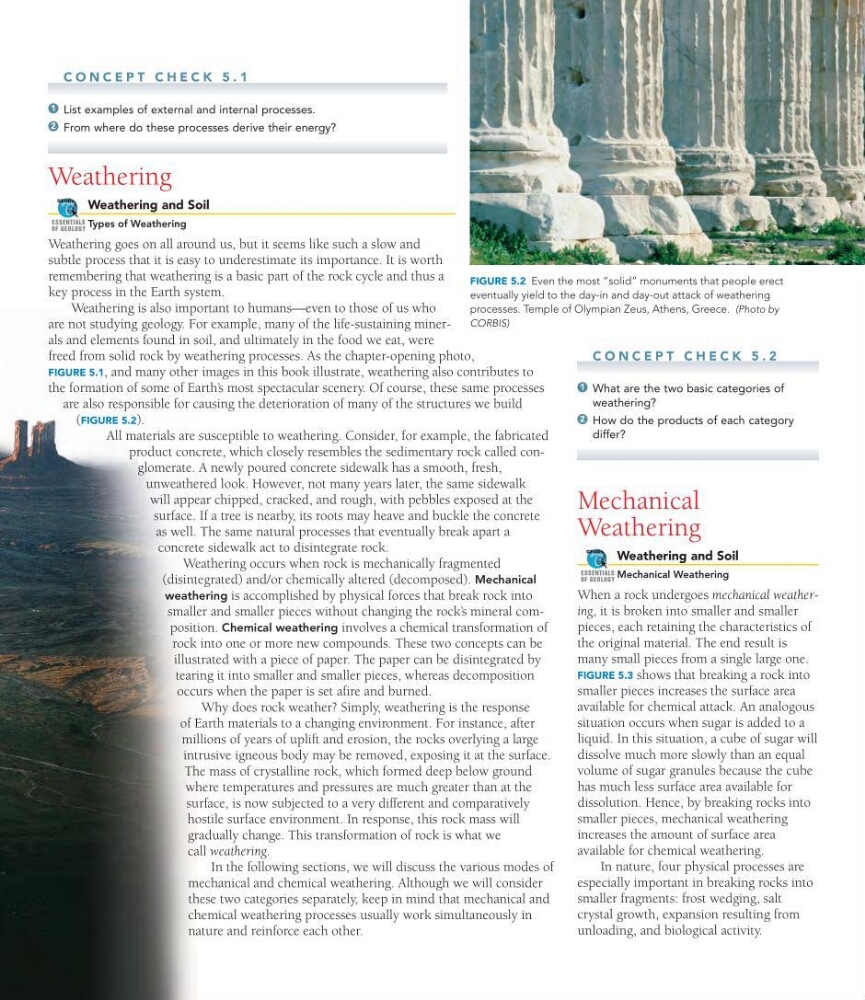
are also responsible for causing the deterioration of many of the structures we build
(FIGURE 5.2).
All materials are susceptible to weathering. Consider, for example, the fabricated
product concrete, which closely resembles the sedimentary rock called conglomerate. A newly poured concrete sidewalk has a smooth, fresh,
unweathered look. However, not many years later, the same sidewalk
will appear chipped, cracked, and rough, with pebbles exposed at the
surface. If a tree is nearby, its roots may heave and buckle the concrete
as well. The same natural processes that eventually break apart a
concrete sidewalk act to disintegrate rock.
Weathering occurs when rock is mechanically fragmented
(disintegrated) and/or chemically altered (decomposed). Mechanical
weathering is accomplished by physical forces that break rock into
smaller and smaller pieces without changing the rock’ s mineral composition. Chemical weathering involves a chemical transformation of
rock into one or more new compounds. These two concepts can be
illustrated with a piece of paper. The paper can be disintegrated by
tearing it into smaller and smaller pieces, whereas decomposition
occurs when the paper is set afire and burned.
Why does rock weather? Simply, weathering is the response
of Earth materials to a changing environment. For instance, after
millions of years of uplift and erosion, the rocks overlying a large
intrusive igneous body may be removed, exposing it at the surface.
The mass of crystalline rock, which formed deep below ground
where temperatures and pressures are much greater than at the
surface, is now subjected to a very different and comparatively
hostile surface environment. In response, this rock mass will
gradually change. This transformation of rock is what we
call weathering.
In the following sections, we will discuss the various modes of
mechanical and chemical weathering. Although we will consider
these two categories separately, keep in mind that mechanical and
chemical weathering processes usually work simultaneously in
nature and reinforce each other.
GEODe
ESSENTIALS
OF GEOLOGY
2
1
FIGURE 5.2 Even the most “solid” monuments that people erect
eventually yield to the day-in and day-out attack of weathering
processes. Temple of Olympian Zeus, Athens, Greece. (Photo by
CORBIS)
C O N C E P T C H E C K 5 . 2
What are the two basic categories of
weathering?
How do the products of each category
differ?
Mechanical
Weathering
Weathering and Soil
Mechanical Weathering
When a rock undergoes mechanical weathering, it is broken into smaller and smaller
pieces, each retaining the characteristics of
the original material. The end result is
many small pieces from a single large one.
FIGURE 5.3 shows that breaking a rock into
smaller pieces increases the surface area
available for chemical attack. An analogous
situation occurs when sugar is added to a
liquid. In this situation, a cube of sugar will
dissolve much more slowly than an equal
volume of sugar granules because the cube
has much less surface area available for
dissolution. Hence, by breaking rocks into
smaller pieces, mechanical weathering
increases the amount of surface area
available for chemical weathering.
In nature, four physical processes are
especially important in breaking rocks into
smaller fragments: frost wedging, salt
crystal growth, expansion resulting from
unloading, and biological activity.
GEODe
ESSENTIALS
OF GEOLOGY
2
1
List examples of external and internal processes.
From where do these processes derive their energy?
Weathering
Weathering and Soil
Types of Weathering
Weathering goes on all around us, but it seems like such a slow and
subtle process that it is easy to underestimate its importance. It is worth
remembering that weathering is a basic part of the rock cycle and thus a
key process in the Earth system.
Weathering is also important to humans—even to those of us who
are not studying geology. For example, many of the life-sustaining minerals and elements found in soil, and ultimately in the food we eat, were
freed from solid rock by weathering processes. As the chapter-opening photo,
FIGURE 5.1, and many other images in this book illustrate, weathering also contributes to
the formation of some of Earth’ s most spectacular scenery. Of course, these same processes
are also responsible for causing the deterioration of many of the structures we build
(FIGURE 5.2).
All materials are susceptible to weathering. Consider, for example, the fabricated
product concrete, which closely resembles the sedimentary rock called conglomerate. A newly poured concrete sidewalk has a smooth, fresh,
unweathered look. However, not many years later, the same sidewalk
will appear chipped, cracked, and rough, with pebbles exposed at the
surface. If a tree is nearby, its roots may heave and buckle the concrete
as well. The same natural processes that eventually break apart a
concrete sidewalk act to disintegrate rock.
Weathering occurs when rock is mechanically fragmented
(disintegrated) and/or chemically altered (decomposed). Mechanical
weathering is accomplished by physical forces that break rock into
smaller and smaller pieces without changing the rock’ s mineral composition. Chemical weathering involves a chemical transformation of
rock into one or more new compounds. These two concepts can be
illustrated with a piece of paper. The paper can be disintegrated by
tearing it into smaller and smaller pieces, whereas decomposition
occurs when the paper is set afire and burned.
Why does rock weather? Simply, weathering is the response
of Earth materials to a changing environment. For instance, after
millions of years of uplift and erosion, the rocks overlying a large
intrusive igneous body may be removed, exposing it at the surface.
The mass of crystalline rock, which formed deep below ground
where temperatures and pressures are much greater than at the
surface, is now subjected to a very different and comparatively
hostile surface environment. In response, this rock mass will
gradually change. This transformation of rock is what we
call weathering.
In the following sections, we will discuss the various modes of
mechanical and chemical weathering. Although we will consider
these two categories separately, keep in mind that mechanical and
chemical weathering processes usually work simultaneously in
nature and reinforce each other.
GEODe
ESSENTIALS
OF GEOLOGY
2
1
FIGURE 5.2 Even the most “solid” monuments that people erect
eventually yield to the day-in and day-out attack of weathering
processes. Temple of Olympian Zeus, Athens, Greece. (Photo by
CORBIS)
C O N C E P T C H E C K 5 . 2
What are the two basic categories of
weathering?
How do the products of each category
differ?
Mechanical
Weathering
Weathering and Soil
Mechanical Weathering
When a rock undergoes mechanical weathering, it is broken into smaller and smaller
pieces, each retaining the characteristics of
the original material. The end result is
many small pieces from a single large one.
FIGURE 5.3 shows that breaking a rock into
smaller pieces increases the surface area
available for chemical attack. An analogous
situation occurs when sugar is added to a
liquid. In this situation, a cube of sugar will
dissolve much more slowly than an equal
volume of sugar granules because the cube
has much less surface area available for
dissolution. Hence, by breaking rocks into
smaller pieces, mechanical weathering
increases the amount of surface area
available for chemical weathering.
In nature, four physical processes are
especially important in breaking rocks into
smaller fragments: frost wedging, salt
crystal growth, expansion resulting from
unloading, and biological activity.
GEODe
ESSENTIALS
OF GEOLOGY
2
1