

CHAPTER 4 Volcanoes and Volcanic Hazards
116
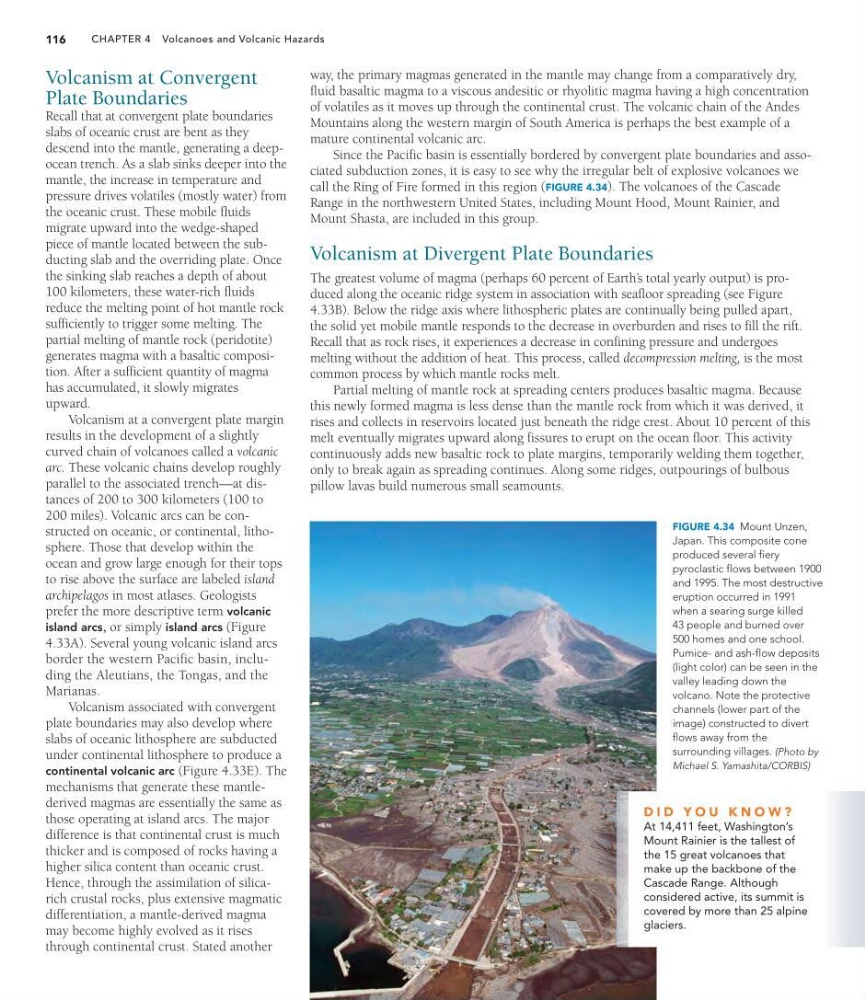
FIGURE 4.34 Mount Unzen,
Japan. This composite cone
produced several fiery
pyroclastic flows between 1900
and 1995. The most destructive
eruption occurred in 1991
when a searing surge killed
43 people and burned over
500 homes and one school.
Pumice- and ash-flow deposits
(light color) can be seen in the
valley leading down the
volcano. Note the protective
channels (lower part of the
image) constructed to divert
flows away from the
surrounding villages. (Photo by
Michael S. Yamashita/CORBIS)
Volcanism at Convergent
Plate Boundaries
Recall that at convergent plate boundaries
slabs of oceanic crust are bent as they
descend into the mantle, generating a deepocean trench. As a slab sinks deeper into the
mantle, the increase in temperature and
pressure drives volatiles (mostly water) from
the oceanic crust. These mobile fluids
migrate upward into the wedge-shaped
piece of mantle located between the subducting slab and the overriding plate. Once
the sinking slab reaches a depth of about
100 kilometers, these water-rich fluids
reduce the melting point of hot mantle rock
sufficiently to trigger some melting. The
partial melting of mantle rock (peridotite)
generates magma with a basaltic composition. After a sufficient quantity of magma
has accumulated, it slowly migrates
upward.
Volcanism at a convergent plate margin
results in the development of a slightly
curved chain of volcanoes called a volcanic
arc. These volcanic chains develop roughly
parallel to the associated trench—at distances of 200 to 300 kilometers (100 to
200 miles). Volcanic arcs can be constructed on oceanic, or continental, lithosphere. Those that develop within the
ocean and grow large enough for their tops
to rise above the surface are labeled island
archipelagos in most atlases. Geologists
prefer the more descriptive term volcanic
island arcs, or simply island arcs (Figure
4.33A). Several young volcanic island arcs
border the western Pacific basin, including the Aleutians, the Tongas, and the
Marianas.
Volcanism associated with convergent
plate boundaries may also develop where
slabs of oceanic lithosphere are subducted
under continental lithosphere to produce a
continental volcanic arc (Figure 4.33E). The
mechanisms that generate these mantlederived magmas are essentially the same as
those operating at island arcs. The major
difference is that continental crust is much
thicker and is composed of rocks having a
higher silica content than oceanic crust.
Hence, through the assimilation of silicarich crustal rocks, plus extensive magmatic
differentiation, a mantle-derived magma
may become highly evolved as it rises
through continental crust. Stated another
way, the primary magmas generated in the mantle may change from a comparatively dry,
fluid basaltic magma to a viscous andesitic or rhyolitic magma having a high concentration
of volatiles as it moves up through the continental crust. The volcanic chain of the Andes
Mountains along the western margin of South America is perhaps the best example of a
mature continental volcanic arc.
Since the Pacific basin is essentially bordered by convergent plate boundaries and associated subduction zones, it is easy to see why the irregular belt of explosive volcanoes we
call the Ring of Fire formed in this region (FIGURE 4.34). The volcanoes of the Cascade
Range in the northwestern United States, including Mount Hood, Mount Rainier, and
Mount Shasta, are included in this group.
Volcanism at Divergent Plate Boundaries
The greatest volume of magma (perhaps 60 percent of Earth’ s total yearly output) is produced along the oceanic ridge system in association with seafloor spreading (see Figure
4.33B). Below the ridge axis where lithospheric plates are continually being pulled apart,
the solid yet mobile mantle responds to the decrease in overburden and rises to fill the rift.
Recall that as rock rises, it experiences a decrease in confining pressure and undergoes
melting without the addition of heat. This process, called decompression melting, is the most
common process by which mantle rocks melt.
Partial melting of mantle rock at spreading centers produces basaltic magma. Because
this newly formed magma is less dense than the mantle rock from which it was derived, it
rises and collects in reservoirs located just beneath the ridge crest. About 10 percent of this
melt eventually migrates upward along fissures to erupt on the ocean floor. This activity
continuously adds new basaltic rock to plate margins, temporarily welding them together,
only to break again as spreading continues. Along some ridges, outpourings of bulbous
pillow lavas build numerous small seamounts.
D I D Y O U K N O W ?
At 14,411 feet, Washington’s
Mount Rainier is the tallest of
the 15 great volcanoes that
make up the backbone of the
Cascade Range. Although
considered active, its summit is
covered by more than 25 alpine
glaciers.
116
FIGURE 4.34 Mount Unzen,
Japan. This composite cone
produced several fiery
pyroclastic flows between 1900
and 1995. The most destructive
eruption occurred in 1991
when a searing surge killed
43 people and burned over
500 homes and one school.
Pumice- and ash-flow deposits
(light color) can be seen in the
valley leading down the
volcano. Note the protective
channels (lower part of the
image) constructed to divert
flows away from the
surrounding villages. (Photo by
Michael S. Yamashita/CORBIS)
Volcanism at Convergent
Plate Boundaries
Recall that at convergent plate boundaries
slabs of oceanic crust are bent as they
descend into the mantle, generating a deepocean trench. As a slab sinks deeper into the
mantle, the increase in temperature and
pressure drives volatiles (mostly water) from
the oceanic crust. These mobile fluids
migrate upward into the wedge-shaped
piece of mantle located between the subducting slab and the overriding plate. Once
the sinking slab reaches a depth of about
100 kilometers, these water-rich fluids
reduce the melting point of hot mantle rock
sufficiently to trigger some melting. The
partial melting of mantle rock (peridotite)
generates magma with a basaltic composition. After a sufficient quantity of magma
has accumulated, it slowly migrates
upward.
Volcanism at a convergent plate margin
results in the development of a slightly
curved chain of volcanoes called a volcanic
arc. These volcanic chains develop roughly
parallel to the associated trench—at distances of 200 to 300 kilometers (100 to
200 miles). Volcanic arcs can be constructed on oceanic, or continental, lithosphere. Those that develop within the
ocean and grow large enough for their tops
to rise above the surface are labeled island
archipelagos in most atlases. Geologists
prefer the more descriptive term volcanic
island arcs, or simply island arcs (Figure
4.33A). Several young volcanic island arcs
border the western Pacific basin, including the Aleutians, the Tongas, and the
Marianas.
Volcanism associated with convergent
plate boundaries may also develop where
slabs of oceanic lithosphere are subducted
under continental lithosphere to produce a
continental volcanic arc (Figure 4.33E). The
mechanisms that generate these mantlederived magmas are essentially the same as
those operating at island arcs. The major
difference is that continental crust is much
thicker and is composed of rocks having a
higher silica content than oceanic crust.
Hence, through the assimilation of silicarich crustal rocks, plus extensive magmatic
differentiation, a mantle-derived magma
may become highly evolved as it rises
through continental crust. Stated another
way, the primary magmas generated in the mantle may change from a comparatively dry,
fluid basaltic magma to a viscous andesitic or rhyolitic magma having a high concentration
of volatiles as it moves up through the continental crust. The volcanic chain of the Andes
Mountains along the western margin of South America is perhaps the best example of a
mature continental volcanic arc.
Since the Pacific basin is essentially bordered by convergent plate boundaries and associated subduction zones, it is easy to see why the irregular belt of explosive volcanoes we
call the Ring of Fire formed in this region (FIGURE 4.34). The volcanoes of the Cascade
Range in the northwestern United States, including Mount Hood, Mount Rainier, and
Mount Shasta, are included in this group.
Volcanism at Divergent Plate Boundaries
The greatest volume of magma (perhaps 60 percent of Earth’ s total yearly output) is produced along the oceanic ridge system in association with seafloor spreading (see Figure
4.33B). Below the ridge axis where lithospheric plates are continually being pulled apart,
the solid yet mobile mantle responds to the decrease in overburden and rises to fill the rift.
Recall that as rock rises, it experiences a decrease in confining pressure and undergoes
melting without the addition of heat. This process, called decompression melting, is the most
common process by which mantle rocks melt.
Partial melting of mantle rock at spreading centers produces basaltic magma. Because
this newly formed magma is less dense than the mantle rock from which it was derived, it
rises and collects in reservoirs located just beneath the ridge crest. About 10 percent of this
melt eventually migrates upward along fissures to erupt on the ocean floor. This activity
continuously adds new basaltic rock to plate margins, temporarily welding them together,
only to break again as spreading continues. Along some ridges, outpourings of bulbous
pillow lavas build numerous small seamounts.
D I D Y O U K N O W ?
At 14,411 feet, Washington’s
Mount Rainier is the tallest of
the 15 great volcanoes that
make up the backbone of the
Cascade Range. Although
considered active, its summit is
covered by more than 25 alpine
glaciers.