

Spirit Lake
CHAPTER 4 Volcanoes and Volcanic Hazards
92
Mount St. Helens Versus Kilauea
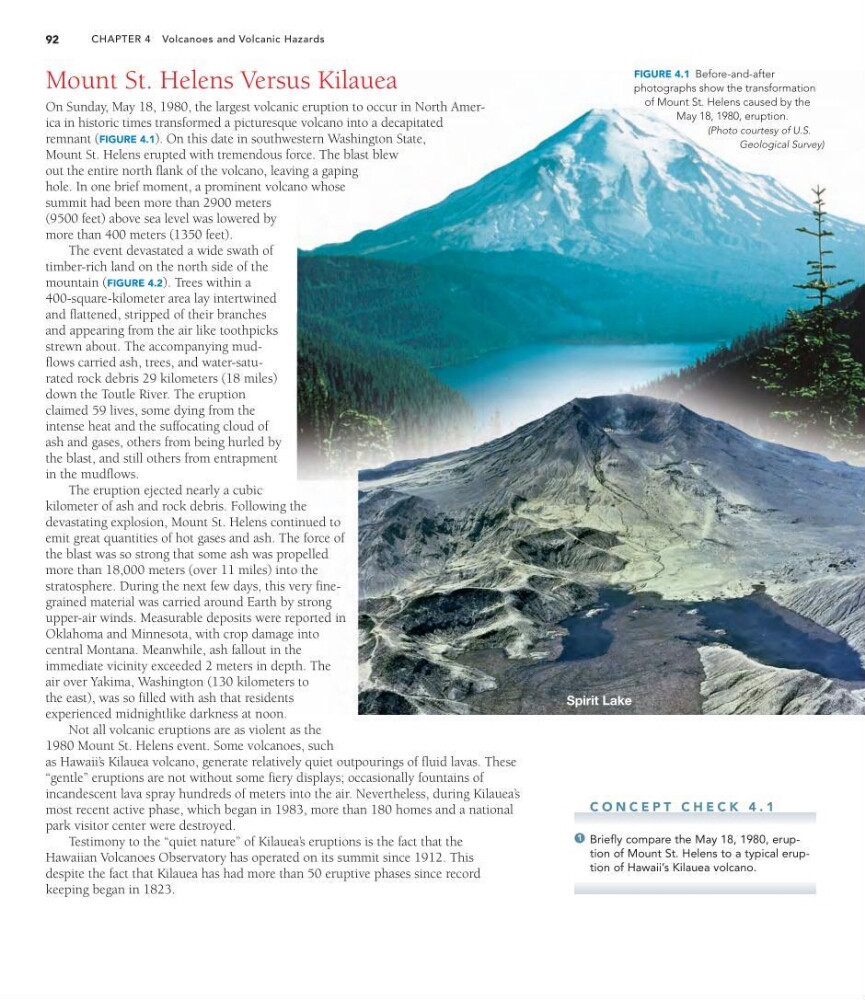
On Sunday, May 18, 1980, the largest volcanic eruption to occur in North America in historic times transformed a picturesque volcano into a decapitated
remnant (FIGURE 4.1). On this date in southwestern Washington State,
Mount St. Helens erupted with tremendous force. The blast blew
out the entire north flank of the volcano, leaving a gaping
hole. In one brief moment, a prominent volcano whose
summit had been more than 2900 meters
(9500 feet) above sea level was lowered by
more than 400 meters (1350 feet).
The event devastated a wide swath of
timber-rich land on the north side of the
mountain (FIGURE 4.2). Trees within a
400-square-kilometer area lay intertwined
and flattened, stripped of their branches
and appearing from the air like toothpicks
strewn about. The accompanying mudflows carried ash, trees, and water-saturated rock debris 29 kilometers (18 miles)
down the Toutle River. The eruption
claimed 59 lives, some dying from the
intense heat and the suffocating cloud of
ash and gases, others from being hurled by
the blast, and still others from entrapment
in the mudflows.
The eruption ejected nearly a cubic
kilometer of ash and rock debris. Following the
devastating explosion, Mount St. Helens continued to
emit great quantities of hot gases and ash. The force of
the blast was so strong that some ash was propelled
more than 18,000 meters (over 11 miles) into the
stratosphere. During the next few days, this very finegrained material was carried around Earth by strong
upper-air winds. Measurable deposits were reported in
Oklahoma and Minnesota, with crop damage into
central Montana. Meanwhile, ash fallout in the
immediate vicinity exceeded 2 meters in depth. The
air over Yakima, Washington (130 kilometers to
the east), was so filled with ash that residents
experienced midnightlike darkness at noon.
Not all volcanic eruptions are as violent as the
1980 Mount St. Helens event. Some volcanoes, such
as Hawaii’ s Kilauea volcano, generate relatively quiet outpourings of fluid lavas. These
“gentle” eruptions are not without some fiery displays; occasionally fountains of
incandescent lava spray hundreds of meters into the air. Nevertheless, during Kilauea’ s
most recent active phase, which began in 1983, more than 180 homes and a national
park visitor center were destroyed.
Testimony to the “quiet nature” of Kilauea’ s eruptions is the fact that the
Hawaiian Volcanoes Observatory has operated on its summit since 1912. This
despite the fact that Kilauea has had more than 50 eruptive phases since record
keeping began in 1823.
FIGURE 4.1 Before-and-after
photographs show the transformation
of Mount St. Helens caused by the
May 18, 1980, eruption.
(Photo courtesy of U.S.
Geological Survey)
C O N C E P T C H E C K 4 . 1
Briefly compare the May 18, 1980, eruption of Mount St. Helens to a typical eruption of Hawaii’s Kilauea volcano.
1
CHAPTER 4 Volcanoes and Volcanic Hazards
92
Mount St. Helens Versus Kilauea
On Sunday, May 18, 1980, the largest volcanic eruption to occur in North America in historic times transformed a picturesque volcano into a decapitated
remnant (FIGURE 4.1). On this date in southwestern Washington State,
Mount St. Helens erupted with tremendous force. The blast blew
out the entire north flank of the volcano, leaving a gaping
hole. In one brief moment, a prominent volcano whose
summit had been more than 2900 meters
(9500 feet) above sea level was lowered by
more than 400 meters (1350 feet).
The event devastated a wide swath of
timber-rich land on the north side of the
mountain (FIGURE 4.2). Trees within a
400-square-kilometer area lay intertwined
and flattened, stripped of their branches
and appearing from the air like toothpicks
strewn about. The accompanying mudflows carried ash, trees, and water-saturated rock debris 29 kilometers (18 miles)
down the Toutle River. The eruption
claimed 59 lives, some dying from the
intense heat and the suffocating cloud of
ash and gases, others from being hurled by
the blast, and still others from entrapment
in the mudflows.
The eruption ejected nearly a cubic
kilometer of ash and rock debris. Following the
devastating explosion, Mount St. Helens continued to
emit great quantities of hot gases and ash. The force of
the blast was so strong that some ash was propelled
more than 18,000 meters (over 11 miles) into the
stratosphere. During the next few days, this very finegrained material was carried around Earth by strong
upper-air winds. Measurable deposits were reported in
Oklahoma and Minnesota, with crop damage into
central Montana. Meanwhile, ash fallout in the
immediate vicinity exceeded 2 meters in depth. The
air over Yakima, Washington (130 kilometers to
the east), was so filled with ash that residents
experienced midnightlike darkness at noon.
Not all volcanic eruptions are as violent as the
1980 Mount St. Helens event. Some volcanoes, such
as Hawaii’ s Kilauea volcano, generate relatively quiet outpourings of fluid lavas. These
“gentle” eruptions are not without some fiery displays; occasionally fountains of
incandescent lava spray hundreds of meters into the air. Nevertheless, during Kilauea’ s
most recent active phase, which began in 1983, more than 180 homes and a national
park visitor center were destroyed.
Testimony to the “quiet nature” of Kilauea’ s eruptions is the fact that the
Hawaiian Volcanoes Observatory has operated on its summit since 1912. This
despite the fact that Kilauea has had more than 50 eruptive phases since record
keeping began in 1823.
FIGURE 4.1 Before-and-after
photographs show the transformation
of Mount St. Helens caused by the
May 18, 1980, eruption.
(Photo courtesy of U.S.
Geological Survey)
C O N C E P T C H E C K 4 . 1
Briefly compare the May 18, 1980, eruption of Mount St. Helens to a typical eruption of Hawaii’s Kilauea volcano.
1