

Coast Range
Coast Range
batholith batholith
Idaho Idaho
batholith batholith
Sierra Nevada
Sierra Nevada
batholith batholith
Coast Range
batholith
Idaho
batholith
Pacific
Ocean
Sierra Nevada
batholith
Souther Southern
Califor California nia
batholith batholith
Southern
California
batholith
Massive Intrusive Bodies:
Batholiths, Stocks, and Laccoliths
BATHOLITHS. By far the largest intrusive igneous bodies are batholiths (
,
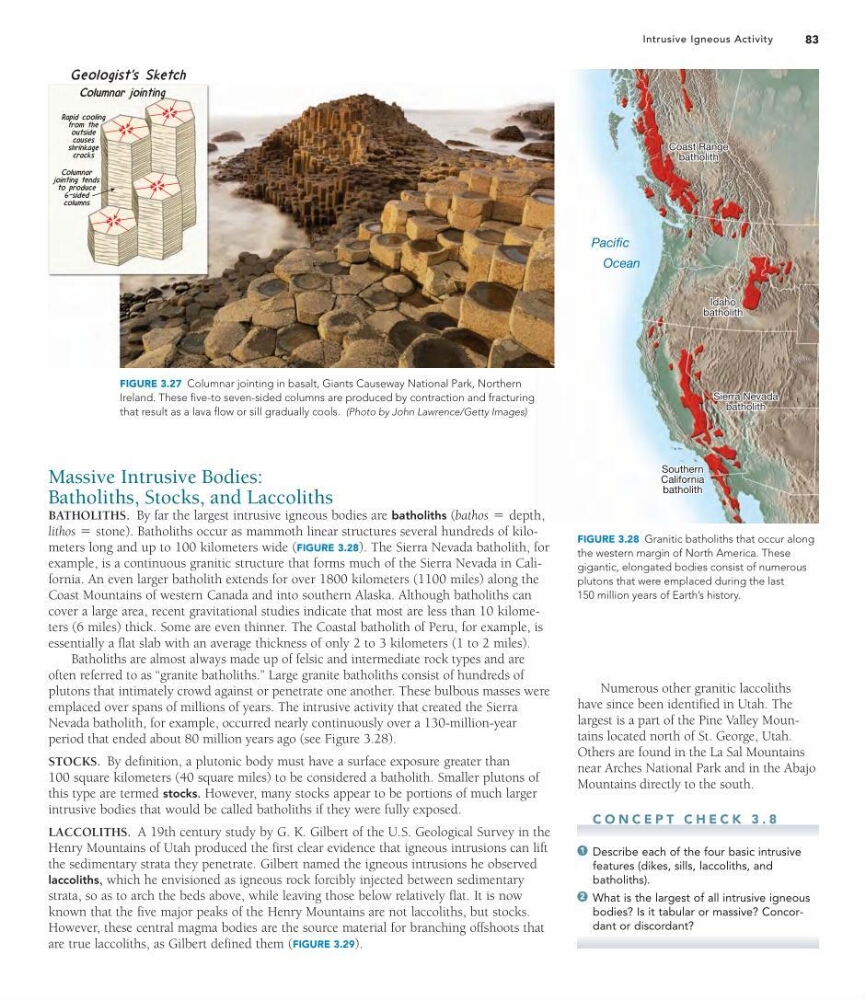
). Batholiths occur as mammoth linear structures several hundreds of kilometers long and up to 100 kilometers wide (FIGURE 3.28). The Sierra Nevada batholith, for
example, is a continuous granitic structure that forms much of the Sierra Nevada in California. An even larger batholith extends for over 1800 kilometers (1100 miles) along the
Coast Mountains of western Canada and into southern Alaska. Although batholiths can
cover a large area, recent gravitational studies indicate that most are less than 10 kilometers (6 miles) thick. Some are even thinner. The Coastal batholith of Peru, for example, is
essentially a flat slab with an average thickness of only 2 to 3 kilometers (1 to 2 miles).
Batholiths are almost always made up of felsic and intermediate rock types and are
often referred to as “granite batholiths.” Large granite batholiths consist of hundreds of
plutons that intimately crowd against or penetrate one another. These bulbous masses were
emplaced over spans of millions of years. The intrusive activity that created the Sierra
Nevada batholith, for example, occurred nearly continuously over a 130-million-year
period that ended about 80 million years ago (see Figure 3.28).
STOCKS. By definition, a plutonic body must have a surface exposure greater than
100 square kilometers (40 square miles) to be considered a batholith. Smaller plutons of
this type are termed stocks. However, many stocks appear to be portions of much larger
intrusive bodies that would be called batholiths if they were fully exposed.
LACCOLITHS. A 19th century study by G. K. Gilbert of the U.S. Geological Survey in the
Henry Mountains of Utah produced the first clear evidence that igneous intrusions can lift
the sedimentary strata they penetrate. Gilbert named the igneous intrusions he observed
laccoliths, which he envisioned as igneous rock forcibly injected between sedimentary
strata, so as to arch the beds above, while leaving those below relatively flat. It is now
known that the five major peaks of the Henry Mountains are not laccoliths, but stocks.
However, these central magma bodies are the source material for branching offshoots that
are true laccoliths, as Gilbert defined them (FIGURE 3.29).
lithos = stone
depth
bathos =
FIGURE 3.27 Columnar jointing in basalt, Giants Causeway National Park, Northern
Ireland. These five-to seven-sided columns are produced by contraction and fracturing
that result as a lava flow or sill gradually cools. (Photo by John Lawrence/Getty Images)
FIGURE 3.28 Granitic batholiths that occur along
the western margin of North America. These
gigantic, elongated bodies consist of numerous
plutons that were emplaced during the last
150 million years of Earth’s history.
Numerous other granitic laccoliths
have since been identified in Utah. The
largest is a part of the Pine Valley Mountains located north of St. George, Utah.
Others are found in the La Sal Mountains
near Arches National Park and in the Abajo
Mountains directly to the south.
C O N C E P T C H E C K 3 . 8
Describe each of the four basic intrusive
features (dikes, sills, laccoliths, and
batholiths).
What is the largest of all intrusive igneous
bodies? Is it tabular or massive? Concordant or discordant?
2
1
83
Intrusive Igneous Activity
Coast Range
batholith batholith
Idaho Idaho
batholith batholith
Sierra Nevada
Sierra Nevada
batholith batholith
Coast Range
batholith
Idaho
batholith
Pacific
Ocean
Sierra Nevada
batholith
Souther Southern
Califor California nia
batholith batholith
Southern
California
batholith
Massive Intrusive Bodies:
Batholiths, Stocks, and Laccoliths
BATHOLITHS. By far the largest intrusive igneous bodies are batholiths (
,
). Batholiths occur as mammoth linear structures several hundreds of kilometers long and up to 100 kilometers wide (FIGURE 3.28). The Sierra Nevada batholith, for
example, is a continuous granitic structure that forms much of the Sierra Nevada in California. An even larger batholith extends for over 1800 kilometers (1100 miles) along the
Coast Mountains of western Canada and into southern Alaska. Although batholiths can
cover a large area, recent gravitational studies indicate that most are less than 10 kilometers (6 miles) thick. Some are even thinner. The Coastal batholith of Peru, for example, is
essentially a flat slab with an average thickness of only 2 to 3 kilometers (1 to 2 miles).
Batholiths are almost always made up of felsic and intermediate rock types and are
often referred to as “granite batholiths.” Large granite batholiths consist of hundreds of
plutons that intimately crowd against or penetrate one another. These bulbous masses were
emplaced over spans of millions of years. The intrusive activity that created the Sierra
Nevada batholith, for example, occurred nearly continuously over a 130-million-year
period that ended about 80 million years ago (see Figure 3.28).
STOCKS. By definition, a plutonic body must have a surface exposure greater than
100 square kilometers (40 square miles) to be considered a batholith. Smaller plutons of
this type are termed stocks. However, many stocks appear to be portions of much larger
intrusive bodies that would be called batholiths if they were fully exposed.
LACCOLITHS. A 19th century study by G. K. Gilbert of the U.S. Geological Survey in the
Henry Mountains of Utah produced the first clear evidence that igneous intrusions can lift
the sedimentary strata they penetrate. Gilbert named the igneous intrusions he observed
laccoliths, which he envisioned as igneous rock forcibly injected between sedimentary
strata, so as to arch the beds above, while leaving those below relatively flat. It is now
known that the five major peaks of the Henry Mountains are not laccoliths, but stocks.
However, these central magma bodies are the source material for branching offshoots that
are true laccoliths, as Gilbert defined them (FIGURE 3.29).
lithos = stone
depth
bathos =
FIGURE 3.27 Columnar jointing in basalt, Giants Causeway National Park, Northern
Ireland. These five-to seven-sided columns are produced by contraction and fracturing
that result as a lava flow or sill gradually cools. (Photo by John Lawrence/Getty Images)
FIGURE 3.28 Granitic batholiths that occur along
the western margin of North America. These
gigantic, elongated bodies consist of numerous
plutons that were emplaced during the last
150 million years of Earth’s history.
Numerous other granitic laccoliths
have since been identified in Utah. The
largest is a part of the Pine Valley Mountains located north of St. George, Utah.
Others are found in the La Sal Mountains
near Arches National Park and in the Abajo
Mountains directly to the south.
C O N C E P T C H E C K 3 . 8
Describe each of the four basic intrusive
features (dikes, sills, laccoliths, and
batholiths).
What is the largest of all intrusive igneous
bodies? Is it tabular or massive? Concordant or discordant?
2
1
83
Intrusive Igneous Activity