

granite
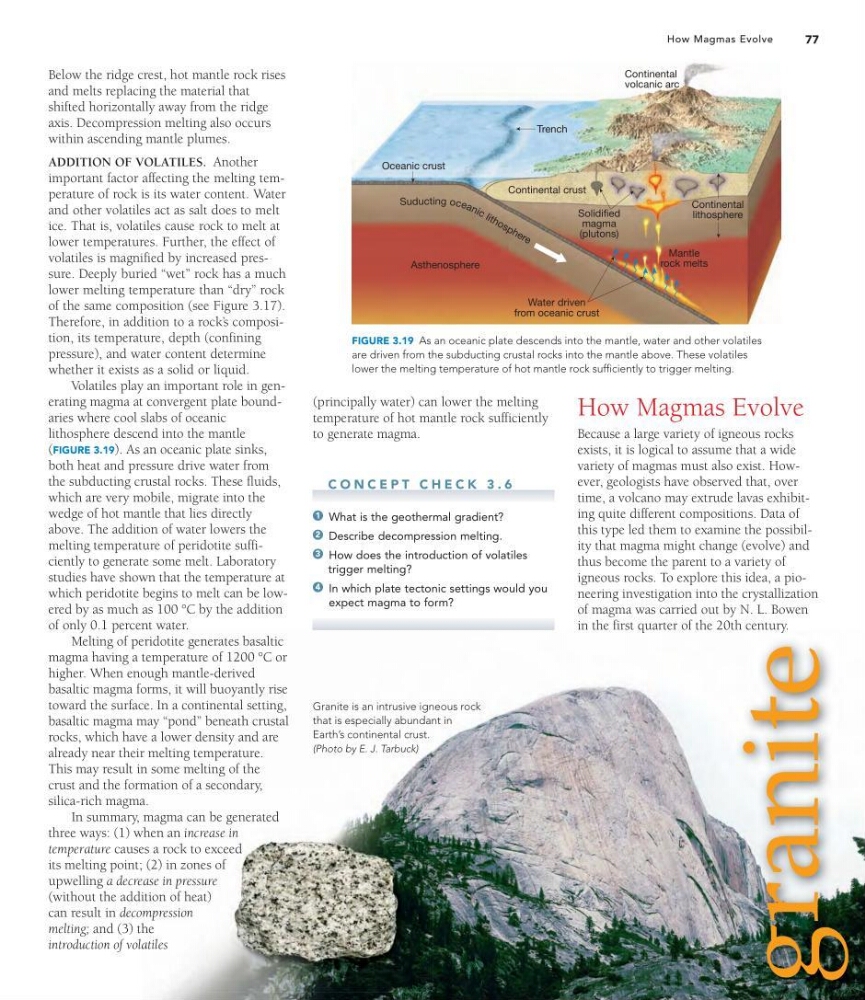
Granite is an intrusive igneous rock
that is especially abundant in
Earth’s continental crust.
(Photo by E. J. Tarbuck)
Water driven
from oceanic crust
Mantle
Solidified
magma
(plutons)
rock melts
Oceanic crust
Trench
Continental
volcanic arc
Continental crust
Asthenosphere
Continental
lithosphere
Suducting oc e a n ic li t h o s p h e r e
(principally water) can lower the melting
temperature of hot mantle rock sufficiently
to generate magma.
C O N C E P T C H E C K 3 . 6
What is the geothermal gradient?
Describe decompression melting.
How does the introduction of volatiles
trigger melting?
In which plate tectonic settings would you
expect magma to form?
4
3
2
1
FIGURE 3.19 As an oceanic plate descends into the mantle, water and other volatiles
are driven from the subducting crustal rocks into the mantle above. These volatiles
lower the melting temperature of hot mantle rock sufficiently to trigger melting.
Below the ridge crest, hot mantle rock rises
and melts replacing the material that
shifted horizontally away from the ridge
axis. Decompression melting also occurs
within ascending mantle plumes.
ADDITION OF VOLATILES. Another
important factor affecting the melting temperature of rock is its water content. Water
and other volatiles act as salt does to melt
ice. That is, volatiles cause rock to melt at
lower temperatures. Further, the effect of
volatiles is magnified by increased pressure. Deeply buried “wet” rock has a much
lower melting temperature than “dry” rock
of the same composition (see Figure 3.17).
Therefore, in addition to a rock’ s composition, its temperature, depth (confining
pressure), and water content determine
whether it exists as a solid or liquid.
Volatiles play an important role in generating magma at convergent plate boundaries where cool slabs of oceanic
lithosphere descend into the mantle
(FIGURE 3.19). As an oceanic plate sinks,
both heat and pressure drive water from
the subducting crustal rocks. These fluids,
which are very mobile, migrate into the
wedge of hot mantle that lies directly
above. The addition of water lowers the
melting temperature of peridotite sufficiently to generate some melt. Laboratory
studies have shown that the temperature at
which peridotite begins to melt can be lowered by as much as 100 °C by the addition
of only 0.1 percent water.
Melting of peridotite generates basaltic
magma having a temperature of 1200 °C or
higher. When enough mantle-derived
basaltic magma forms, it will buoyantly rise
toward the surface. In a continental setting,
basaltic magma may “pond” beneath crustal
rocks, which have a lower density and are
already near their melting temperature.
This may result in some melting of the
crust and the formation of a secondary,
silica-rich magma.
In summary, magma can be generated
three ways: (1) when an increase in
temperature causes a rock to exceed
its melting point; (2) in zones of
upwelling a decrease in pressure
(without the addition of heat)
can result in decompression
melting; and (3) the
introduction of volatiles
77
How Magmas Evolve
How Magmas Evolve
Because a large variety of igneous rocks
exists, it is logical to assume that a wide
variety of magmas must also exist. However, geologists have observed that, over
time, a volcano may extrude lavas exhibiting quite different compositions. Data of
this type led them to examine the possibility that magma might change (evolve) and
thus become the parent to a variety of
igneous rocks. To explore this idea, a pioneering investigation into the crystallization
of magma was carried out by N. L. Bowen
in the first quarter of the 20th century.
Granite is an intrusive igneous rock
that is especially abundant in
Earth’s continental crust.
(Photo by E. J. Tarbuck)
Water driven
from oceanic crust
Mantle
Solidified
magma
(plutons)
rock melts
Oceanic crust
Trench
Continental
volcanic arc
Continental crust
Asthenosphere
Continental
lithosphere
Suducting oc e a n ic li t h o s p h e r e
(principally water) can lower the melting
temperature of hot mantle rock sufficiently
to generate magma.
C O N C E P T C H E C K 3 . 6
What is the geothermal gradient?
Describe decompression melting.
How does the introduction of volatiles
trigger melting?
In which plate tectonic settings would you
expect magma to form?
4
3
2
1
FIGURE 3.19 As an oceanic plate descends into the mantle, water and other volatiles
are driven from the subducting crustal rocks into the mantle above. These volatiles
lower the melting temperature of hot mantle rock sufficiently to trigger melting.
Below the ridge crest, hot mantle rock rises
and melts replacing the material that
shifted horizontally away from the ridge
axis. Decompression melting also occurs
within ascending mantle plumes.
ADDITION OF VOLATILES. Another
important factor affecting the melting temperature of rock is its water content. Water
and other volatiles act as salt does to melt
ice. That is, volatiles cause rock to melt at
lower temperatures. Further, the effect of
volatiles is magnified by increased pressure. Deeply buried “wet” rock has a much
lower melting temperature than “dry” rock
of the same composition (see Figure 3.17).
Therefore, in addition to a rock’ s composition, its temperature, depth (confining
pressure), and water content determine
whether it exists as a solid or liquid.
Volatiles play an important role in generating magma at convergent plate boundaries where cool slabs of oceanic
lithosphere descend into the mantle
(FIGURE 3.19). As an oceanic plate sinks,
both heat and pressure drive water from
the subducting crustal rocks. These fluids,
which are very mobile, migrate into the
wedge of hot mantle that lies directly
above. The addition of water lowers the
melting temperature of peridotite sufficiently to generate some melt. Laboratory
studies have shown that the temperature at
which peridotite begins to melt can be lowered by as much as 100 °C by the addition
of only 0.1 percent water.
Melting of peridotite generates basaltic
magma having a temperature of 1200 °C or
higher. When enough mantle-derived
basaltic magma forms, it will buoyantly rise
toward the surface. In a continental setting,
basaltic magma may “pond” beneath crustal
rocks, which have a lower density and are
already near their melting temperature.
This may result in some melting of the
crust and the formation of a secondary,
silica-rich magma.
In summary, magma can be generated
three ways: (1) when an increase in
temperature causes a rock to exceed
its melting point; (2) in zones of
upwelling a decrease in pressure
(without the addition of heat)
can result in decompression
melting; and (3) the
introduction of volatiles
77
How Magmas Evolve
How Magmas Evolve
Because a large variety of igneous rocks
exists, it is logical to assume that a wide
variety of magmas must also exist. However, geologists have observed that, over
time, a volcano may extrude lavas exhibiting quite different compositions. Data of
this type led them to examine the possibility that magma might change (evolve) and
thus become the parent to a variety of
igneous rocks. To explore this idea, a pioneering investigation into the crystallization
of magma was carried out by N. L. Bowen
in the first quarter of the 20th century.