

Asthenosphere
Crust
Decompression
melting
Upwelling
mantle rocks
Lithosphere
Magma
chamber
Ridge
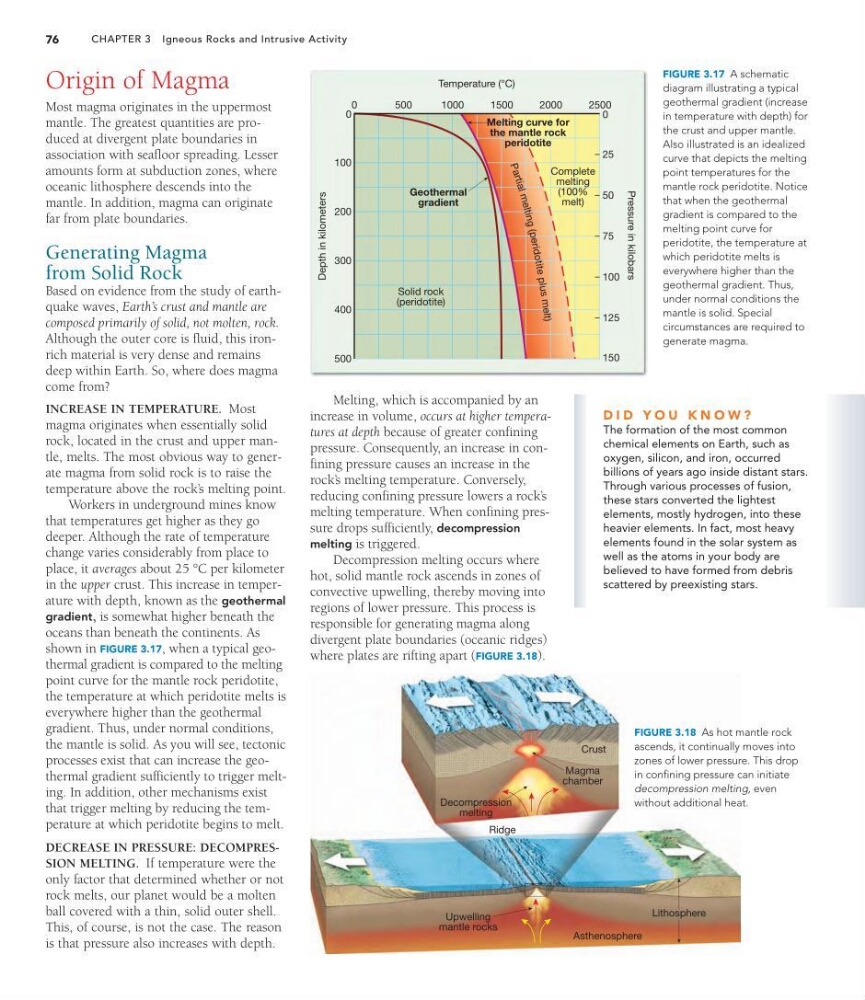
FIGURE 3.18 As hot mantle rock
ascends, it continually moves into
zones of lower pressure. This drop
in confining pressure can initiate
decompression melting, even
without additional heat.
FIGURE 3.17 A schematic
diagram illustrating a typical
geothermal gradient (increase
in temperature with depth) for
the crust and upper mantle.
Also illustrated is an idealized
curve that depicts the melting
point temperatures for the
mantle rock peridotite. Notice
that when the geothermal
gradient is compared to the
melting point curve for
peridotite, the temperature at
which peridotite melts is
everywhere higher than the
geothermal gradient. Thus,
under normal conditions the
mantle is solid. Special
circumstances are required to
generate magma.
CHAPTER 3 Igneous Rocks and Intrusive Activity
76
Melting, which is accompanied by an
increase in volume, occurs at higher temperatures at depth because of greater confining
pressure. Consequently, an increase in confining pressure causes an increase in the
rock’ s melting temperature. Conversely,
reducing confining pressure lowers a rock’ s
melting temperature. When confining pressure drops sufficiently, decompression
melting is triggered.
Decompression melting occurs where
hot, solid mantle rock ascends in zones of
convective upwelling, thereby moving into
regions of lower pressure. This process is
responsible for generating magma along
divergent plate boundaries (oceanic ridges)
where plates are rifting apart (FIGURE 3.18).
Origin of Magma
Most magma originates in the uppermost
mantle. The greatest quantities are produced at divergent plate boundaries in
association with seafloor spreading. Lesser
amounts form at subduction zones, where
oceanic lithosphere descends into the
mantle. In addition, magma can originate
far from plate boundaries.
Generating Magma
from Solid Rock
Based on evidence from the study of earthquake waves, Earth’s crust and mantle are
composed primarily of solid, not molten, rock.
Although the outer core is fluid, this ironrich material is very dense and remains
deep within Earth. So, where does magma
come from?
INCREASE IN TEMPERATURE. Most
magma originates when essentially solid
rock, located in the crust and upper mantle, melts. The most obvious way to generate magma from solid rock is to raise the
temperature above the rock’ s melting point.
Workers in underground mines know
that temperatures get higher as they go
deeper. Although the rate of temperature
change varies considerably from place to
place, it averages about 25 °C per kilometer
in the upper crust. This increase in temperature with depth, known as the geothermal
gradient, is somewhat higher beneath the
oceans than beneath the continents. As
shown in FIGURE 3.17, when a typical geothermal gradient is compared to the melting
point curve for the mantle rock peridotite,
the temperature at which peridotite melts is
everywhere higher than the geothermal
gradient. Thus, under normal conditions,
the mantle is solid. As you will see, tectonic
processes exist that can increase the geothermal gradient sufficiently to trigger melting. In addition, other mechanisms exist
that trigger melting by reducing the temperature at which peridotite begins to melt.
DECREASE IN PRESSURE: DECOMPRESSION MELTING. If temperature were the
only factor that determined whether or not
rock melts, our planet would be a molten
ball covered with a thin, solid outer shell.
This, of course, is not the case. The reason
is that pressure also increases with depth.
Temperature (°C)
Depth in kilometers
Pressure in kilobars
300
400
500
500
1000
1500
2000
2500
100
200
75
100
150
125
25
50
0
0
0
Melting curve for
the mantle rock
peridotite
Complete
melting
(100%
melt)
Geothermal
gradient
Solid rock
(peridotite)
P a rt ia l m e lt in g (p er id ot ite pl us me lt)
D I D Y O U K N O W ?
The formation of the most common
chemical elements on Earth, such as
oxygen, silicon, and iron, occurred
billions of years ago inside distant stars.
Through various processes of fusion,
these stars converted the lightest
elements, mostly hydrogen, into these
heavier elements. In fact, most heavy
elements found in the solar system as
well as the atoms in your body are
believed to have formed from debris
scattered by preexisting stars.
Crust
Decompression
melting
Upwelling
mantle rocks
Lithosphere
Magma
chamber
Ridge
FIGURE 3.18 As hot mantle rock
ascends, it continually moves into
zones of lower pressure. This drop
in confining pressure can initiate
decompression melting, even
without additional heat.
FIGURE 3.17 A schematic
diagram illustrating a typical
geothermal gradient (increase
in temperature with depth) for
the crust and upper mantle.
Also illustrated is an idealized
curve that depicts the melting
point temperatures for the
mantle rock peridotite. Notice
that when the geothermal
gradient is compared to the
melting point curve for
peridotite, the temperature at
which peridotite melts is
everywhere higher than the
geothermal gradient. Thus,
under normal conditions the
mantle is solid. Special
circumstances are required to
generate magma.
CHAPTER 3 Igneous Rocks and Intrusive Activity
76
Melting, which is accompanied by an
increase in volume, occurs at higher temperatures at depth because of greater confining
pressure. Consequently, an increase in confining pressure causes an increase in the
rock’ s melting temperature. Conversely,
reducing confining pressure lowers a rock’ s
melting temperature. When confining pressure drops sufficiently, decompression
melting is triggered.
Decompression melting occurs where
hot, solid mantle rock ascends in zones of
convective upwelling, thereby moving into
regions of lower pressure. This process is
responsible for generating magma along
divergent plate boundaries (oceanic ridges)
where plates are rifting apart (FIGURE 3.18).
Origin of Magma
Most magma originates in the uppermost
mantle. The greatest quantities are produced at divergent plate boundaries in
association with seafloor spreading. Lesser
amounts form at subduction zones, where
oceanic lithosphere descends into the
mantle. In addition, magma can originate
far from plate boundaries.
Generating Magma
from Solid Rock
Based on evidence from the study of earthquake waves, Earth’s crust and mantle are
composed primarily of solid, not molten, rock.
Although the outer core is fluid, this ironrich material is very dense and remains
deep within Earth. So, where does magma
come from?
INCREASE IN TEMPERATURE. Most
magma originates when essentially solid
rock, located in the crust and upper mantle, melts. The most obvious way to generate magma from solid rock is to raise the
temperature above the rock’ s melting point.
Workers in underground mines know
that temperatures get higher as they go
deeper. Although the rate of temperature
change varies considerably from place to
place, it averages about 25 °C per kilometer
in the upper crust. This increase in temperature with depth, known as the geothermal
gradient, is somewhat higher beneath the
oceans than beneath the continents. As
shown in FIGURE 3.17, when a typical geothermal gradient is compared to the melting
point curve for the mantle rock peridotite,
the temperature at which peridotite melts is
everywhere higher than the geothermal
gradient. Thus, under normal conditions,
the mantle is solid. As you will see, tectonic
processes exist that can increase the geothermal gradient sufficiently to trigger melting. In addition, other mechanisms exist
that trigger melting by reducing the temperature at which peridotite begins to melt.
DECREASE IN PRESSURE: DECOMPRESSION MELTING. If temperature were the
only factor that determined whether or not
rock melts, our planet would be a molten
ball covered with a thin, solid outer shell.
This, of course, is not the case. The reason
is that pressure also increases with depth.
Temperature (°C)
Depth in kilometers
Pressure in kilobars
300
400
500
500
1000
1500
2000
2500
100
200
75
100
150
125
25
50
0
0
0
Melting curve for
the mantle rock
peridotite
Complete
melting
(100%
melt)
Geothermal
gradient
Solid rock
(peridotite)
P a rt ia l m e lt in g (p er id ot ite pl us me lt)
D I D Y O U K N O W ?
The formation of the most common
chemical elements on Earth, such as
oxygen, silicon, and iron, occurred
billions of years ago inside distant stars.
Through various processes of fusion,
these stars converted the lightest
elements, mostly hydrogen, into these
heavier elements. In fact, most heavy
elements found in the solar system as
well as the atoms in your body are
believed to have formed from debris
scattered by preexisting stars.