

3.2 POROSITY AND PERMEABILITY
69
uted to the rotting of organic material in stromatolites or to buckling of laminated mud
during intertidal exposure (Shinn, 1983).
3.2.2.3.3 Stromatactis
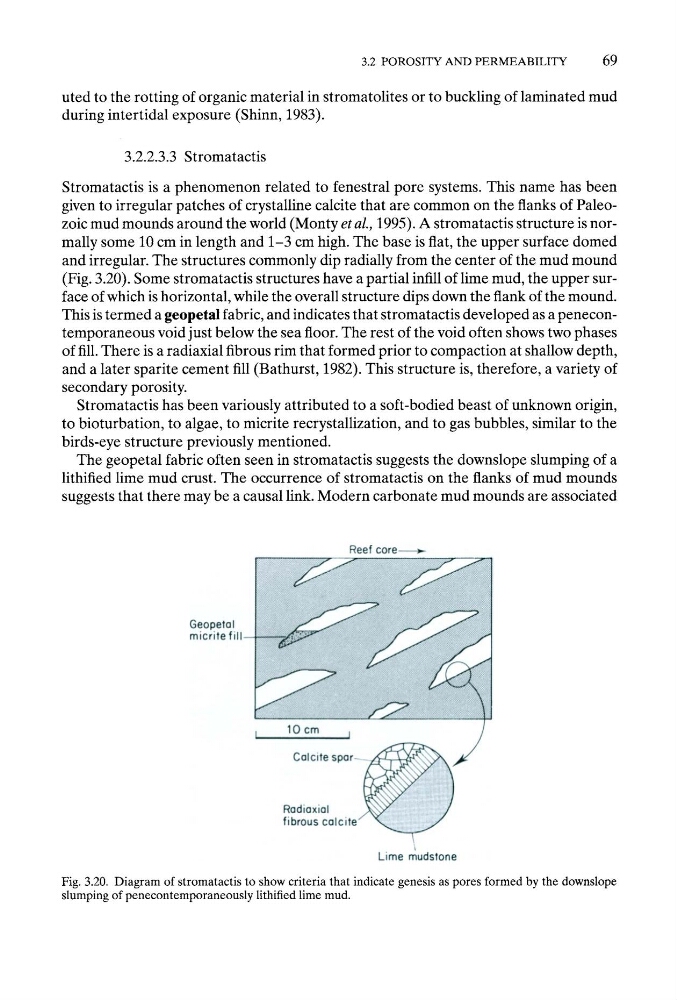
Stromatactis is a phenomenon related to fenestral pore systems. This name has been
given to irregular patches of crystalline calcite that are common on the flanks of Paleozoic mud mounds around the world (Monty et aL, 1995). A stromatactis structure is normally some 10 cm in length and 1-3 cm high. The base is flat, the upper surface domed
and irregular. The structures commonly dip radially from the center of the mud mound
(Fig. 3.20). Some stromatactis structures have a partial infill of lime mud, the upper surface of which is horizontal, while the overall structure dips down the flank of the mound.
This is termed a geopetal fabric, and indicates that stromatactis developed as a penecontemporaneous void just below the sea floor. The rest of the void often shows two phases
of fill. There is a radiaxial fibrous rim that formed prior to compaction at shallow depth,
and a later sparite cement fill (Bathurst, 1982). This structure is, therefore, a variety of
secondary porosity.
Stromatactis has been variously attributed to a soft-bodied beast of unknown origin,
to bioturbation, to algae, to micrite recrystallization, and to gas bubbles, similar to the
birds-eye structure previously mentioned.
The geopetal fabric often seen in stromatactis suggests the downslope slumping of a
lithified lime mud crust. The occurrence of stromatactis on the flanks of mud mounds
suggests that there may be a causal link. Modern carbonate mud mounds are associated
Fig. 3.20. Diagram of stromatactis to show criteria that indicate genesis as pores formed by the downslope
slumping of penecontemporaneously lithified lime mud.
69
uted to the rotting of organic material in stromatolites or to buckling of laminated mud
during intertidal exposure (Shinn, 1983).
3.2.2.3.3 Stromatactis
Stromatactis is a phenomenon related to fenestral pore systems. This name has been
given to irregular patches of crystalline calcite that are common on the flanks of Paleozoic mud mounds around the world (Monty et aL, 1995). A stromatactis structure is normally some 10 cm in length and 1-3 cm high. The base is flat, the upper surface domed
and irregular. The structures commonly dip radially from the center of the mud mound
(Fig. 3.20). Some stromatactis structures have a partial infill of lime mud, the upper surface of which is horizontal, while the overall structure dips down the flank of the mound.
This is termed a geopetal fabric, and indicates that stromatactis developed as a penecontemporaneous void just below the sea floor. The rest of the void often shows two phases
of fill. There is a radiaxial fibrous rim that formed prior to compaction at shallow depth,
and a later sparite cement fill (Bathurst, 1982). This structure is, therefore, a variety of
secondary porosity.
Stromatactis has been variously attributed to a soft-bodied beast of unknown origin,
to bioturbation, to algae, to micrite recrystallization, and to gas bubbles, similar to the
birds-eye structure previously mentioned.
The geopetal fabric often seen in stromatactis suggests the downslope slumping of a
lithified lime mud crust. The occurrence of stromatactis on the flanks of mud mounds
suggests that there may be a causal link. Modern carbonate mud mounds are associated
Fig. 3.20. Diagram of stromatactis to show criteria that indicate genesis as pores formed by the downslope
slumping of penecontemporaneously lithified lime mud.