

68
3 PARTICLES, PORES, AND PERMEABILITY
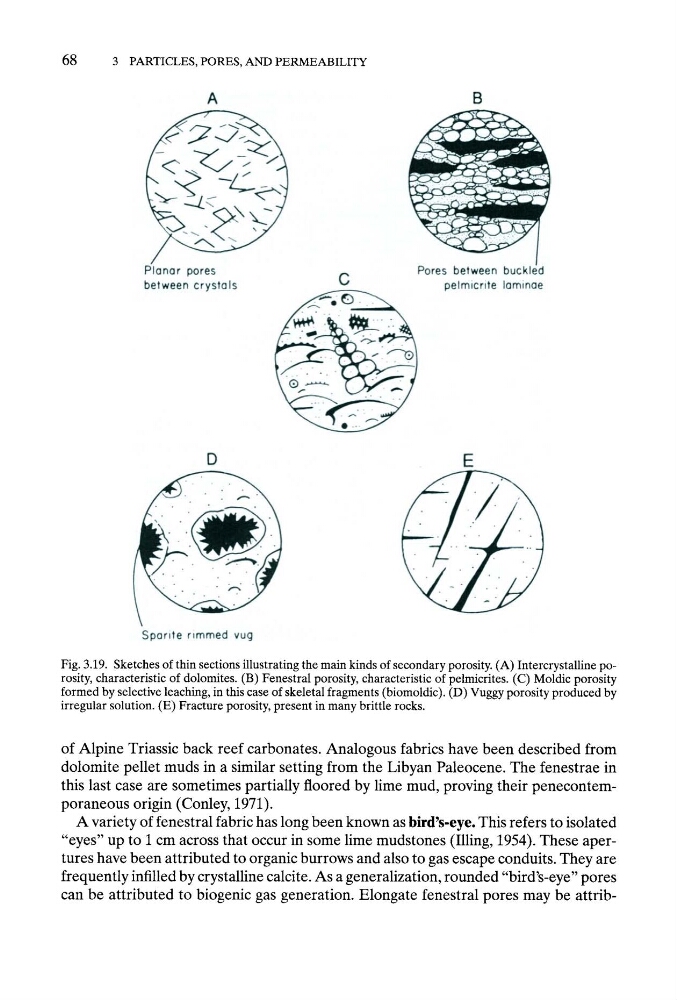
Fig. 3.19. Sketches of thin sections illustrating the main kinds of secondary porosity. (A) Intercrystalline porosity, characteristic of dolomites. (B) Fenestral porosity, characteristic of pelmicrites. (C) Moldic porosity
formed by selective leaching, in this case of skeletal fragments (biomoldic). (D) Vuggy porosity produced by
irregular solution. (E) Fracture porosity, present in many brittle rocks.
of Alpine Triassic back reef carbonates. Analogous fabrics have been described from
dolomite pellet muds in a similar setting from the Libyan Paleocene. The fenestrae in
this last case are sometimes partially floored by lime mud, proving their penecontemporaneous origin (Conley, 1971).
A variety of fenestral fabric has long been known as bird's-eye. This refers to isolated
"eyes" up to 1 cm across that occur in some lime mudstones (Illing, 1954). These apertures have been attributed to organic burrows and also to gas escape conduits. They are
frequently infilled by crystalline calcite. As a generalization, rounded "bird's-eye" pores
can be attributed to biogenic gas generation. Elongate fenestral pores may be attrib-
3 PARTICLES, PORES, AND PERMEABILITY
Fig. 3.19. Sketches of thin sections illustrating the main kinds of secondary porosity. (A) Intercrystalline porosity, characteristic of dolomites. (B) Fenestral porosity, characteristic of pelmicrites. (C) Moldic porosity
formed by selective leaching, in this case of skeletal fragments (biomoldic). (D) Vuggy porosity produced by
irregular solution. (E) Fracture porosity, present in many brittle rocks.
of Alpine Triassic back reef carbonates. Analogous fabrics have been described from
dolomite pellet muds in a similar setting from the Libyan Paleocene. The fenestrae in
this last case are sometimes partially floored by lime mud, proving their penecontemporaneous origin (Conley, 1971).
A variety of fenestral fabric has long been known as bird's-eye. This refers to isolated
"eyes" up to 1 cm across that occur in some lime mudstones (Illing, 1954). These apertures have been attributed to organic burrows and also to gas escape conduits. They are
frequently infilled by crystalline calcite. As a generalization, rounded "bird's-eye" pores
can be attributed to biogenic gas generation. Elongate fenestral pores may be attrib-