

3.2 POROSITY AND PERMEABILITY
59
pressure gradient of one atmosphere per centimeter. The permeability of most rocks is
considerably less than one darcy. To avoid fractions or decimals, the millidarcy, which
is one-thousandth of a darcy, is generally used.
Darcy's law is valid for three assumptions: that there is only one fluid phase present,
that the pore system is homogeneous, and that there is no reaction between the fluid
and the rock. These conditions are not always satisfied, either in nature or in the laboratory. To illustrate the problem of the first assumption: Many petroleum reservoirs are
admixtures of gas, oil, and water, all of which have different viscosities and thus flow
rates. To illustrate the problems of the second assumption, that the pore size distribution is uniform: Many rocks have dual pore systems. They may consist, for example, of
pores between sand grains and fracture pores that cross-cut the main rock fabric. The
former will have a much lower permeability than the latter. To illustrate the problems of
the third assumption, that there is no reaction between fluid and rock: Rocks sometimes
contain minerals that react with drilling mud and other fluids that are passed through
the rock underground or in the laboratory. Halite cement, for example, may be leached
out, thus increasing porosity and permeability, or a montmorillonite clay matrix may expand, thus decreasing porosity and permeability (see Section 8.3.2.3). All three of these
problems can invalidate the simple assumptions of Darcy's law.
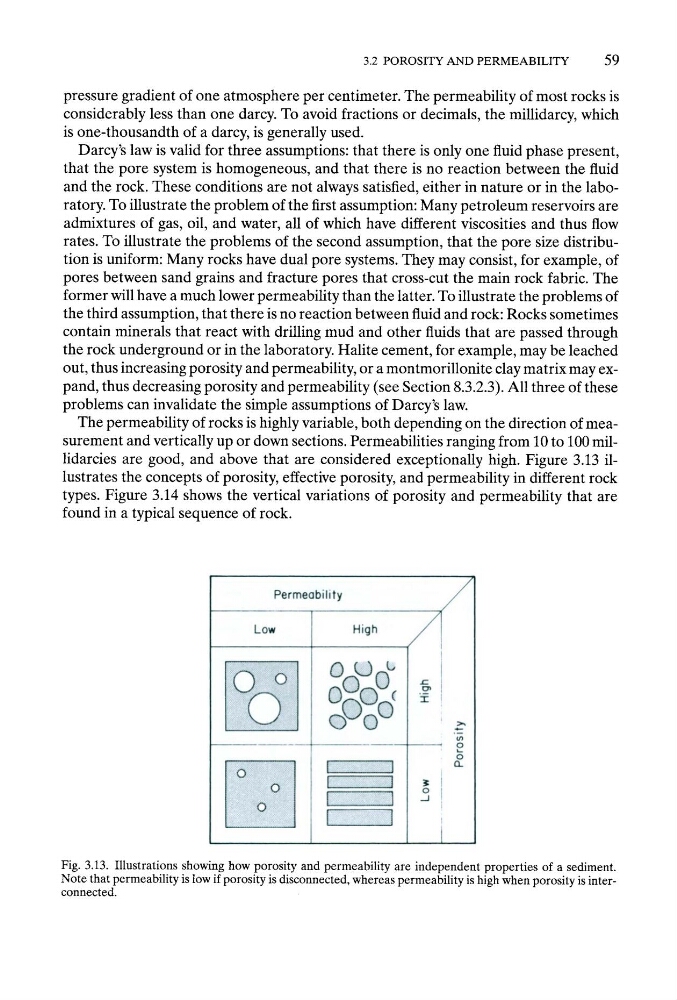
The permeability of rocks is highly variable, both depending on the direction of measurement and vertically up or down sections. Permeabilities ranging from 10 to 100 millidarcies are good, and above that are considered exceptionally high. Figure 3.13 illustrates the concepts of porosity, effective porosity, and permeability in different rock
types. Figure 3.14 shows the vertical variations of porosity and permeability that are
found in a typical sequence of rock.
Fig. 3.13. Illustrations showing how porosity and permeability are independent properties of a sediment.
Note that permeability is low if porosity is disconnected, whereas permeability is high when porosity is interconnected.
59
pressure gradient of one atmosphere per centimeter. The permeability of most rocks is
considerably less than one darcy. To avoid fractions or decimals, the millidarcy, which
is one-thousandth of a darcy, is generally used.
Darcy's law is valid for three assumptions: that there is only one fluid phase present,
that the pore system is homogeneous, and that there is no reaction between the fluid
and the rock. These conditions are not always satisfied, either in nature or in the laboratory. To illustrate the problem of the first assumption: Many petroleum reservoirs are
admixtures of gas, oil, and water, all of which have different viscosities and thus flow
rates. To illustrate the problems of the second assumption, that the pore size distribution is uniform: Many rocks have dual pore systems. They may consist, for example, of
pores between sand grains and fracture pores that cross-cut the main rock fabric. The
former will have a much lower permeability than the latter. To illustrate the problems of
the third assumption, that there is no reaction between fluid and rock: Rocks sometimes
contain minerals that react with drilling mud and other fluids that are passed through
the rock underground or in the laboratory. Halite cement, for example, may be leached
out, thus increasing porosity and permeability, or a montmorillonite clay matrix may expand, thus decreasing porosity and permeability (see Section 8.3.2.3). All three of these
problems can invalidate the simple assumptions of Darcy's law.
The permeability of rocks is highly variable, both depending on the direction of measurement and vertically up or down sections. Permeabilities ranging from 10 to 100 millidarcies are good, and above that are considered exceptionally high. Figure 3.13 illustrates the concepts of porosity, effective porosity, and permeability in different rock
types. Figure 3.14 shows the vertical variations of porosity and permeability that are
found in a typical sequence of rock.
Fig. 3.13. Illustrations showing how porosity and permeability are independent properties of a sediment.
Note that permeability is low if porosity is disconnected, whereas permeability is high when porosity is interconnected.