

3.2 POROSITY AND PERMEABILITY
57
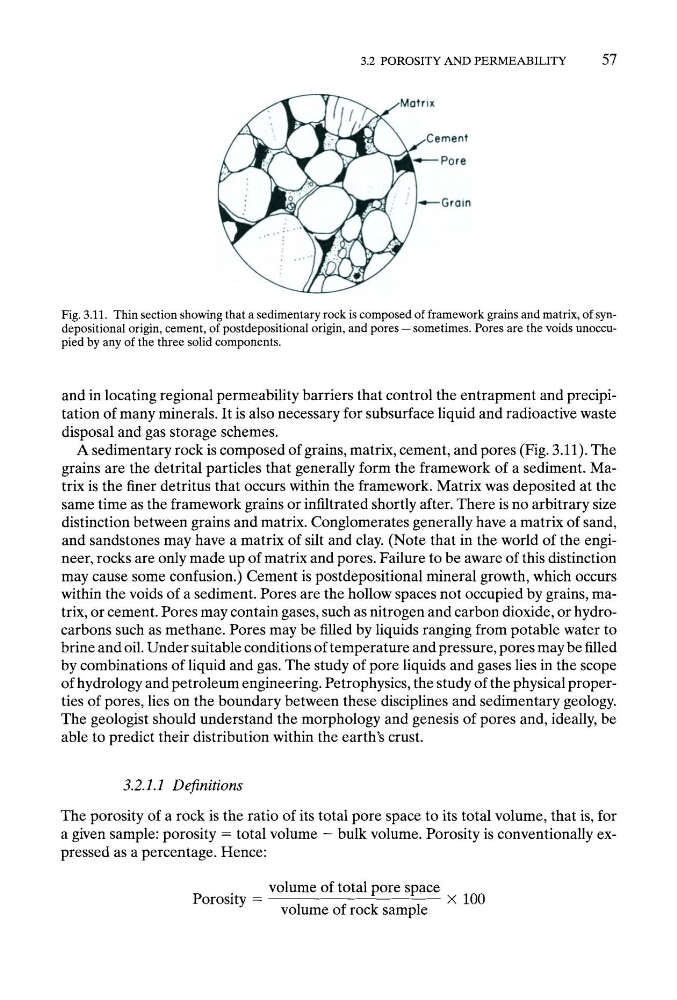
Fig. 3.11. Thin section showing that a sedimentary rock is composed of framework grains and matrix, of syndepositional origin, cement, of postdepositional origin, and p o r e s - sometimes. Pores are the voids unoccupied by any of the three solid components.
and in locating regional permeability barriers that control the entrapment and precipitation of many minerals. It is also necessary for subsurface liquid and radioactive waste
disposal and gas storage schemes.
A sedimentary rock is composed of grains, matrix, cement, and pores (Fig. 3.11). The
grains are the detrital particles that generally form the framework of a sediment. Matrix is the finer detritus that occurs within the framework. Matrix was deposited at the
same time as the framework grains or infiltrated shortly after. There is no arbitrary size
distinction between grains and matrix. Conglomerates generally have a matrix of sand,
and sandstones may have a matrix of silt and clay. (Note that in the world of the engineer, rocks are only made up of matrix and pores. Failure to be aware of this distinction
may cause some confusion.) Cement is postdepositional mineral growth, which occurs
within the voids of a sediment. Pores are the hollow spaces not occupied by grains, matrix, or cement. Pores may contain gases, such as nitrogen and carbon dioxide, or hydrocarbons such as methane. Pores may be filled by liquids ranging from potable water to
brine and oil. Under suitable conditions of temperature and pressure, pores may be filled
by combinations of liquid and gas. The study of pore liquids and gases lies in the scope
of hydrology and petroleum engineering. Petrophysics, the study of the physical properties of pores, lies on the boundary between these disciplines and sedimentary geology.
The geologist should understand the morphology and genesis of pores and, ideally, be
able to predict their distribution within the earth's crust.
3.2.1.1 Definitions
The porosity of a rock is the ratio of its total pore space to its total volume, that is, for
a given sample: porosity - total volume - bulk volume. Porosity is conventionally expressed as a percentage. Hence:
volume of total pore space
Porosity -
x 100
volume of rock sample
57
Fig. 3.11. Thin section showing that a sedimentary rock is composed of framework grains and matrix, of syndepositional origin, cement, of postdepositional origin, and p o r e s - sometimes. Pores are the voids unoccupied by any of the three solid components.
and in locating regional permeability barriers that control the entrapment and precipitation of many minerals. It is also necessary for subsurface liquid and radioactive waste
disposal and gas storage schemes.
A sedimentary rock is composed of grains, matrix, cement, and pores (Fig. 3.11). The
grains are the detrital particles that generally form the framework of a sediment. Matrix is the finer detritus that occurs within the framework. Matrix was deposited at the
same time as the framework grains or infiltrated shortly after. There is no arbitrary size
distinction between grains and matrix. Conglomerates generally have a matrix of sand,
and sandstones may have a matrix of silt and clay. (Note that in the world of the engineer, rocks are only made up of matrix and pores. Failure to be aware of this distinction
may cause some confusion.) Cement is postdepositional mineral growth, which occurs
within the voids of a sediment. Pores are the hollow spaces not occupied by grains, matrix, or cement. Pores may contain gases, such as nitrogen and carbon dioxide, or hydrocarbons such as methane. Pores may be filled by liquids ranging from potable water to
brine and oil. Under suitable conditions of temperature and pressure, pores may be filled
by combinations of liquid and gas. The study of pore liquids and gases lies in the scope
of hydrology and petroleum engineering. Petrophysics, the study of the physical properties of pores, lies on the boundary between these disciplines and sedimentary geology.
The geologist should understand the morphology and genesis of pores and, ideally, be
able to predict their distribution within the earth's crust.
3.2.1.1 Definitions
The porosity of a rock is the ratio of its total pore space to its total volume, that is, for
a given sample: porosity - total volume - bulk volume. Porosity is conventionally expressed as a percentage. Hence:
volume of total pore space
Porosity -
x 100
volume of rock sample