

56
3 PARTICLES, PORES, AND PERMEABILITY
Log median diameter (mm)
000195 00039
0.0078 0.0156 00312 0.0625
0.125
0.25
!
!
'
I
!
I
!
'
~
|'
E 2| 3/
-/
E
V,, /
C
o 5
o 6
O
to
1
i
I
1
i
1
1
1
9
8
7
6
5
4
3
2
Median diameter ( 4~ units)
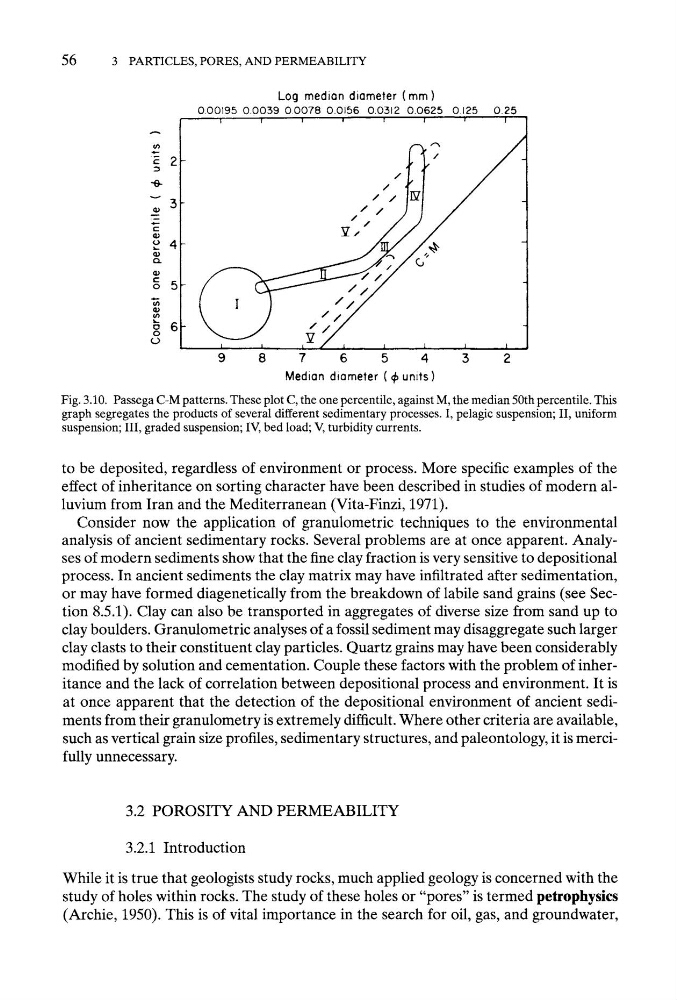
Fig. 3.10. Passega C-M patterns. These plot C, the one percentile, against M, the median 50th percentile. This
graph segregates the products of several different sedimentary processes. I, pelagic suspension; II, uniform
suspension; III, graded suspension; IV, bed load; V, turbidity currents.
to be deposited, regardless of environment or process. More specific examples of the
effect of inheritance on sorting character have been described in studies of modern alluvium from Iran and the Mediterranean (Vita-Finzi, 1971).
Consider now the application of granulometric techniques to the environmental
analysis of ancient sedimentary rocks. Several problems are at once apparent. Analyses of modern sediments show that the fine clay fraction is very sensitive to depositional
process. In ancient sediments the clay matrix may have infiltrated after sedimentation,
or may have formed diagenetically from the breakdown of labile sand grains (see Section 8.5.1). Clay can also be transported in aggregates of diverse size from sand up to
clay boulders. Granulometric analyses of a fossil sediment may disaggregate such larger
clay clasts to their constituent clay particles. Quartz grains may have been considerably
modified by solution and cementation. Couple these factors with the problem of inheritance and the lack of correlation between depositional process and environment. It is
at once apparent that the detection of the depositional environment of ancient sediments from their granulometry is extremely difficult. Where other criteria are available,
such as vertical grain size profiles, sedimentary structures, and paleontology, it is mercifully unnecessary.
3.2 POROSITY AND PERMEABILITY
3.2.1 Introduction
While it is true that geologists study rocks, much applied geology is concerned with the
study of holes within rocks. The study of these holes or "pores" is termed petrophysics
(Archie, 1950). This is of vital importance in the search for oil, gas, and groundwater,
3 PARTICLES, PORES, AND PERMEABILITY
Log median diameter (mm)
000195 00039
0.0078 0.0156 00312 0.0625
0.125
0.25
!
!
'
I
!
I
!
'
~
|'
E 2| 3/
-/
E
V,, /
C
o 5
o 6
O
to
1
i
I
1
i
1
1
1
9
8
7
6
5
4
3
2
Median diameter ( 4~ units)
Fig. 3.10. Passega C-M patterns. These plot C, the one percentile, against M, the median 50th percentile. This
graph segregates the products of several different sedimentary processes. I, pelagic suspension; II, uniform
suspension; III, graded suspension; IV, bed load; V, turbidity currents.
to be deposited, regardless of environment or process. More specific examples of the
effect of inheritance on sorting character have been described in studies of modern alluvium from Iran and the Mediterranean (Vita-Finzi, 1971).
Consider now the application of granulometric techniques to the environmental
analysis of ancient sedimentary rocks. Several problems are at once apparent. Analyses of modern sediments show that the fine clay fraction is very sensitive to depositional
process. In ancient sediments the clay matrix may have infiltrated after sedimentation,
or may have formed diagenetically from the breakdown of labile sand grains (see Section 8.5.1). Clay can also be transported in aggregates of diverse size from sand up to
clay boulders. Granulometric analyses of a fossil sediment may disaggregate such larger
clay clasts to their constituent clay particles. Quartz grains may have been considerably
modified by solution and cementation. Couple these factors with the problem of inheritance and the lack of correlation between depositional process and environment. It is
at once apparent that the detection of the depositional environment of ancient sediments from their granulometry is extremely difficult. Where other criteria are available,
such as vertical grain size profiles, sedimentary structures, and paleontology, it is mercifully unnecessary.
3.2 POROSITY AND PERMEABILITY
3.2.1 Introduction
While it is true that geologists study rocks, much applied geology is concerned with the
study of holes within rocks. The study of these holes or "pores" is termed petrophysics
(Archie, 1950). This is of vital importance in the search for oil, gas, and groundwater,