

3.1 PHYSICAL PROPERTIES OF PARTICLES
43
e.m
I3
1.1
eIncreasing sphericity
,
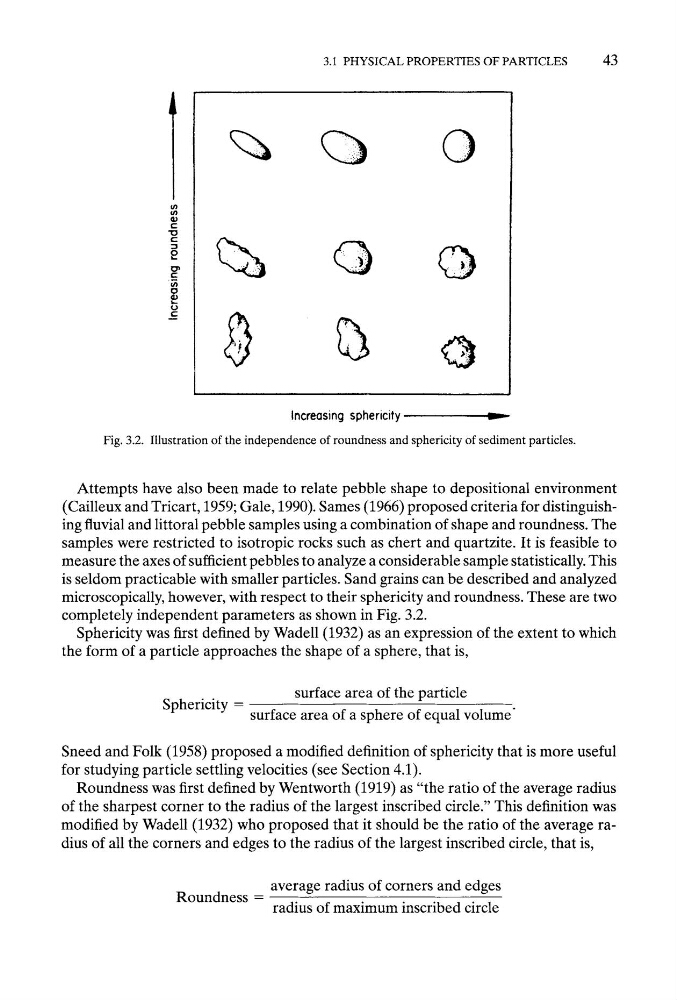
Fig. 3.2. Illustration of the independence of roundness and sphericity of sediment particles.
Attempts have also been made to relate pebble shape to depositional environment
(Cailleux and Tricart, 1959; Gale, 1990). Sames (1966) proposed criteria for distinguishing fluvial and littoral pebble samples using a combination of shape and roundness. The
samples were restricted to isotropic rocks such as chert and quartzite. It is feasible to
measure the axes of sufficient pebbles to analyze a considerable sample statistically. This
is seldom practicable with smaller particles. Sand grains can be described and analyzed
microscopically, however, with respect to their sphericity and roundness. These are two
completely independent parameters as shown in Fig. 3.2.
Sphericity was first defined by Wadell (1932) as an expression of the extent to which
the form of a particle approaches the shape of a sphere, that is,
surface area of the particle
Sphericity = surface area of a sphere of equal volume"
Sneed and Folk (1958) proposed a modified definition of sphericity that is more useful
for studying particle settling velocities (see Section 4.1).
Roundness was first defined by Wentworth (1919) as "the ratio of the average radius
of the sharpest corner to the radius of the largest inscribed circle." This definition was
modified by Wadell (1932) who proposed that it should be the ratio of the average radius of all the corners and edges to the radius of the largest inscribed circle, that is,
Roundness =
average radius of corners and edges
radius of maximum inscribed circle
43
e.m
I3
1.1
eIncreasing sphericity
,
Fig. 3.2. Illustration of the independence of roundness and sphericity of sediment particles.
Attempts have also been made to relate pebble shape to depositional environment
(Cailleux and Tricart, 1959; Gale, 1990). Sames (1966) proposed criteria for distinguishing fluvial and littoral pebble samples using a combination of shape and roundness. The
samples were restricted to isotropic rocks such as chert and quartzite. It is feasible to
measure the axes of sufficient pebbles to analyze a considerable sample statistically. This
is seldom practicable with smaller particles. Sand grains can be described and analyzed
microscopically, however, with respect to their sphericity and roundness. These are two
completely independent parameters as shown in Fig. 3.2.
Sphericity was first defined by Wadell (1932) as an expression of the extent to which
the form of a particle approaches the shape of a sphere, that is,
surface area of the particle
Sphericity = surface area of a sphere of equal volume"
Sneed and Folk (1958) proposed a modified definition of sphericity that is more useful
for studying particle settling velocities (see Section 4.1).
Roundness was first defined by Wentworth (1919) as "the ratio of the average radius
of the sharpest corner to the radius of the largest inscribed circle." This definition was
modified by Wadell (1932) who proposed that it should be the ratio of the average radius of all the corners and edges to the radius of the largest inscribed circle, that is,
Roundness =
average radius of corners and edges
radius of maximum inscribed circle