

42
3 PARTICLES, PORES, AND PERMEABILITY
surfaces of water-deposited sand grains are characterized by V-shaped percussion pits
and grooves. Glacial sands show conchoidal fractures and irregular angled microtopography. Eolian sands show a flaky surface pattern.
Unfortunately though, many sand grains bear the imprints of several processes. Consider, for example, a quartz grain in a sand dune on a periglacial outwash plain. Furthermore, at subcrop, and at outcrop in the tropics, these abrasional features may be
modified by solution and by secondary quartz cementation. Where extensive diagenesis is absent, however, the original imprint of the depositional process has been seen on
quartz grains of all ages from Recent to Pre-Cambrian (Krinsley and Trusty, 1986).
3.1.2 Particle Shape, Sphericity, and Roundness
Numerous attempts have been made to define the shape of sediment particles and study
the controlling factors of grain shape. Pebble shapes have conventionally been described
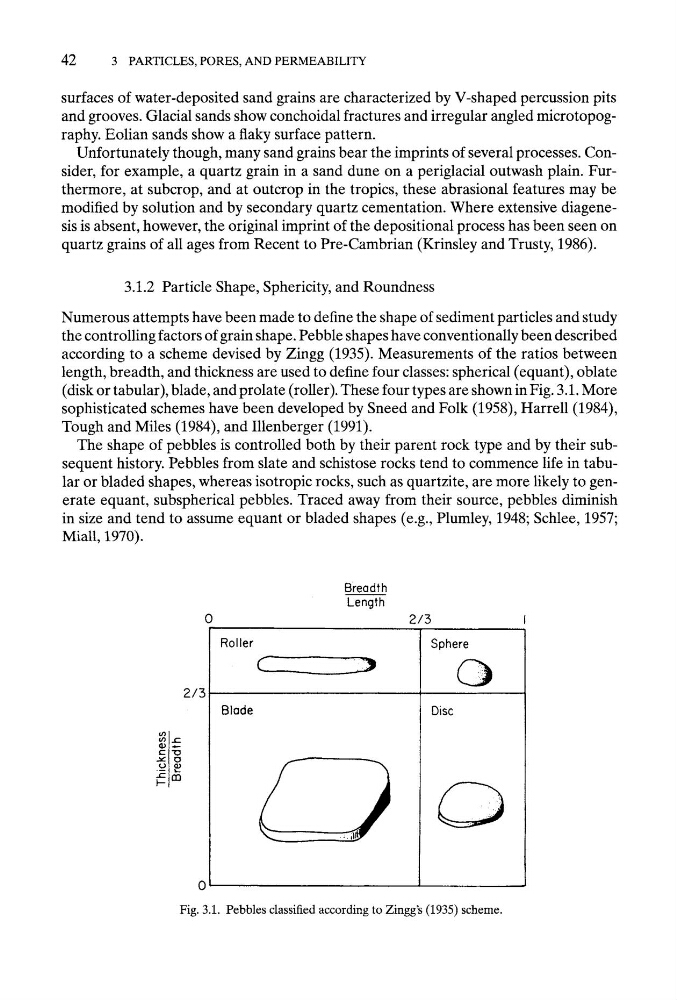
according to a scheme devised by Zingg (1935). Measurements of the ratios between
length, breadth, and thickness are used to define four classes: spherical (equant), oblate
(disk or tabular), blade, and prolate (roller). These four types are shown in Fig. 3.1. More
sophisticated schemes have been developed by Sneed and Folk (1958), Harrell (1984),
Tough and Miles (1984), and Illenberger (1991).
The shape of pebbles is controlled both by their parent rock type and by their subsequent history. Pebbles from slate and schistose rocks tend to commence life in tabular or bladed shapes, whereas isotropic rocks, such as quartzite, are more likely to generate equant, subspherical pebbles. Traced away from their source, pebbles diminish
in size and tend to assume equant or bladed shapes (e.g., Plumley, 1948; Schlee, 1957;
Miall, 1970).
t",-- m
FBreadth
2/3 ,,
0
Length
0
2/5
C
T ..~
Roller
Blade
Sphere
0
Disc
Fig. 3.1. Pebbles classified according to Zingg's (1935) scheme.
3 PARTICLES, PORES, AND PERMEABILITY
surfaces of water-deposited sand grains are characterized by V-shaped percussion pits
and grooves. Glacial sands show conchoidal fractures and irregular angled microtopography. Eolian sands show a flaky surface pattern.
Unfortunately though, many sand grains bear the imprints of several processes. Consider, for example, a quartz grain in a sand dune on a periglacial outwash plain. Furthermore, at subcrop, and at outcrop in the tropics, these abrasional features may be
modified by solution and by secondary quartz cementation. Where extensive diagenesis is absent, however, the original imprint of the depositional process has been seen on
quartz grains of all ages from Recent to Pre-Cambrian (Krinsley and Trusty, 1986).
3.1.2 Particle Shape, Sphericity, and Roundness
Numerous attempts have been made to define the shape of sediment particles and study
the controlling factors of grain shape. Pebble shapes have conventionally been described
according to a scheme devised by Zingg (1935). Measurements of the ratios between
length, breadth, and thickness are used to define four classes: spherical (equant), oblate
(disk or tabular), blade, and prolate (roller). These four types are shown in Fig. 3.1. More
sophisticated schemes have been developed by Sneed and Folk (1958), Harrell (1984),
Tough and Miles (1984), and Illenberger (1991).
The shape of pebbles is controlled both by their parent rock type and by their subsequent history. Pebbles from slate and schistose rocks tend to commence life in tabular or bladed shapes, whereas isotropic rocks, such as quartzite, are more likely to generate equant, subspherical pebbles. Traced away from their source, pebbles diminish
in size and tend to assume equant or bladed shapes (e.g., Plumley, 1948; Schlee, 1957;
Miall, 1970).
t",-- m
FBreadth
2/3 ,,
0
Length
0
2/5
C
T ..~
Roller
Blade
Sphere
0
Disc
Fig. 3.1. Pebbles classified according to Zingg's (1935) scheme.