

10.2 SEDIMENTARY BASINS CLASSIFIED AND DESCRIBED
493
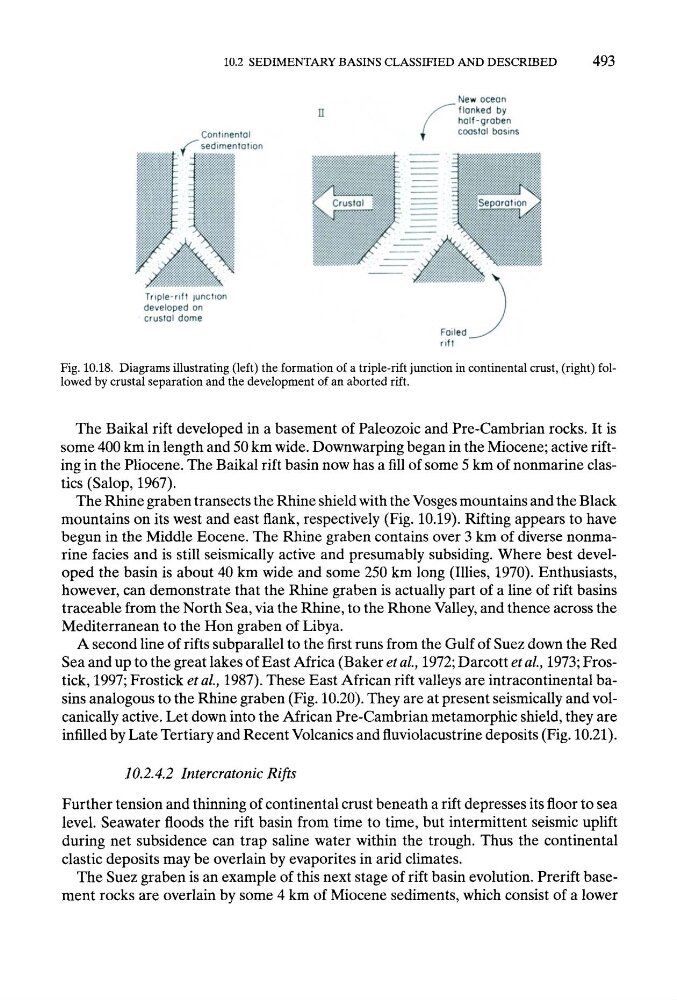
Fig. 10.18. Diagrams illustrating (left) the formation of a triple-rift junction in continental crust, (right) followed by crustal separation and the development of an aborted rift.
The Baikal rift developed in a basement of Paleozoic and Pre-Cambrian rocks. It is
some 400 km in length and 50 km wide. Downwarping began in the Miocene; active rifting in the Pliocene. The Baikal rift basin now has a fill of some 5 km of nonmarine clastics (Salop, 1967).
The Rhine graben transects the Rhine shield with the Vosges mountains and the Black
mountains on its west and east flank, respectively (Fig. 10.19). Rifting appears to have
begun in the Middle Eocene. The Rhine graben contains over 3 km of diverse nonmarine facies and is still seismically active and presumably subsiding. Where best developed the basin is about 40 km wide and some 250 km long (Illies, 1970). Enthusiasts,
however, can demonstrate that the Rhine graben is actually part of a line of rift basins
traceable from the North Sea, via the Rhine, to the Rhone Valley, and thence across the
Mediterranean to the Hon graben of Libya.
A second line of rifts subparallel to the first runs from the Gulf of Suez down the Red
Sea and up to the great lakes of East Africa (Baker et al., 1972; Darcott et al., 1973; Frostick, 1997; Frostick et al., 1987). These East African rift valleys are intracontinental basins analogous to the Rhine graben (Fig. 10.20). They are at present seismically and volcanically active. Let down into the African Pre-Cambrian metamorphic shield, they are
infilled by Late Tertiary and Recent Volcanics and fluviolacustrine deposits (Fig. 10.21).
10.2.4.2 Intercratonic Riffs
Further tension and thinning of continental crust beneath a rift depresses its floor to sea
level. Seawater floods the rift basin from time to time, but intermittent seismic uplift
during net subsidence can trap saline water within the trough. Thus the continental
clastic deposits may be overlain by evaporites in arid climates.
The Suez graben is an example of this next stage of rift basin evolution. Prerift basement rocks are overlain by some 4 km of Miocene sediments, which consist of a lower
493
Fig. 10.18. Diagrams illustrating (left) the formation of a triple-rift junction in continental crust, (right) followed by crustal separation and the development of an aborted rift.
The Baikal rift developed in a basement of Paleozoic and Pre-Cambrian rocks. It is
some 400 km in length and 50 km wide. Downwarping began in the Miocene; active rifting in the Pliocene. The Baikal rift basin now has a fill of some 5 km of nonmarine clastics (Salop, 1967).
The Rhine graben transects the Rhine shield with the Vosges mountains and the Black
mountains on its west and east flank, respectively (Fig. 10.19). Rifting appears to have
begun in the Middle Eocene. The Rhine graben contains over 3 km of diverse nonmarine facies and is still seismically active and presumably subsiding. Where best developed the basin is about 40 km wide and some 250 km long (Illies, 1970). Enthusiasts,
however, can demonstrate that the Rhine graben is actually part of a line of rift basins
traceable from the North Sea, via the Rhine, to the Rhone Valley, and thence across the
Mediterranean to the Hon graben of Libya.
A second line of rifts subparallel to the first runs from the Gulf of Suez down the Red
Sea and up to the great lakes of East Africa (Baker et al., 1972; Darcott et al., 1973; Frostick, 1997; Frostick et al., 1987). These East African rift valleys are intracontinental basins analogous to the Rhine graben (Fig. 10.20). They are at present seismically and volcanically active. Let down into the African Pre-Cambrian metamorphic shield, they are
infilled by Late Tertiary and Recent Volcanics and fluviolacustrine deposits (Fig. 10.21).
10.2.4.2 Intercratonic Riffs
Further tension and thinning of continental crust beneath a rift depresses its floor to sea
level. Seawater floods the rift basin from time to time, but intermittent seismic uplift
during net subsidence can trap saline water within the trough. Thus the continental
clastic deposits may be overlain by evaporites in arid climates.
The Suez graben is an example of this next stage of rift basin evolution. Prerift basement rocks are overlain by some 4 km of Miocene sediments, which consist of a lower