

10.2 SEDIMENTARY BASINS CLASSIFIED AND DESCRIBED
487
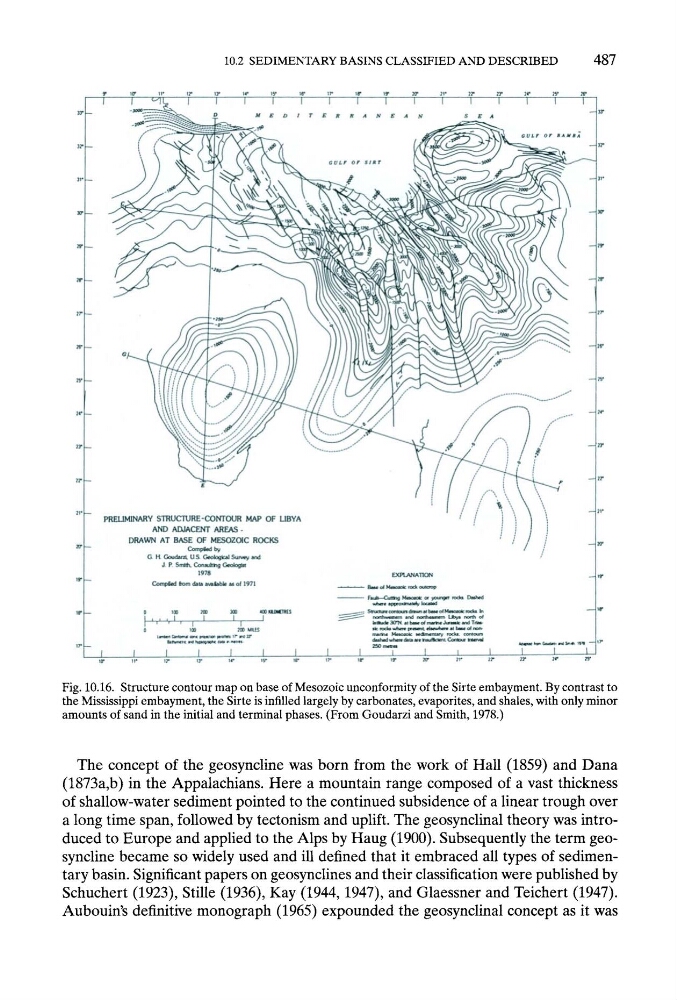
Fig. 10.16. Structure contour map on base of Mesozoic unconformity of the Sirte embayment. By contrast to
the Mississippi embayment, the Sirte is infilled largely by carbonates, evaporites, and shales, with only minor
amounts of sand in the initial and terminal phases. (From Goudarzi and Smith, 1978.)
The concept of the geosyncline was born from the work of Hall (1859) and Dana
(1873a,b) in the Appalachians. Here a mountain range composed of a vast thickness
of shallow-water sediment pointed to the continued subsidence of a linear trough over
a long time span, followed by tectonism and uplift. The geosynclinal theory was introduced to Europe and applied to the Alps by Haug (1900). Subsequently the term geosyncline became so widely used and ill defined that it embraced all types of sedimentary basin. Significant papers on geosynclines and their classification were published by
Schuchert (1923), Stille (1936), Kay (1944, 1947), and Glaessner and Teichert (1947).
Aubouin's definitive monograph (1965) expounded the geosynclinal concept as it was
487
Fig. 10.16. Structure contour map on base of Mesozoic unconformity of the Sirte embayment. By contrast to
the Mississippi embayment, the Sirte is infilled largely by carbonates, evaporites, and shales, with only minor
amounts of sand in the initial and terminal phases. (From Goudarzi and Smith, 1978.)
The concept of the geosyncline was born from the work of Hall (1859) and Dana
(1873a,b) in the Appalachians. Here a mountain range composed of a vast thickness
of shallow-water sediment pointed to the continued subsidence of a linear trough over
a long time span, followed by tectonism and uplift. The geosynclinal theory was introduced to Europe and applied to the Alps by Haug (1900). Subsequently the term geosyncline became so widely used and ill defined that it embraced all types of sedimentary basin. Significant papers on geosynclines and their classification were published by
Schuchert (1923), Stille (1936), Kay (1944, 1947), and Glaessner and Teichert (1947).
Aubouin's definitive monograph (1965) expounded the geosynclinal concept as it was