

486
10 SEDIMENTARY BASINS
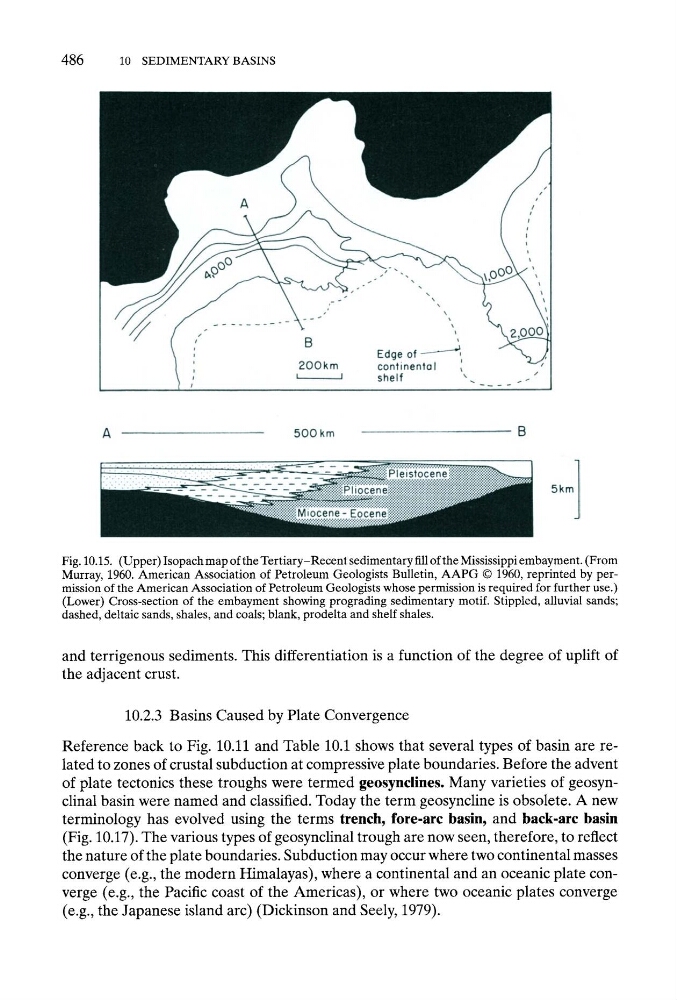
Fig. 10.15. (Upper) Isopach map of the Tertiary-Recent sedimentary fill of the Mississippi embayment. (From
Murray, 1960. American Association of Petroleum Geologists Bulletin, AAPG 9 1960, reprinted by permission of the American Association of Petroleum Geologists whose permission is required for further use.)
(Lower) Cross-section of the embayment showing prograding sedimentary motif. Stippled, alluvial sands;
dashed, deltaic sands, shales, and coals; blank, prodelta and shelf shales.
and terrigenous sediments. This differentiation is a function of the degree of uplift of
the adjacent crust.
10.2.3 Basins Caused by Plate Convergence
Reference back to Fig. 10.11 and Table 10.1 shows that several types of basin are related to zones of crustal subduction at compressive plate boundaries. Before the advent
of plate tectonics these troughs were termed geosyndines. Many varieties of geosynclinal basin were named and classified. Today the term geosyncline is obsolete. A new
terminology has evolved using the terms trench, fore-arc basin, and back-arc basin
(Fig. 10.17). The various types of geosynclinal trough are now seen, therefore, to reflect
the nature of the plate boundaries. Subduction may occur where two continental masses
converge (e.g., the modern Himalayas), where a continental and an oceanic plate converge (e.g., the Pacific coast of the Americas), or where two oceanic plates converge
(e.g., the Japanese island arc) (Dickinson and Seely, 1979).
10 SEDIMENTARY BASINS
Fig. 10.15. (Upper) Isopach map of the Tertiary-Recent sedimentary fill of the Mississippi embayment. (From
Murray, 1960. American Association of Petroleum Geologists Bulletin, AAPG 9 1960, reprinted by permission of the American Association of Petroleum Geologists whose permission is required for further use.)
(Lower) Cross-section of the embayment showing prograding sedimentary motif. Stippled, alluvial sands;
dashed, deltaic sands, shales, and coals; blank, prodelta and shelf shales.
and terrigenous sediments. This differentiation is a function of the degree of uplift of
the adjacent crust.
10.2.3 Basins Caused by Plate Convergence
Reference back to Fig. 10.11 and Table 10.1 shows that several types of basin are related to zones of crustal subduction at compressive plate boundaries. Before the advent
of plate tectonics these troughs were termed geosyndines. Many varieties of geosynclinal basin were named and classified. Today the term geosyncline is obsolete. A new
terminology has evolved using the terms trench, fore-arc basin, and back-arc basin
(Fig. 10.17). The various types of geosynclinal trough are now seen, therefore, to reflect
the nature of the plate boundaries. Subduction may occur where two continental masses
converge (e.g., the modern Himalayas), where a continental and an oceanic plate converge (e.g., the Pacific coast of the Americas), or where two oceanic plates converge
(e.g., the Japanese island arc) (Dickinson and Seely, 1979).