

474
10 SEDIMENTARY BASINS
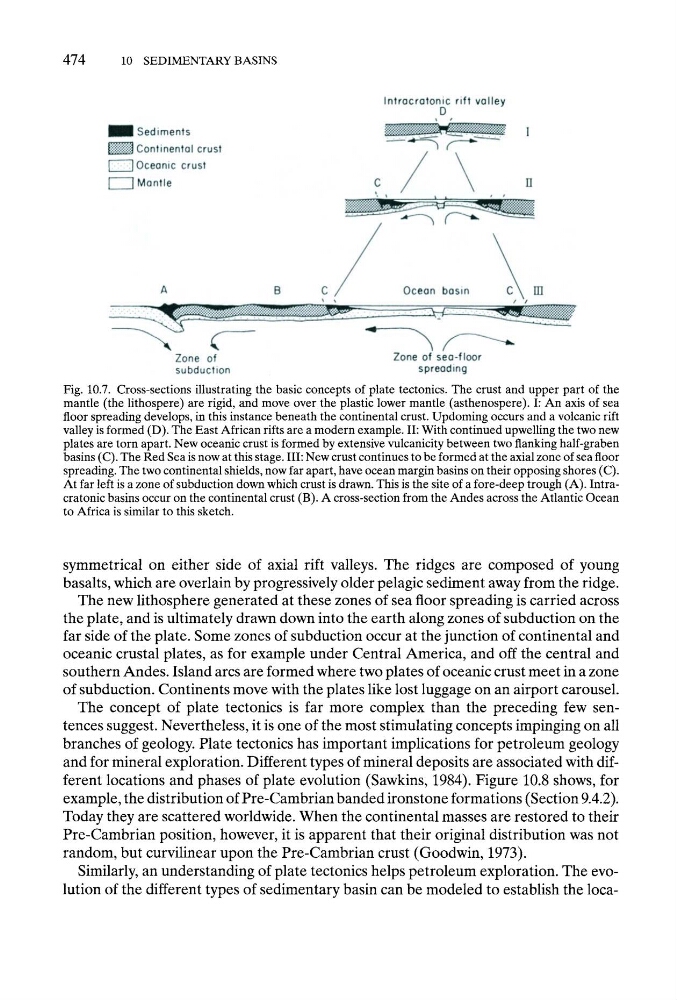
Fig. 10.7. Cross-sections illustrating the basic concepts of plate tectonics. The crust and upper part of the
mantle (the lithospere) are rigid, and move over the plastic lower mantle (asthenospere). I: An axis of sea
floor spreading develops, in this instance beneath the continental crust. Updoming occurs and a volcanic rift
valley is formed (D). The East African rifts are a modern example. II: With continued upwelling the two new
plates are torn apart. New oceanic crust is formed by extensive vulcanicity between two flanking half-graben
basins (C). The Red Sea is now at this stage. III: New crust continues to be formed at the axial zone of sea floor
spreading. The two continental shields, now far apart, have ocean margin basins on their opposing shores (C).
At far left is a zone of subduction down which crust is drawn. This is the site of a fore-deep trough (A). Intracratonic basins occur on the continental crust (B). A cross-section from the Andes across the Atlantic Ocean
to Africa is similar to this sketch.
symmetrical on either side of axial rift valleys. The ridges are c o m p o s e d of young
basalts, which are overlain by progressively older pelagic sediment away from the ridge.
The new lithosphere g e n e r a t e d at these zones of sea floor spreading is carried across
the plate, and is ultimately drawn down into the earth along zones of subduction on the
far side of the plate. S o m e zones of subduction occur at the junction of continental and
oceanic crustal plates, as for example u n d e r Central A m e r i c a , and off the central and
s o u t h e r n Andes. Island arcs are f o r m e d w h e r e two plates of oceanic crust m e e t in a zone
of subduction. C o n t i n e n t s move with the plates like lost luggage on an airport carousel.
The concept of plate tectonics is far m o r e complex than the preceding few sentences suggest. Nevertheless, it is one of the most stimulating concepts impinging on all
branches of geology. Plate tectonics has i m p o r t a n t implications for p e t r o l e u m geology
and for mineral exploration. Different types of mineral deposits are associated with different locations and phases of plate evolution (Sawkins, 1984). Figure 10.8 shows, for
example, the distribution of P r e - C a m b r i a n b a n d e d ironstone f o r m a t i o n s (Section 9.4.2).
Today they are scattered worldwide. W h e n the continental masses are restored to their
P r e - C a m b r i a n position, however, it is a p p a r e n t that their original distribution was not
r a n d o m , but curvilinear u p o n the P r e - C a m b r i a n crust ( G o o d w i n , 1973).
Similarly, an u n d e r s t a n d i n g of plate tectonics helps p e t r o l e u m exploration. The evolution of the different types of s e d i m e n t a r y basin can be m o d e l e d to establish the loca-
10 SEDIMENTARY BASINS
Fig. 10.7. Cross-sections illustrating the basic concepts of plate tectonics. The crust and upper part of the
mantle (the lithospere) are rigid, and move over the plastic lower mantle (asthenospere). I: An axis of sea
floor spreading develops, in this instance beneath the continental crust. Updoming occurs and a volcanic rift
valley is formed (D). The East African rifts are a modern example. II: With continued upwelling the two new
plates are torn apart. New oceanic crust is formed by extensive vulcanicity between two flanking half-graben
basins (C). The Red Sea is now at this stage. III: New crust continues to be formed at the axial zone of sea floor
spreading. The two continental shields, now far apart, have ocean margin basins on their opposing shores (C).
At far left is a zone of subduction down which crust is drawn. This is the site of a fore-deep trough (A). Intracratonic basins occur on the continental crust (B). A cross-section from the Andes across the Atlantic Ocean
to Africa is similar to this sketch.
symmetrical on either side of axial rift valleys. The ridges are c o m p o s e d of young
basalts, which are overlain by progressively older pelagic sediment away from the ridge.
The new lithosphere g e n e r a t e d at these zones of sea floor spreading is carried across
the plate, and is ultimately drawn down into the earth along zones of subduction on the
far side of the plate. S o m e zones of subduction occur at the junction of continental and
oceanic crustal plates, as for example u n d e r Central A m e r i c a , and off the central and
s o u t h e r n Andes. Island arcs are f o r m e d w h e r e two plates of oceanic crust m e e t in a zone
of subduction. C o n t i n e n t s move with the plates like lost luggage on an airport carousel.
The concept of plate tectonics is far m o r e complex than the preceding few sentences suggest. Nevertheless, it is one of the most stimulating concepts impinging on all
branches of geology. Plate tectonics has i m p o r t a n t implications for p e t r o l e u m geology
and for mineral exploration. Different types of mineral deposits are associated with different locations and phases of plate evolution (Sawkins, 1984). Figure 10.8 shows, for
example, the distribution of P r e - C a m b r i a n b a n d e d ironstone f o r m a t i o n s (Section 9.4.2).
Today they are scattered worldwide. W h e n the continental masses are restored to their
P r e - C a m b r i a n position, however, it is a p p a r e n t that their original distribution was not
r a n d o m , but curvilinear u p o n the P r e - C a m b r i a n crust ( G o o d w i n , 1973).
Similarly, an u n d e r s t a n d i n g of plate tectonics helps p e t r o l e u m exploration. The evolution of the different types of s e d i m e n t a r y basin can be m o d e l e d to establish the loca-