

10.1 INTRODUCTION
473
J
s
PACIFIC
PLATE
PLATE
AMERICAS
PLATE
AFRICAN
PLATE
EURASIAN
PLATE
INDIAN
~OCEAN
PLATE
Zones of
subducllon
---0---0- zo0es of
~ \
sea- floor spreading ~,
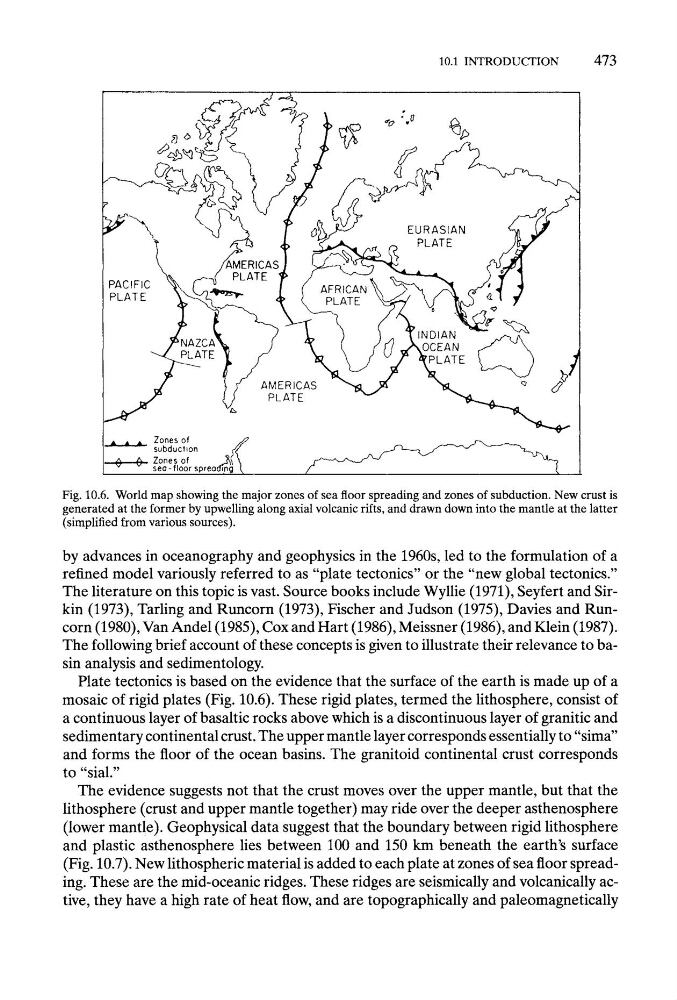
Fig. 10.6. World map showing the major zones of sea floor spreading and zones of subduction. New crust is
generated at the former by upwelling along axial volcanic rifts, and drawn down into the mantle at the latter
(simplified from various sources).
by advances in oceanography and geophysics in the 1960s, led to the formulation of a
refined model variously referred to as "plate tectonics" or the "new global tectonics."
The literature on this topic is vast. Source books include Wyllie (1971), Seyfert and Sirkin (1973), Tarling and Runcorn (1973), Fischer and Judson (1975), Davies and Runcorn (1980), Van Andel (1985), Cox and Hart (1986), Meissner (1986), and Klein (1987).
The following brief account of these concepts is given to illustrate their relevance to basin analysis and sedimentology.
Plate tectonics is based on the evidence that the surface of the earth is made up of a
mosaic of rigid plates (Fig. 10.6). These rigid plates, termed the lithosphere, consist of
a continuous layer of basaltic rocks above which is a discontinuous layer of granitic and
sedimentary continental crust. The upper mantle layer corresponds essentially to "sima"
and forms the floor of the ocean basins. The granitoid continental crust corresponds
to "sial."
The evidence suggests not that the crust moves over the upper mantle, but that the
lithosphere (crust and upper mantle together) may ride over the deeper asthenosphere
(lower mantle). Geophysical data suggest that the boundary between rigid lithosphere
and plastic asthenosphere lies between 100 and 150 km beneath the earth's surface
(Fig. 10.7). New lithospheric material is added to each plate at zones of sea floor spreading. These are the mid-oceanic ridges. These ridges are seismically and volcanically active, they have a high rate of heat flow, and are topographically and paleomagnetically
473
J
s
PACIFIC
PLATE
PLATE
AMERICAS
PLATE
AFRICAN
PLATE
EURASIAN
PLATE
INDIAN
~OCEAN
PLATE
Zones of
subducllon
---0---0- zo0es of
~ \
sea- floor spreading ~,
Fig. 10.6. World map showing the major zones of sea floor spreading and zones of subduction. New crust is
generated at the former by upwelling along axial volcanic rifts, and drawn down into the mantle at the latter
(simplified from various sources).
by advances in oceanography and geophysics in the 1960s, led to the formulation of a
refined model variously referred to as "plate tectonics" or the "new global tectonics."
The literature on this topic is vast. Source books include Wyllie (1971), Seyfert and Sirkin (1973), Tarling and Runcorn (1973), Fischer and Judson (1975), Davies and Runcorn (1980), Van Andel (1985), Cox and Hart (1986), Meissner (1986), and Klein (1987).
The following brief account of these concepts is given to illustrate their relevance to basin analysis and sedimentology.
Plate tectonics is based on the evidence that the surface of the earth is made up of a
mosaic of rigid plates (Fig. 10.6). These rigid plates, termed the lithosphere, consist of
a continuous layer of basaltic rocks above which is a discontinuous layer of granitic and
sedimentary continental crust. The upper mantle layer corresponds essentially to "sima"
and forms the floor of the ocean basins. The granitoid continental crust corresponds
to "sial."
The evidence suggests not that the crust moves over the upper mantle, but that the
lithosphere (crust and upper mantle together) may ride over the deeper asthenosphere
(lower mantle). Geophysical data suggest that the boundary between rigid lithosphere
and plastic asthenosphere lies between 100 and 150 km beneath the earth's surface
(Fig. 10.7). New lithospheric material is added to each plate at zones of sea floor spreading. These are the mid-oceanic ridges. These ridges are seismically and volcanically active, they have a high rate of heat flow, and are topographically and paleomagnetically