

10.1 INTRODUCTION
469
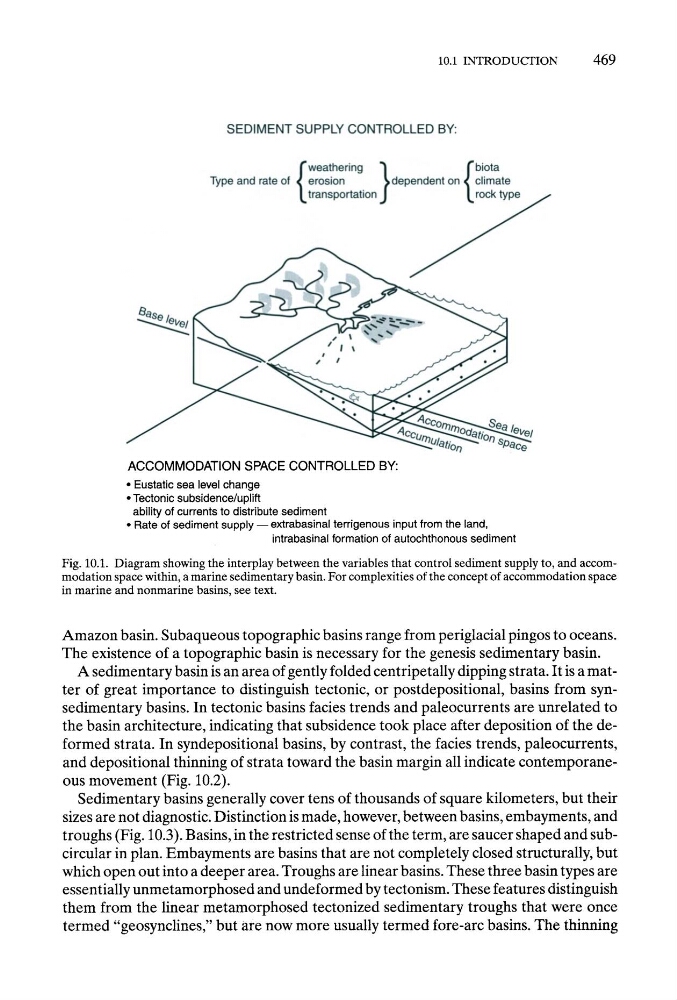
A C C O M M O D A T I O N SPACE C O N T R O L L E D BY:
9 Eustatic sea level change
9 Tectonic subsidence/uplift
ability of currents to distribute sediment
9 Rate of sediment supply m extrabasinal terrigenous input from the land,
intrabasinal formation of autochthonous sediment
Fig. 10.1. Diagram showing the interplay between the variables that control sediment supply to, and accommodation space within, a marine sedimentary basin. For complexities of the concept of accommodation space
in marine and nonmarine basins, see text.
Amazon basin. Subaqueous topographic basins range from periglacial pingos to oceans.
The existence of a topographic basin is necessary for the genesis sedimentary basin.
A sedimentary basin is an area of gently folded centripetally dipping strata. It is a matter of great importance to distinguish tectonic, or postdepositional, basins from synsedimentary basins. In tectonic basins facies trends and paleocurrents are unrelated to
the basin architecture, indicating that subsidence took place after deposition of the deformed strata. In syndepositional basins, by contrast, the facies trends, paleocurrents,
and depositional thinning of strata toward the basin margin all indicate contemporaneous movement (Fig. 10.2).
Sedimentary basins generally cover tens of thousands of square kilometers, but their
sizes are not diagnostic. Distinction is made, however, between basins, embayments, and
troughs (Fig. 10.3). Basins, in the restricted sense of the term, are saucer shaped and subcircular in plan. Embayments are basins that are not completely closed structurally, but
which open out into a deeper area. Troughs are linear basins. These three basin types are
essentially unmetamorphosed and undeformed by tectonism. These features distinguish
them from the linear metamorphosed tectonized sedimentary troughs that were once
termed "geosynclines," but are now more usually termed fore-arc basins. The thinning
469
A C C O M M O D A T I O N SPACE C O N T R O L L E D BY:
9 Eustatic sea level change
9 Tectonic subsidence/uplift
ability of currents to distribute sediment
9 Rate of sediment supply m extrabasinal terrigenous input from the land,
intrabasinal formation of autochthonous sediment
Fig. 10.1. Diagram showing the interplay between the variables that control sediment supply to, and accommodation space within, a marine sedimentary basin. For complexities of the concept of accommodation space
in marine and nonmarine basins, see text.
Amazon basin. Subaqueous topographic basins range from periglacial pingos to oceans.
The existence of a topographic basin is necessary for the genesis sedimentary basin.
A sedimentary basin is an area of gently folded centripetally dipping strata. It is a matter of great importance to distinguish tectonic, or postdepositional, basins from synsedimentary basins. In tectonic basins facies trends and paleocurrents are unrelated to
the basin architecture, indicating that subsidence took place after deposition of the deformed strata. In syndepositional basins, by contrast, the facies trends, paleocurrents,
and depositional thinning of strata toward the basin margin all indicate contemporaneous movement (Fig. 10.2).
Sedimentary basins generally cover tens of thousands of square kilometers, but their
sizes are not diagnostic. Distinction is made, however, between basins, embayments, and
troughs (Fig. 10.3). Basins, in the restricted sense of the term, are saucer shaped and subcircular in plan. Embayments are basins that are not completely closed structurally, but
which open out into a deeper area. Troughs are linear basins. These three basin types are
essentially unmetamorphosed and undeformed by tectonism. These features distinguish
them from the linear metamorphosed tectonized sedimentary troughs that were once
termed "geosynclines," but are now more usually termed fore-arc basins. The thinning