

36
2 WEATHERING AND THE SEDIMENTARY CYCLE
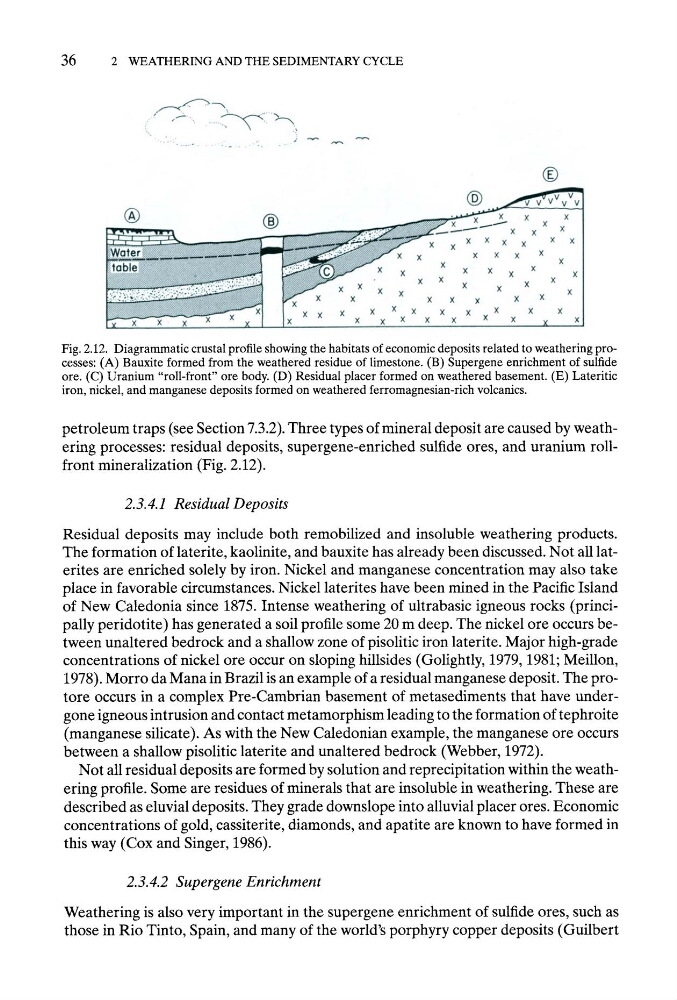
Fig. 2.12. Diagrammatic crustal profile showing the habitats of economic deposits related to weathering processes: (A) Bauxite formed from the weathered residue of limestone. (B) Supergene enrichment of sulfide
ore. (C) Uranium "roll-front" ore body. (D) Residual placer formed on weathered basement. (E) Lateritic
iron, nickel, and manganese deposits formed on weathered ferromagnesian-rich volcanics.
petroleum traps (see Section 7.3.2). Three types of mineral deposit are caused by weathering processes: residual deposits, supergene-enriched sulfide ores, and uranium rollfront mineralization (Fig. 2.12).
2.3.4.1 Residual Deposits
Residual deposits may include both remobilized and insoluble weathering products.
The formation of laterite, kaolinite, and bauxite has already been discussed. Not all laterites are enriched solely by iron. Nickel and manganese concentration may also take
place in favorable circumstances. Nickel laterites have been mined in the Pacific Island
of New Caledonia since 1875. Intense weathering of ultrabasic igneous rocks (principally peridotite) has generated a soil profile some 20 m deep. The nickel ore occurs between unaltered bedrock and a shallow zone of pisolitic iron laterite. Major high-grade
concentrations of nickel ore occur on sloping hillsides (Golightly, 1979, 1981; Meillon,
1978). Morro da Mana in Brazil is an example of a residual manganese deposit. The protore occurs in a complex Pre-Cambrian basement of metasediments that have undergone igneous intrusion and contact metamorphism leading to the formation of tephroite
(manganese silicate). As with the New Caledonian example, the manganese ore occurs
between a shallow pisolitic laterite and unaltered bedrock (Webber, 1972).
Not all residual deposits are formed by solution and reprecipitation within the weathering profile. Some are residues of minerals that are insoluble in weathering. These are
described as eluvial deposits. They grade downslope into alluvial placer ores. Economic
concentrations of gold, cassiterite, diamonds, and apatite are known to have formed in
this way (Cox and Singer, 1986).
2.3.4.2 Supergene Enrichment
Weathering is also very important in the supergene enrichment of sulfide ores, such as
those in Rio Tinto, Spain, and many of the world's porphyry copper deposits (Guilbert
2 WEATHERING AND THE SEDIMENTARY CYCLE
Fig. 2.12. Diagrammatic crustal profile showing the habitats of economic deposits related to weathering processes: (A) Bauxite formed from the weathered residue of limestone. (B) Supergene enrichment of sulfide
ore. (C) Uranium "roll-front" ore body. (D) Residual placer formed on weathered basement. (E) Lateritic
iron, nickel, and manganese deposits formed on weathered ferromagnesian-rich volcanics.
petroleum traps (see Section 7.3.2). Three types of mineral deposit are caused by weathering processes: residual deposits, supergene-enriched sulfide ores, and uranium rollfront mineralization (Fig. 2.12).
2.3.4.1 Residual Deposits
Residual deposits may include both remobilized and insoluble weathering products.
The formation of laterite, kaolinite, and bauxite has already been discussed. Not all laterites are enriched solely by iron. Nickel and manganese concentration may also take
place in favorable circumstances. Nickel laterites have been mined in the Pacific Island
of New Caledonia since 1875. Intense weathering of ultrabasic igneous rocks (principally peridotite) has generated a soil profile some 20 m deep. The nickel ore occurs between unaltered bedrock and a shallow zone of pisolitic iron laterite. Major high-grade
concentrations of nickel ore occur on sloping hillsides (Golightly, 1979, 1981; Meillon,
1978). Morro da Mana in Brazil is an example of a residual manganese deposit. The protore occurs in a complex Pre-Cambrian basement of metasediments that have undergone igneous intrusion and contact metamorphism leading to the formation of tephroite
(manganese silicate). As with the New Caledonian example, the manganese ore occurs
between a shallow pisolitic laterite and unaltered bedrock (Webber, 1972).
Not all residual deposits are formed by solution and reprecipitation within the weathering profile. Some are residues of minerals that are insoluble in weathering. These are
described as eluvial deposits. They grade downslope into alluvial placer ores. Economic
concentrations of gold, cassiterite, diamonds, and apatite are known to have formed in
this way (Cox and Singer, 1986).
2.3.4.2 Supergene Enrichment
Weathering is also very important in the supergene enrichment of sulfide ores, such as
those in Rio Tinto, Spain, and many of the world's porphyry copper deposits (Guilbert