

2.3 WEATHERING
35
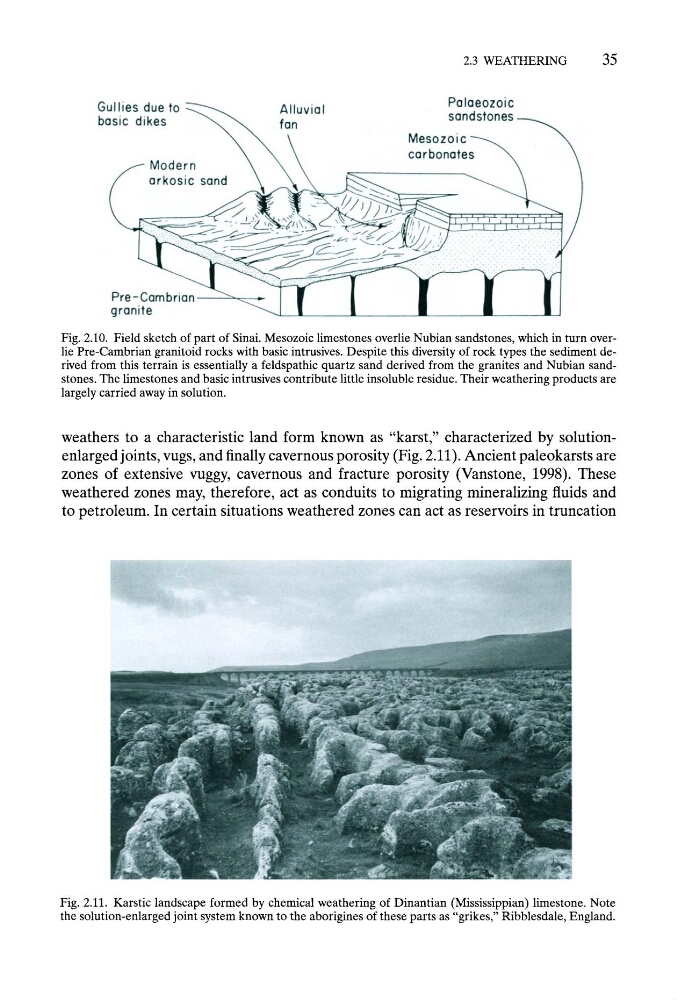
Fig. 2.10. Field sketch of part of Sinai. Mesozoic limestones overlie Nubian sandstones, which in turn overlie Pre-Cambrian granitoid rocks with basic intrusives. Despite this diversity of rock types the sediment derived from this terrain is essentially a feldspathic quartz sand derived from the granites and Nubian sandstones. The limestones and basic intrusives contribute little insoluble residue. Their weathering products are
largely carried away in solution.
weathers to a characteristic land form known as "karst," characterized by solutionenlarged joints, rugs, and finally cavernous porosity (Fig. 2.11). Ancient paleokarsts are
zones of extensive vuggy, cavernous and fracture porosity (Vanstone, 1998). These
weathered zones may, therefore, act as conduits to migrating mineralizing fluids and
to petroleum. In certain situations weathered zones can act as reservoirs in truncation
Fig. 2.11. Karstic landscape formed by chemical weathering of Dinantian (Mississippian) limestone. Note
the solution-enlarged joint system known to the aborigines of these parts as "grikes," Ribblesdale, England.
35
Fig. 2.10. Field sketch of part of Sinai. Mesozoic limestones overlie Nubian sandstones, which in turn overlie Pre-Cambrian granitoid rocks with basic intrusives. Despite this diversity of rock types the sediment derived from this terrain is essentially a feldspathic quartz sand derived from the granites and Nubian sandstones. The limestones and basic intrusives contribute little insoluble residue. Their weathering products are
largely carried away in solution.
weathers to a characteristic land form known as "karst," characterized by solutionenlarged joints, rugs, and finally cavernous porosity (Fig. 2.11). Ancient paleokarsts are
zones of extensive vuggy, cavernous and fracture porosity (Vanstone, 1998). These
weathered zones may, therefore, act as conduits to migrating mineralizing fluids and
to petroleum. In certain situations weathered zones can act as reservoirs in truncation
Fig. 2.11. Karstic landscape formed by chemical weathering of Dinantian (Mississippian) limestone. Note
the solution-enlarged joint system known to the aborigines of these parts as "grikes," Ribblesdale, England.