

426
9 AUTOCHTHONOUS SEDIMENTS
,,
N \N
N\
~
----P.W.C.
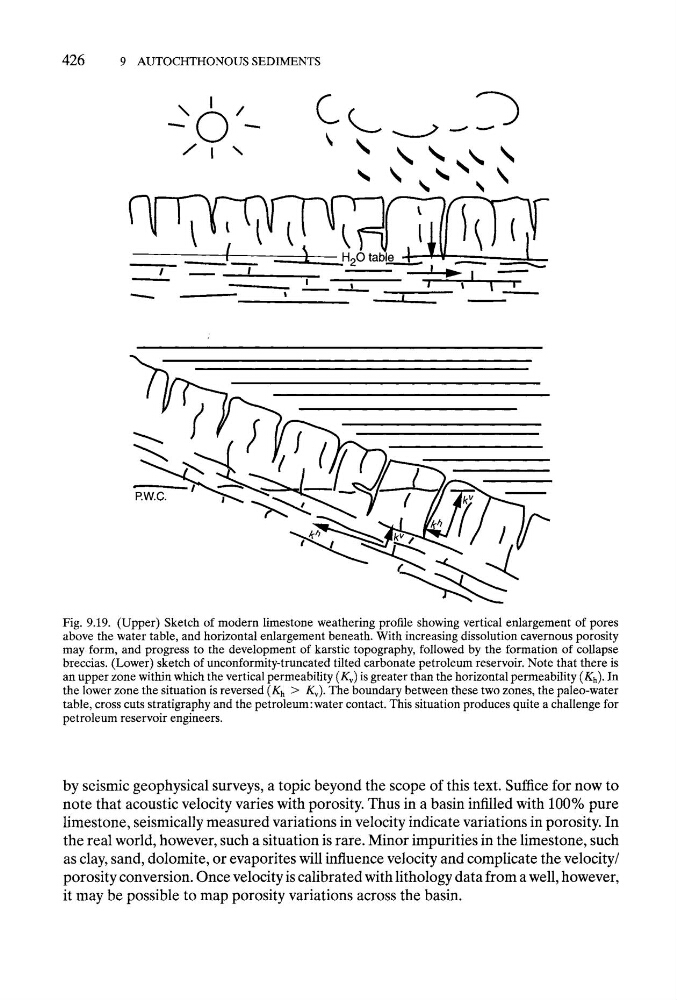
Fig. 9.19. (Upper) Sketch of modern limestone weathering profile showing vertical enlargement of pores
above the water table, and horizontal enlargement beneath. With increasing dissolution cavernous porosity
may form, and progress to the development of karstic topography, followed by the formation of collapse
breccias. (Lower) sketch of unconformity-truncated tilted carbonate petroleum reservoir. Note that there is
an upper zone within which the vertical permeability (Kv) is greater than the horizontal permeability (Kh). In
the lower zone the situation is reversed (Kh > Kv). The boundary between these two zones, the paleo-water
table, cross cuts stratigraphy and the petroleum:water contact. This situation produces quite a challenge for
petroleum reservoir engineers.
by seismic geophysical surveys, a topic beyond the scope of this text. Suffice for now to
note that acoustic velocity varies with porosity. Thus in a basin infilled with 100% pure
limestone, seismically measured variations in velocity indicate variations in porosity. In
the real world, however, such a situation is rare. Minor impurities in the limestone, such
as clay, sand, dolomite, or evaporites will influence velocity and complicate the velocity/
porosity conversion. Once velocity is calibrated with lithology data from a well, however,
it may be possible to map porosity variations across the basin.
9 AUTOCHTHONOUS SEDIMENTS
,,
N \N
N\
~
----P.W.C.
Fig. 9.19. (Upper) Sketch of modern limestone weathering profile showing vertical enlargement of pores
above the water table, and horizontal enlargement beneath. With increasing dissolution cavernous porosity
may form, and progress to the development of karstic topography, followed by the formation of collapse
breccias. (Lower) sketch of unconformity-truncated tilted carbonate petroleum reservoir. Note that there is
an upper zone within which the vertical permeability (Kv) is greater than the horizontal permeability (Kh). In
the lower zone the situation is reversed (Kh > Kv). The boundary between these two zones, the paleo-water
table, cross cuts stratigraphy and the petroleum:water contact. This situation produces quite a challenge for
petroleum reservoir engineers.
by seismic geophysical surveys, a topic beyond the scope of this text. Suffice for now to
note that acoustic velocity varies with porosity. Thus in a basin infilled with 100% pure
limestone, seismically measured variations in velocity indicate variations in porosity. In
the real world, however, such a situation is rare. Minor impurities in the limestone, such
as clay, sand, dolomite, or evaporites will influence velocity and complicate the velocity/
porosity conversion. Once velocity is calibrated with lithology data from a well, however,
it may be possible to map porosity variations across the basin.