

9.2 CARBONATES
425
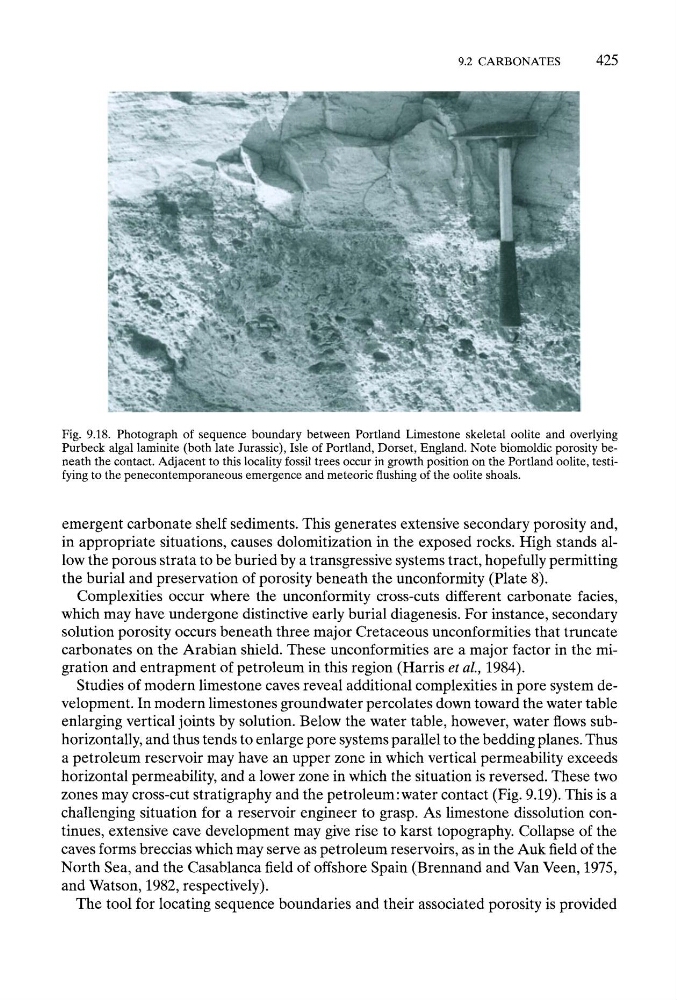
Fig. 9.18. Photograph of sequence boundary between Portland Limestone skeletal oolite and overlying
Purbeck algal laminite (both late Jurassic), Isle of Portland, Dorset, England. Note biomoldic porosity beneath the contact. Adjacent to this locality fossil trees occur in growth position on the Portland oolite, testifying to the penecontemporaneous emergence and meteoric flushing of the oolite shoals.
emergent carbonate shelf sediments. This generates extensive secondary porosity and,
in appropriate situations, causes dolomitization in the exposed rocks. High stands allow the porous strata to be buried by a transgressive systems tract, hopefully permitting
the burial and preservation of porosity beneath the unconformity (Plate 8).
Complexities occur where the unconformity cross-cuts different carbonate facies,
which may have undergone distinctive early burial diagenesis. For instance, secondary
solution porosity occurs beneath three major Cretaceous unconformities that truncate
carbonates on the Arabian shield. These unconformities are a major factor in the migration and entrapment of petroleum in this region (Harris et al., 1984).
Studies of modern limestone caves reveal additional complexities in pore system development. In modern limestones groundwater percolates down toward the water table
enlarging vertical joints by solution. Below the water table, however, water flows subhorizontally, and thus tends to enlarge pore systems parallel to the bedding planes. Thus
a petroleum reservoir may have an upper zone in which vertical permeability exceeds
horizontal permeability, and a lower zone in which the situation is reversed. These two
zones may cross-cut stratigraphy and the petroleum:water contact (Fig. 9.19). This is a
challenging situation for a reservoir engineer to grasp. As limestone dissolution continues, extensive cave development may give rise to karst topography. Collapse of the
caves forms breccias which may serve as petroleum reservoirs, as in the Auk field of the
North Sea, and the Casablanca field of offshore Spain (Brennand and Van Veen, 1975,
and Watson, 1982, respectively).
The tool for locating sequence boundaries and their associated porosity is provided
425
Fig. 9.18. Photograph of sequence boundary between Portland Limestone skeletal oolite and overlying
Purbeck algal laminite (both late Jurassic), Isle of Portland, Dorset, England. Note biomoldic porosity beneath the contact. Adjacent to this locality fossil trees occur in growth position on the Portland oolite, testifying to the penecontemporaneous emergence and meteoric flushing of the oolite shoals.
emergent carbonate shelf sediments. This generates extensive secondary porosity and,
in appropriate situations, causes dolomitization in the exposed rocks. High stands allow the porous strata to be buried by a transgressive systems tract, hopefully permitting
the burial and preservation of porosity beneath the unconformity (Plate 8).
Complexities occur where the unconformity cross-cuts different carbonate facies,
which may have undergone distinctive early burial diagenesis. For instance, secondary
solution porosity occurs beneath three major Cretaceous unconformities that truncate
carbonates on the Arabian shield. These unconformities are a major factor in the migration and entrapment of petroleum in this region (Harris et al., 1984).
Studies of modern limestone caves reveal additional complexities in pore system development. In modern limestones groundwater percolates down toward the water table
enlarging vertical joints by solution. Below the water table, however, water flows subhorizontally, and thus tends to enlarge pore systems parallel to the bedding planes. Thus
a petroleum reservoir may have an upper zone in which vertical permeability exceeds
horizontal permeability, and a lower zone in which the situation is reversed. These two
zones may cross-cut stratigraphy and the petroleum:water contact (Fig. 9.19). This is a
challenging situation for a reservoir engineer to grasp. As limestone dissolution continues, extensive cave development may give rise to karst topography. Collapse of the
caves forms breccias which may serve as petroleum reservoirs, as in the Auk field of the
North Sea, and the Casablanca field of offshore Spain (Brennand and Van Veen, 1975,
and Watson, 1982, respectively).
The tool for locating sequence boundaries and their associated porosity is provided