

9.2 CARBONATES
419
described from the Upper Cretaceus chalk of northwest Europe (Jefferies, 1963; Bromley, 1967).
These chalk hardgrounds act as permeability barriers that seal off the underlying sediments, rendering them an essentially closed system, inhibiting the migration of connate
fluids and hence cement precipitation. Diagenesis may be restricted to pressure solution
at coccolith contacts (Scholle et al., 1998).
Thus hardgrounds may play a role in preserving porosity by restricting the extent of
early cementation in the underlying sediment. The presence of hardgrounds within a
limestone formation that is otherwise porous and permeable may cause verticaipermeability barriers within the succession. As such they may influence the migration and
entrapment of oil and affect the reservoir engineering characteristics of the formation
as a whole.
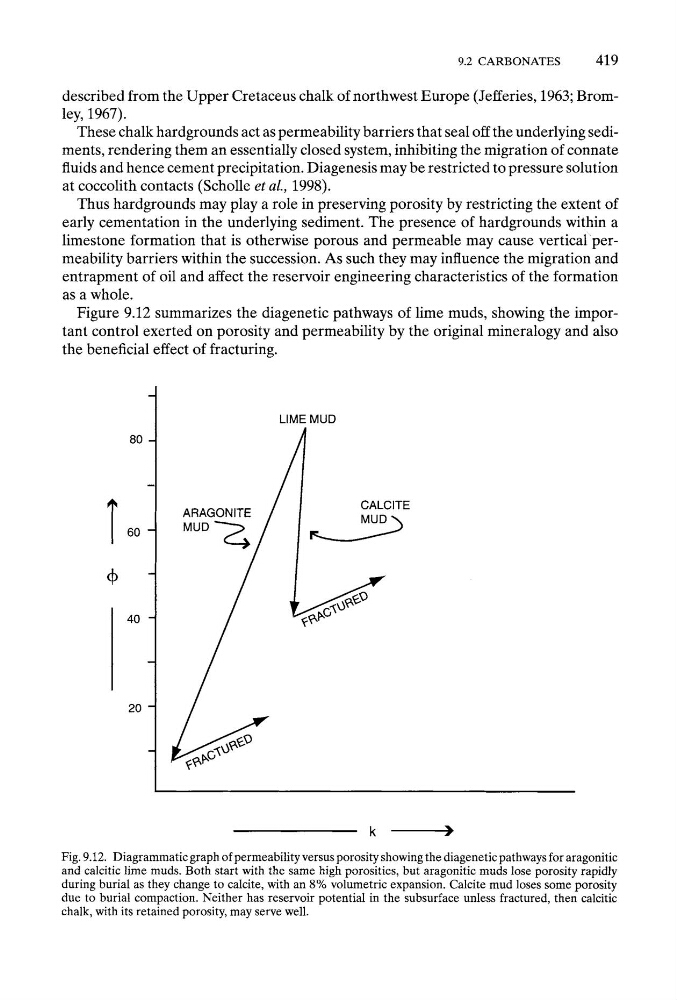
Figure 9.12 summarizes the diagenetic pathways of lime muds, showing the important control exerted on porosity and permeability by the original mineralogy and also
the beneficial effect of fracturing.
T
+
6040
ARAGONITE
MUD
LIME MUD
CALCITE
MUD "~
20k
,~ J
Fig. 9.12. Diagrammatic graph of permeability versus porosity showing the diagenetic pathways for aragonitic
and calcitic lime muds. Both start with the same high porosities, but aragonitic muds lose porosity rapidly
during burial as they change to calcite, with an 8% volumetric expansion. Calcite mud loses some porosity
due to burial compaction. Neither has reservoir potential in the subsurface unless fractured, then calcitic
chalk, with its retained porosity, may serve well.
419
described from the Upper Cretaceus chalk of northwest Europe (Jefferies, 1963; Bromley, 1967).
These chalk hardgrounds act as permeability barriers that seal off the underlying sediments, rendering them an essentially closed system, inhibiting the migration of connate
fluids and hence cement precipitation. Diagenesis may be restricted to pressure solution
at coccolith contacts (Scholle et al., 1998).
Thus hardgrounds may play a role in preserving porosity by restricting the extent of
early cementation in the underlying sediment. The presence of hardgrounds within a
limestone formation that is otherwise porous and permeable may cause verticaipermeability barriers within the succession. As such they may influence the migration and
entrapment of oil and affect the reservoir engineering characteristics of the formation
as a whole.
Figure 9.12 summarizes the diagenetic pathways of lime muds, showing the important control exerted on porosity and permeability by the original mineralogy and also
the beneficial effect of fracturing.
T
+
6040
ARAGONITE
MUD
LIME MUD
CALCITE
MUD "~
20k
,~ J
Fig. 9.12. Diagrammatic graph of permeability versus porosity showing the diagenetic pathways for aragonitic
and calcitic lime muds. Both start with the same high porosities, but aragonitic muds lose porosity rapidly
during burial as they change to calcite, with an 8% volumetric expansion. Calcite mud loses some porosity
due to burial compaction. Neither has reservoir potential in the subsurface unless fractured, then calcitic
chalk, with its retained porosity, may serve well.