

418
9 AUTOCHTHONOUS SEDIMENTS
Evidence for early cementation is provided by the observation that the upper part
of the beds is often extensively affected by the activities of boring organisms, or colonized by organisms such as oysters, which required a rigid substrate on which to attach
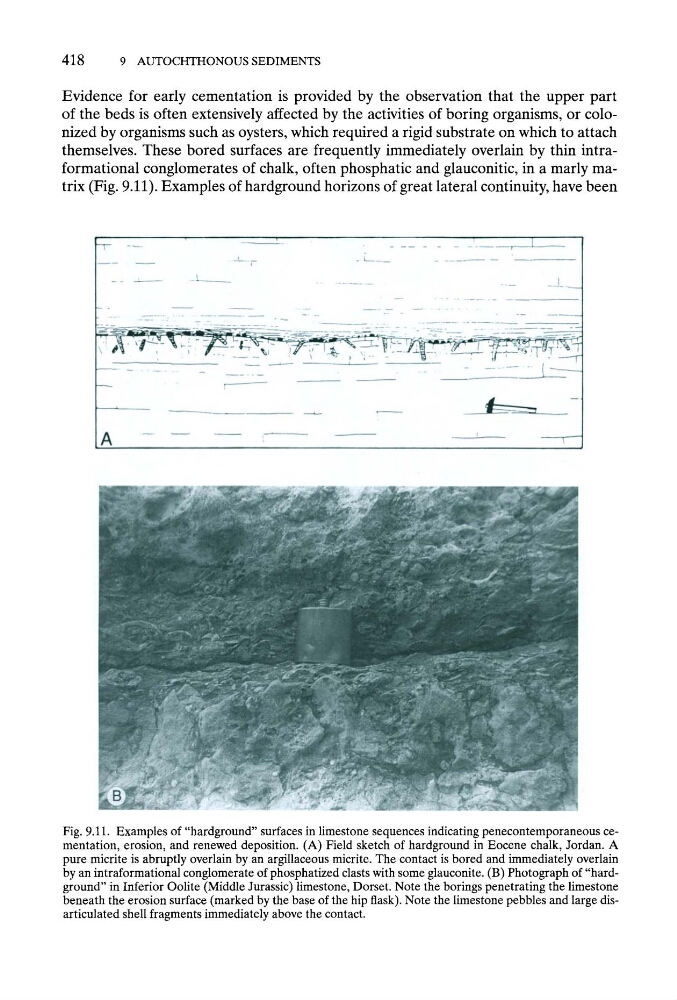
themselves. These bored surfaces are frequently immediately overlain by thin intraformational conglomerates of chalk, often phosphatic and glauconitic, in a marly matrix (Fig. 9.11). Examples of hardground horizons of great lateral continuity, have been
Fig. 9.11. Examples of "hardground" surfaces in limestone sequences indicating penecontemporaneous cementation, erosion, and renewed deposition. (A) Field sketch of hardground in Eocene chalk, Jordan. A
pure micrite is abruptly overlain by an argillaceous micrite. The contact is bored and immediately overlain
by an intraformational conglomerate of phosphatized clasts with some glauconite. (B) Photograph of "hardground" in Inferior Oolite (Middle Jurassic) limestone, Dorset. Note the borings penetrating the limestone
beneath the erosion surface (marked by the base of the hip flask). Note the limestone pebbles and large disarticulated shell fragments immediately above the contact.
9 AUTOCHTHONOUS SEDIMENTS
Evidence for early cementation is provided by the observation that the upper part
of the beds is often extensively affected by the activities of boring organisms, or colonized by organisms such as oysters, which required a rigid substrate on which to attach
themselves. These bored surfaces are frequently immediately overlain by thin intraformational conglomerates of chalk, often phosphatic and glauconitic, in a marly matrix (Fig. 9.11). Examples of hardground horizons of great lateral continuity, have been
Fig. 9.11. Examples of "hardground" surfaces in limestone sequences indicating penecontemporaneous cementation, erosion, and renewed deposition. (A) Field sketch of hardground in Eocene chalk, Jordan. A
pure micrite is abruptly overlain by an argillaceous micrite. The contact is bored and immediately overlain
by an intraformational conglomerate of phosphatized clasts with some glauconite. (B) Photograph of "hardground" in Inferior Oolite (Middle Jurassic) limestone, Dorset. Note the borings penetrating the limestone
beneath the erosion surface (marked by the base of the hip flask). Note the limestone pebbles and large disarticulated shell fragments immediately above the contact.