

32
2 WEATHERING AND THE SEDIMENTARY CYCLE
to be largely composed of quartz (silica) and, depending on the degree of weathering,
of varying amounts of feldspar and mica.
A further important result of chemical weathering is the formation of new minerals,
principally the clays (Wilson, 1999). The mineralogy and deposition of the clays is described in Chapter 8. It is, however, necessary at this point to discuss their formation by
weathering. The clay minerals are a complex group of hydrated aluminosilicates. Their
chemically fairly stable molecular structures scavenge available cations and attach them
to their lattices in various geometric arrangements. The clay minerals are thus classified according to the way in which hydrated aluminosilicate combines with calcium, potassium, magnesium, and iron. During the early stages of weathering the mafic minerals
(olivines, pyroxenes, and amphiboles) break down to form the iron- and magnesiumrich chlorite clays. Simultaneously, weathering of the feldspars produces the smectites,
illites, and kaolinite clays. As weathering progresses the clays are partially flushed out
as colloidal-clay particles, but can also remain to form a residual clay deposit. If weathering continues further still all the magnesium and calcium-bearing minerals are finally
leached out. The ultimate residuum of a maturely weathered rock consists, therefore, of
quartz (if it was abundant in the parent rock), newly formed kaolinite (the purest clay
mineral, composed only of hydrated aluminosilicate), bauxite (hydrated alumina), and
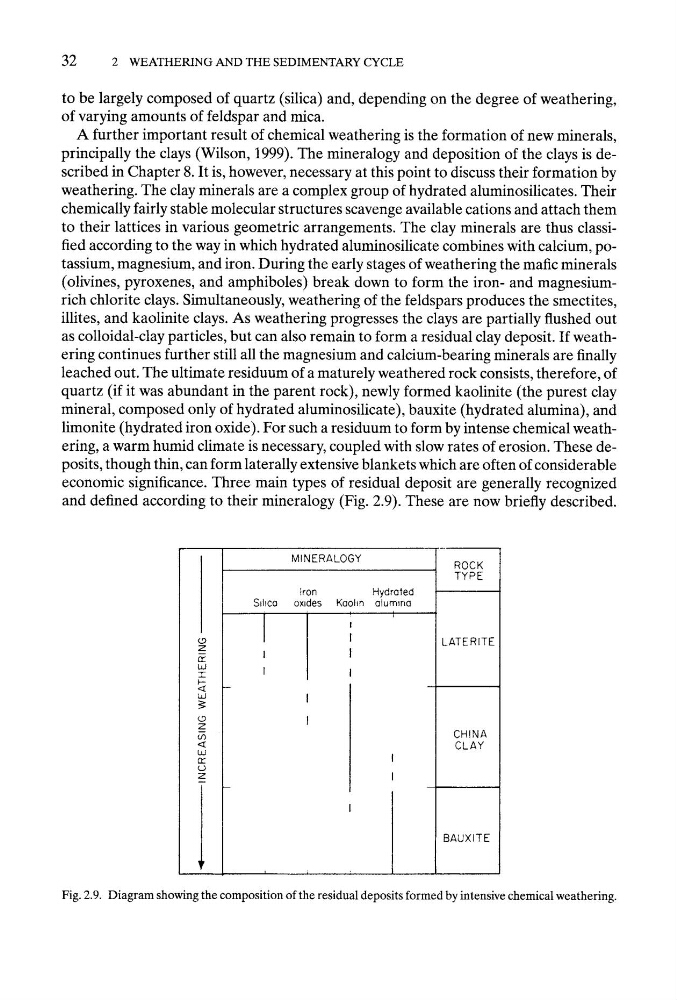
limonite (hydrated iron oxide). For such a residuum to form by intense chemical weathering, a warm humid climate is necessary, coupled with slow rates of erosion. These deposits, though thin, can form laterally extensive blankets which are often of considerable
economic significance. Three main types of residual deposit are generally recognized
and defined according to their mineralogy (Fig. 2.9). These are now briefly described.
MINERALOGY
ROCK
TYPE
S~I,co
Iron
ox,des
Hydrated
Kaolin alumina
t
I
I
I
I
LATERITE
CHINA
CLAY
BAUXITE
Fig. 2.9. Diagram showing the composition of the residual deposits formed by intensive chemical weathering.
2 WEATHERING AND THE SEDIMENTARY CYCLE
to be largely composed of quartz (silica) and, depending on the degree of weathering,
of varying amounts of feldspar and mica.
A further important result of chemical weathering is the formation of new minerals,
principally the clays (Wilson, 1999). The mineralogy and deposition of the clays is described in Chapter 8. It is, however, necessary at this point to discuss their formation by
weathering. The clay minerals are a complex group of hydrated aluminosilicates. Their
chemically fairly stable molecular structures scavenge available cations and attach them
to their lattices in various geometric arrangements. The clay minerals are thus classified according to the way in which hydrated aluminosilicate combines with calcium, potassium, magnesium, and iron. During the early stages of weathering the mafic minerals
(olivines, pyroxenes, and amphiboles) break down to form the iron- and magnesiumrich chlorite clays. Simultaneously, weathering of the feldspars produces the smectites,
illites, and kaolinite clays. As weathering progresses the clays are partially flushed out
as colloidal-clay particles, but can also remain to form a residual clay deposit. If weathering continues further still all the magnesium and calcium-bearing minerals are finally
leached out. The ultimate residuum of a maturely weathered rock consists, therefore, of
quartz (if it was abundant in the parent rock), newly formed kaolinite (the purest clay
mineral, composed only of hydrated aluminosilicate), bauxite (hydrated alumina), and
limonite (hydrated iron oxide). For such a residuum to form by intense chemical weathering, a warm humid climate is necessary, coupled with slow rates of erosion. These deposits, though thin, can form laterally extensive blankets which are often of considerable
economic significance. Three main types of residual deposit are generally recognized
and defined according to their mineralogy (Fig. 2.9). These are now briefly described.
MINERALOGY
ROCK
TYPE
S~I,co
Iron
ox,des
Hydrated
Kaolin alumina
t
I
I
I
I
LATERITE
CHINA
CLAY
BAUXITE
Fig. 2.9. Diagram showing the composition of the residual deposits formed by intensive chemical weathering.