

2.3 WEATHERING
31
This reaction leads to the formation of kaolinite and silica. The weathering reactions
are extremely complex and still little understood. (For further details, see Curtis, 1976.)
Numerous studies have been made of the rate of chemical weathering of different rockforming minerals (e.g., Ruxton, 1968; Parker, 1970). This work suggests that the rate of
relative mobility of the main rock-forming elements decreases from calcium and sodium to magnesium, potassium, silicon, iron, and aluminum. Rocks undergoing chemical weathering, therefore, tend to be depleted in the first of these elements, with a concomitant relative increase in the proportions of iron oxide, alumina, and silica.
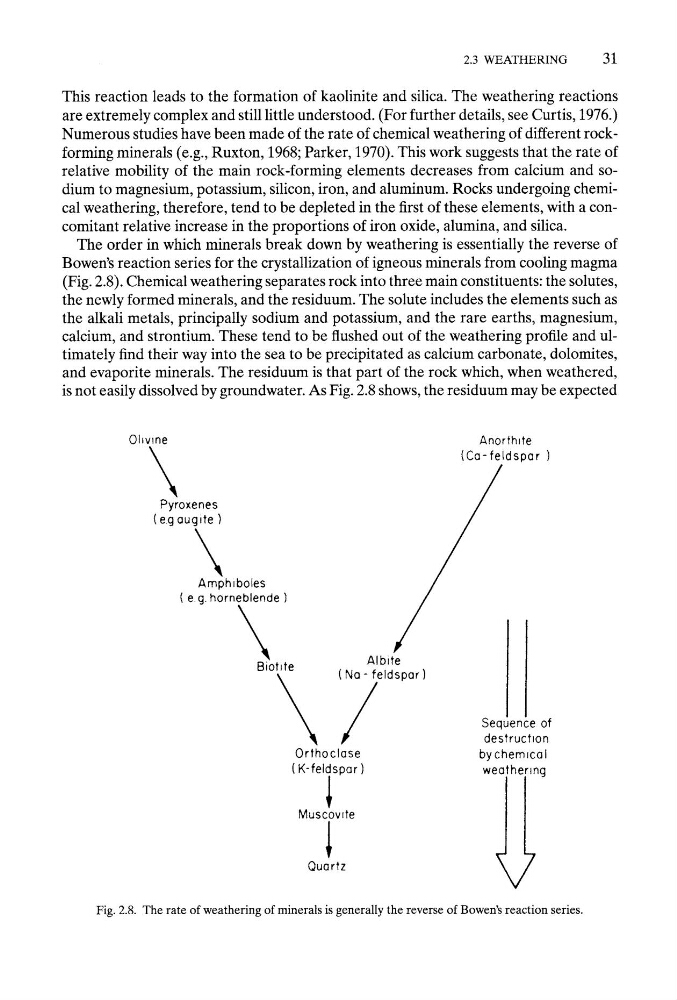
The order in which minerals break down by weathering is essentially the reverse of
Bowen's reaction series for the crystallization of igneous minerals from cooling magma
(Fig. 2.8). Chemical weathering separates rock into three main constituents: the solutes,
the newly formed minerals, and the residuum. The solute includes the elements such as
the alkali metals, principally sodium and potassium, and the rare earths, magnesium,
calcium, and strontium. These tend to be flushed out of the weathering profile and ultimately find their way into the sea to be precipitated as calcium carbonate, dolomites,
and evaporite minerals. The residuum is that part of the rock which, when weathered,
is not easily dissolved by groundwater. As Fig. 2.8 shows, the residuum may be expected
Ol~v~ne
Pyroxenes
( e.g augite )
Amphiboles
( e.g. horneblende )
Biotste
Anorth~te
(Ca-feldspar)
Albite
(Na- feldspar)
////
Sequence of
destruction
Orthoclase
bychem~cal
( K-feldspar )
weathering
l
Muscovite
Quartz
Fig. 2.8. The rate of weathering of minerals is generally the reverse of Bowen's reaction series.
31
This reaction leads to the formation of kaolinite and silica. The weathering reactions
are extremely complex and still little understood. (For further details, see Curtis, 1976.)
Numerous studies have been made of the rate of chemical weathering of different rockforming minerals (e.g., Ruxton, 1968; Parker, 1970). This work suggests that the rate of
relative mobility of the main rock-forming elements decreases from calcium and sodium to magnesium, potassium, silicon, iron, and aluminum. Rocks undergoing chemical weathering, therefore, tend to be depleted in the first of these elements, with a concomitant relative increase in the proportions of iron oxide, alumina, and silica.
The order in which minerals break down by weathering is essentially the reverse of
Bowen's reaction series for the crystallization of igneous minerals from cooling magma
(Fig. 2.8). Chemical weathering separates rock into three main constituents: the solutes,
the newly formed minerals, and the residuum. The solute includes the elements such as
the alkali metals, principally sodium and potassium, and the rare earths, magnesium,
calcium, and strontium. These tend to be flushed out of the weathering profile and ultimately find their way into the sea to be precipitated as calcium carbonate, dolomites,
and evaporite minerals. The residuum is that part of the rock which, when weathered,
is not easily dissolved by groundwater. As Fig. 2.8 shows, the residuum may be expected
Ol~v~ne
Pyroxenes
( e.g augite )
Amphiboles
( e.g. horneblende )
Biotste
Anorth~te
(Ca-feldspar)
Albite
(Na- feldspar)
////
Sequence of
destruction
Orthoclase
bychem~cal
( K-feldspar )
weathering
l
Muscovite
Quartz
Fig. 2.8. The rate of weathering of minerals is generally the reverse of Bowen's reaction series.