

8.5 SANDSTONES
361
Eh
1.0
tN
"O
X
O
v
(9
>
. m
O
13_
0
"-~,
t-"
. m
O "m
"(3
v
>
. m
Z
-1.0
Acid
pH
7
Alkaline
Sea
water
%
i
Stability
limits
of water
14
o
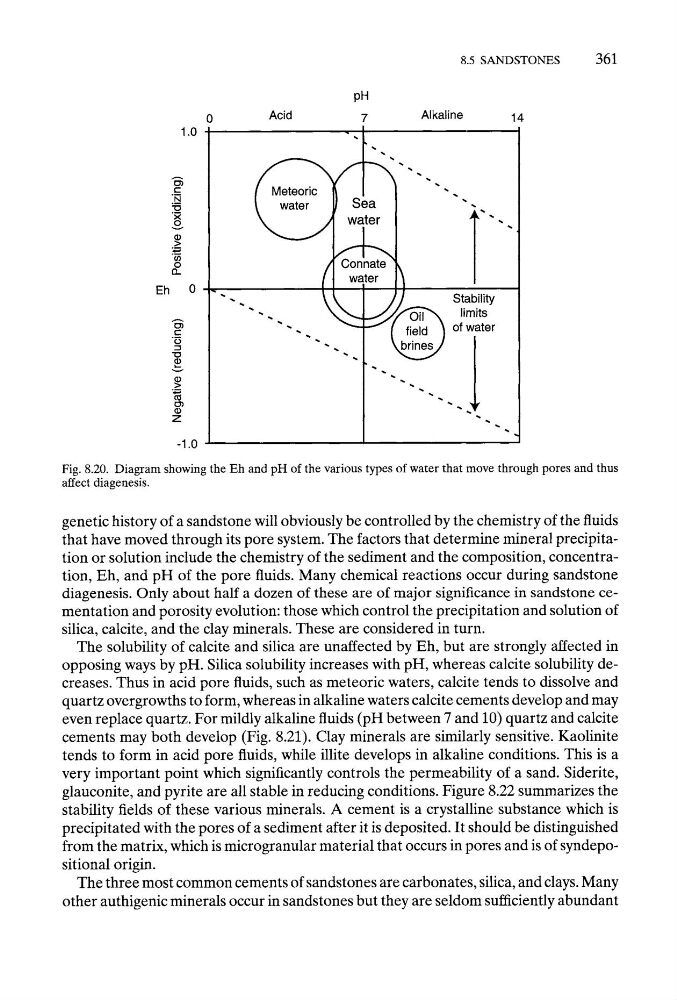
Fig. 8.20. Diagram showing the Eh and pH of the various types of water that move through pores and thus
affect diagenesis.
genetic history of a sandstone will obviously be controlled by the chemistry of the fluids
that have moved through its pore system. The factors that determine mineral precipitation or solution include the chemistry of the sediment and the composition, concentration, Eh, and pH of the pore fluids. Many chemical reactions occur during sandstone
diagenesis. Only about half a dozen of these are of major significance in sandstone cementation and porosity evolution: those which control the precipitation and solution of
silica, calcite, and the clay minerals. These are considered in turn.
The solubility of calcite and silica are unaffected by Eh, but are strongly affected in
opposing ways by pH. Silica solubility increases with pH, whereas calcite solubility decreases. Thus in acid pore fluids, such as meteoric waters, calcite tends to dissolve and
quartz overgrowths to form, whereas in alkaline waters calcite cements develop and may
even replace quartz. For mildly alkaline fluids (pH between 7 and 10) quartz and calcite
cements may both develop (Fig. 8.21). Clay minerals are similarly sensitive. Kaolinite
tends to form in acid pore fluids, while illite develops in alkaline conditions. This is a
very important point which significantly controls the permeability of a sand. Siderite,
glauconite, and pyrite are all stable in reducing conditions. Figure 8.22 summarizes the
stability fields of these various minerals. A cement is a crystalline substance which is
precipitated with the pores of a sediment after it is deposited. It should be distinguished
from the matrix, which is microgranular material that occurs in pores and is of syndepositional origin.
The three most common cements of sandstones are carbonates, silica, and clays. Many
other authigenic minerals occur in sandstones but they are seldom sufficiently abundant
361
Eh
1.0
tN
"O
X
O
v
(9
>
. m
O
13_
0
"-~,
t-"
. m
O "m
"(3
v
>
. m
Z
-1.0
Acid
pH
7
Alkaline
Sea
water
%
i
Stability
limits
of water
14
o
Fig. 8.20. Diagram showing the Eh and pH of the various types of water that move through pores and thus
affect diagenesis.
genetic history of a sandstone will obviously be controlled by the chemistry of the fluids
that have moved through its pore system. The factors that determine mineral precipitation or solution include the chemistry of the sediment and the composition, concentration, Eh, and pH of the pore fluids. Many chemical reactions occur during sandstone
diagenesis. Only about half a dozen of these are of major significance in sandstone cementation and porosity evolution: those which control the precipitation and solution of
silica, calcite, and the clay minerals. These are considered in turn.
The solubility of calcite and silica are unaffected by Eh, but are strongly affected in
opposing ways by pH. Silica solubility increases with pH, whereas calcite solubility decreases. Thus in acid pore fluids, such as meteoric waters, calcite tends to dissolve and
quartz overgrowths to form, whereas in alkaline waters calcite cements develop and may
even replace quartz. For mildly alkaline fluids (pH between 7 and 10) quartz and calcite
cements may both develop (Fig. 8.21). Clay minerals are similarly sensitive. Kaolinite
tends to form in acid pore fluids, while illite develops in alkaline conditions. This is a
very important point which significantly controls the permeability of a sand. Siderite,
glauconite, and pyrite are all stable in reducing conditions. Figure 8.22 summarizes the
stability fields of these various minerals. A cement is a crystalline substance which is
precipitated with the pores of a sediment after it is deposited. It should be distinguished
from the matrix, which is microgranular material that occurs in pores and is of syndepositional origin.
The three most common cements of sandstones are carbonates, silica, and clays. Many
other authigenic minerals occur in sandstones but they are seldom sufficiently abundant