

360
8 ALLOCHTHONOUS SEDIMENTS
6
1=:
C~
o
*-4 co
L..
o
E 2
AZ
0
|
-
%
_
|
I
I
I
!
I
i
I
J
2
4
6
8
10
12
14 16
Porosity gradient (% q~/km)
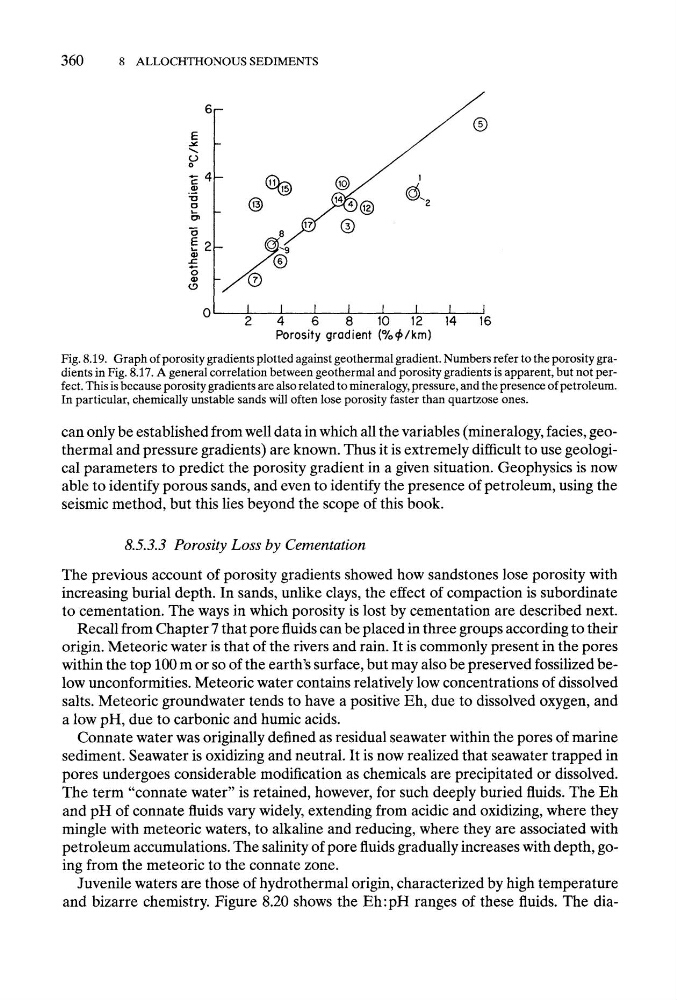
Fig. 8.19. Graph of porosity gradients plotted against geothermal gradient. Numbers refer to the porosity gradients in Fig. 8.17. A general correlation between geothermal and porosity gradients is apparent, but not perfect. This is because porosity gradients are also related to mineralogy, pressure, and the presence of petroleum.
In particular, chemically unstable sands will often lose porosity faster than quartzose ones.
can only be established from well data in which all the variables (mineralogy, facies, geothermal and pressure gradients) are known. Thus it is extremely difficult to use geological parameters to predict the porosity gradient in a given situation. Geophysics is now
able to identify porous sands, and even to identify the presence of petroleum, using the
seismic method, but this lies beyond the scope of this book.
8.5.3.3 Porosity Loss by Cementation
The previous account of porosity gradients showed how sandstones lose porosity with
increasing burial depth. In sands, unlike clays, the effect of compaction is subordinate
to cementation. The ways in which porosity is lost by cementation are described next.
Recall from Chapter 7 that pore fluids can be placed in three groups according to their
origin. Meteoric water is that of the rivers and rain. It is commonly present in the pores
within the top 100 m or so of the earth's surface, but may also be preserved fossilized below unconformities. Meteoric water contains relatively low concentrations of dissolved
salts. Meteoric groundwater tends to have a positive Eh, due to dissolved oxygen, and
a low pH, due to carbonic and humic acids.
Connate water was originally defined as residual seawater within the pores of marine
sediment. Seawater is oxidizing and neutral. It is now realized that seawater trapped in
pores undergoes considerable modification as chemicals are precipitated or dissolved.
The term "connate water" is retained, however, for such deeply buried fluids. The Eh
and pH of connate fluids vary widely, extending from acidic and oxidizing, where they
mingle with meteoric waters, to alkaline and reducing, where they are associated with
petroleum accumulations. The salinity of pore fluids gradually increases with depth, going from the meteoric to the connate zone.
Juvenile waters are those of hydrothermal origin, characterized by high temperature
and bizarre chemistry. Figure 8.20 shows the Eh:pH ranges of these fluids. The dia-
8 ALLOCHTHONOUS SEDIMENTS
6
1=:
C~
o
*-4 co
L..
o
E 2
AZ
0
|
-
%
_
|
I
I
I
!
I
i
I
J
2
4
6
8
10
12
14 16
Porosity gradient (% q~/km)
Fig. 8.19. Graph of porosity gradients plotted against geothermal gradient. Numbers refer to the porosity gradients in Fig. 8.17. A general correlation between geothermal and porosity gradients is apparent, but not perfect. This is because porosity gradients are also related to mineralogy, pressure, and the presence of petroleum.
In particular, chemically unstable sands will often lose porosity faster than quartzose ones.
can only be established from well data in which all the variables (mineralogy, facies, geothermal and pressure gradients) are known. Thus it is extremely difficult to use geological parameters to predict the porosity gradient in a given situation. Geophysics is now
able to identify porous sands, and even to identify the presence of petroleum, using the
seismic method, but this lies beyond the scope of this book.
8.5.3.3 Porosity Loss by Cementation
The previous account of porosity gradients showed how sandstones lose porosity with
increasing burial depth. In sands, unlike clays, the effect of compaction is subordinate
to cementation. The ways in which porosity is lost by cementation are described next.
Recall from Chapter 7 that pore fluids can be placed in three groups according to their
origin. Meteoric water is that of the rivers and rain. It is commonly present in the pores
within the top 100 m or so of the earth's surface, but may also be preserved fossilized below unconformities. Meteoric water contains relatively low concentrations of dissolved
salts. Meteoric groundwater tends to have a positive Eh, due to dissolved oxygen, and
a low pH, due to carbonic and humic acids.
Connate water was originally defined as residual seawater within the pores of marine
sediment. Seawater is oxidizing and neutral. It is now realized that seawater trapped in
pores undergoes considerable modification as chemicals are precipitated or dissolved.
The term "connate water" is retained, however, for such deeply buried fluids. The Eh
and pH of connate fluids vary widely, extending from acidic and oxidizing, where they
mingle with meteoric waters, to alkaline and reducing, where they are associated with
petroleum accumulations. The salinity of pore fluids gradually increases with depth, going from the meteoric to the connate zone.
Juvenile waters are those of hydrothermal origin, characterized by high temperature
and bizarre chemistry. Figure 8.20 shows the Eh:pH ranges of these fluids. The dia-