

8.5 SANDSTONES
347
STABLE G RAI N S
:::)
,,::[
I.t.I
n,"
~
MATRIX
UNSTABLE
GRAINS
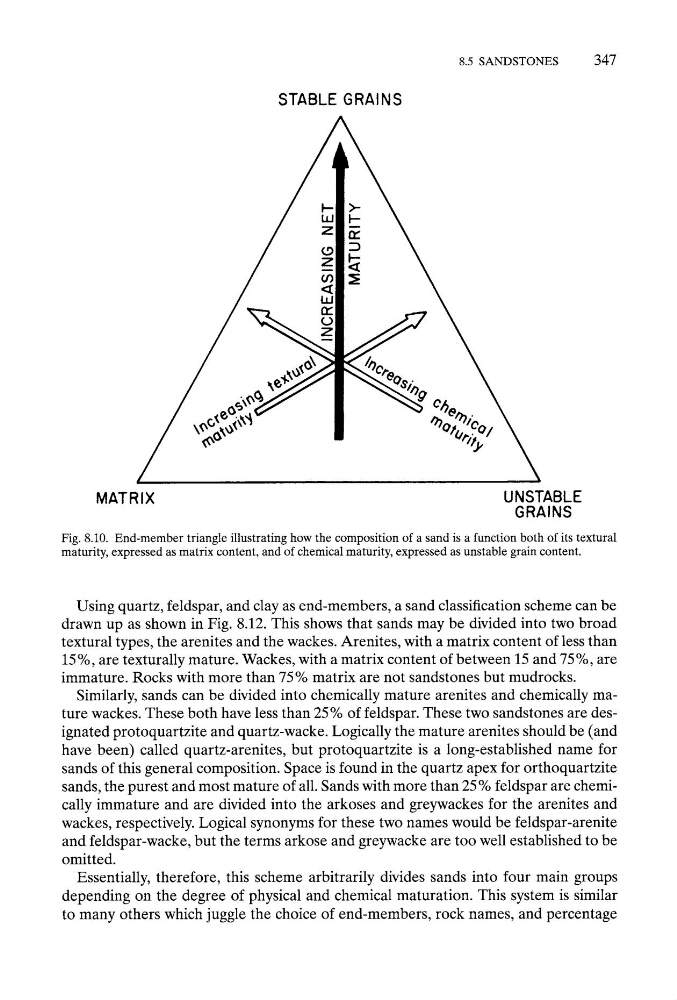
Fig. 8.10. End-member triangle illustrating how the composition of a sand is a function both of its textural
maturity, expressed as matrix content, and of chemical maturity, expressed as unstable grain content.
Using quartz, feldspar, and clay as end-members, a sand classification scheme can be
drawn up as shown in Fig. 8.12. This shows that sands may be divided into two broad
textural types, the arenites and the wackes. Arenites, with a matrix content of less than
15%, are texturally mature. Wackes, with a matrix content of between 15 and 75%, are
immature. Rocks with more than 75 % matrix are not sandstones but mudrocks.
Similarly, sands can be divided into chemically mature arenites and chemically mature wackes. These both have less than 25 % of feldspar. These two sandstones are designated protoquartzite and quartz-wacke. Logically the mature arenites should be (and
have been) called quartz-arenites, but protoquartzite is a long-established name for
sands of this general composition. Space is found in the quartz apex for orthoquartzite
sands, the purest and most mature of all. Sands with more than 25 % feldspar are chemically immature and are divided into the arkoses and greywackes for the arenites and
wackes, respectively. Logical synonyms for these two names would be feldspar-arenite
and feldspar-wacke, but the terms arkose and greywacke are too well established to be
omitted.
Essentially, therefore, this scheme arbitrarily divides sands into four main groups
depending on the degree of physical and chemical maturation. This system is similar
to many others which juggle the choice of end-members, rock names, and percentage
347
STABLE G RAI N S
:::)
,,::[
I.t.I
n,"
~
MATRIX
UNSTABLE
GRAINS
Fig. 8.10. End-member triangle illustrating how the composition of a sand is a function both of its textural
maturity, expressed as matrix content, and of chemical maturity, expressed as unstable grain content.
Using quartz, feldspar, and clay as end-members, a sand classification scheme can be
drawn up as shown in Fig. 8.12. This shows that sands may be divided into two broad
textural types, the arenites and the wackes. Arenites, with a matrix content of less than
15%, are texturally mature. Wackes, with a matrix content of between 15 and 75%, are
immature. Rocks with more than 75 % matrix are not sandstones but mudrocks.
Similarly, sands can be divided into chemically mature arenites and chemically mature wackes. These both have less than 25 % of feldspar. These two sandstones are designated protoquartzite and quartz-wacke. Logically the mature arenites should be (and
have been) called quartz-arenites, but protoquartzite is a long-established name for
sands of this general composition. Space is found in the quartz apex for orthoquartzite
sands, the purest and most mature of all. Sands with more than 25 % feldspar are chemically immature and are divided into the arkoses and greywackes for the arenites and
wackes, respectively. Logical synonyms for these two names would be feldspar-arenite
and feldspar-wacke, but the terms arkose and greywacke are too well established to be
omitted.
Essentially, therefore, this scheme arbitrarily divides sands into four main groups
depending on the degree of physical and chemical maturation. This system is similar
to many others which juggle the choice of end-members, rock names, and percentage