

336
8 ALLOCHTHONOUS SEDIMENTS
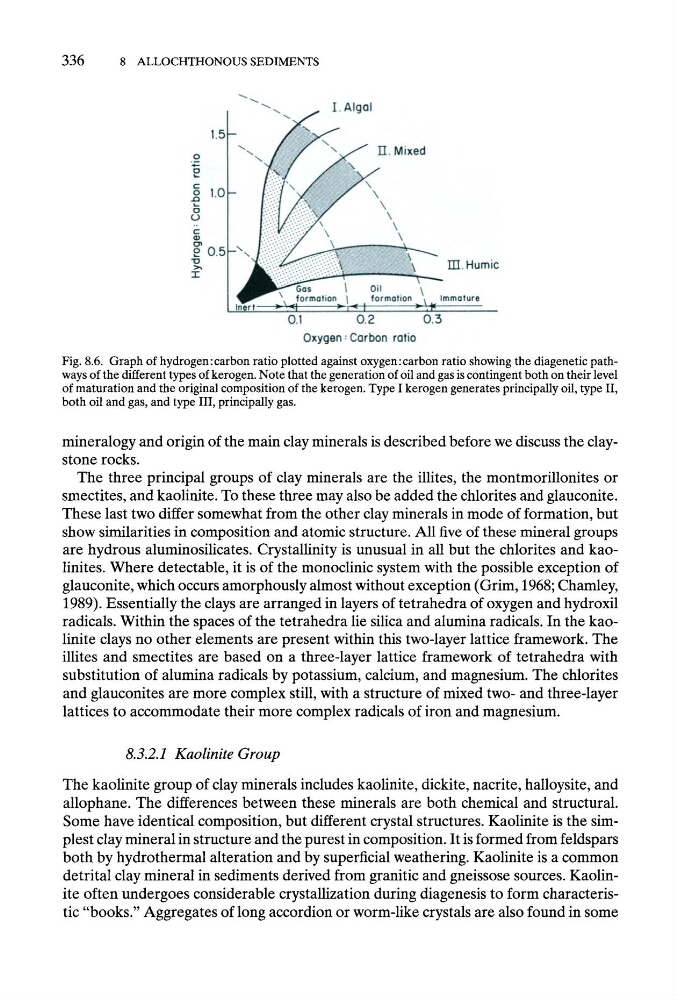
Fig. 8.6. Graph of hydrogen:carbon ratio plotted against oxygen: carbon ratio showing the diagenetic pathways of the different types of kerogen. Note that the generation of oil and gas is contingent both on their level
of maturation and the original composition of the kerogen. Type I kerogen generates principally oil, type II,
both oil and gas, and type III, principally gas.
mineralogy and origin of the main clay minerals is described before we discuss the claystone rocks.
The three principal groups of clay minerals are the illites, the montmorillonites or
smectites, and kaolinite. To these three may also be added the chlorites and glauconite.
These last two differ somewhat from the other clay minerals in mode of formation, but
show similarities in composition and atomic structure. All five of these mineral groups
are hydrous aluminosilicates. Crystallinity is unusual in all but the chlorites and kaolinites. Where detectable, it is of the monoclinic system with the possible exception of
glauconite, which occurs amorphously almost without exception (Grim, 1968; Chamley,
1989). Essentially the clays are arranged in layers of tetrahedra of oxygen and hydroxil
radicals. Within the spaces of the tetrahedra lie silica and alumina radicals. In the kaolinite clays no other elements are present within this two-layer lattice framework. The
illites and smectites are based on a three-layer lattice framework of tetrahedra with
substitution of alumina radicals by potassium, calcium, and magnesium. The chlorites
and glauconites are more complex still, with a structure of mixed two- and three-layer
lattices to accommodate their more complex radicals of iron and magnesium.
8.3.2.1 Kaolinite Group
The kaolinite group of clay minerals includes kaolinite, dickite, nacrite, halloysite, and
allophane. The differences between these minerals are both chemical and structural.
Some have identical composition, but different crystal structures. Kaolinite is the simplest clay mineral in structure and the purest in composition. It is formed from feldspars
both by hydrothermal alteration and by superficial weathering. Kaolinite is a common
detrital clay mineral in sediments derived from granitic and gneissose sources. Kaolinite often undergoes considerable crystallization during diagenesis to form characteristic "books." Aggregates of long accordion or worm-like crystals are also found in some
8 ALLOCHTHONOUS SEDIMENTS
Fig. 8.6. Graph of hydrogen:carbon ratio plotted against oxygen: carbon ratio showing the diagenetic pathways of the different types of kerogen. Note that the generation of oil and gas is contingent both on their level
of maturation and the original composition of the kerogen. Type I kerogen generates principally oil, type II,
both oil and gas, and type III, principally gas.
mineralogy and origin of the main clay minerals is described before we discuss the claystone rocks.
The three principal groups of clay minerals are the illites, the montmorillonites or
smectites, and kaolinite. To these three may also be added the chlorites and glauconite.
These last two differ somewhat from the other clay minerals in mode of formation, but
show similarities in composition and atomic structure. All five of these mineral groups
are hydrous aluminosilicates. Crystallinity is unusual in all but the chlorites and kaolinites. Where detectable, it is of the monoclinic system with the possible exception of
glauconite, which occurs amorphously almost without exception (Grim, 1968; Chamley,
1989). Essentially the clays are arranged in layers of tetrahedra of oxygen and hydroxil
radicals. Within the spaces of the tetrahedra lie silica and alumina radicals. In the kaolinite clays no other elements are present within this two-layer lattice framework. The
illites and smectites are based on a three-layer lattice framework of tetrahedra with
substitution of alumina radicals by potassium, calcium, and magnesium. The chlorites
and glauconites are more complex still, with a structure of mixed two- and three-layer
lattices to accommodate their more complex radicals of iron and magnesium.
8.3.2.1 Kaolinite Group
The kaolinite group of clay minerals includes kaolinite, dickite, nacrite, halloysite, and
allophane. The differences between these minerals are both chemical and structural.
Some have identical composition, but different crystal structures. Kaolinite is the simplest clay mineral in structure and the purest in composition. It is formed from feldspars
both by hydrothermal alteration and by superficial weathering. Kaolinite is a common
detrital clay mineral in sediments derived from granitic and gneissose sources. Kaolinite often undergoes considerable crystallization during diagenesis to form characteristic "books." Aggregates of long accordion or worm-like crystals are also found in some