

8.3 MUDROCKS
335
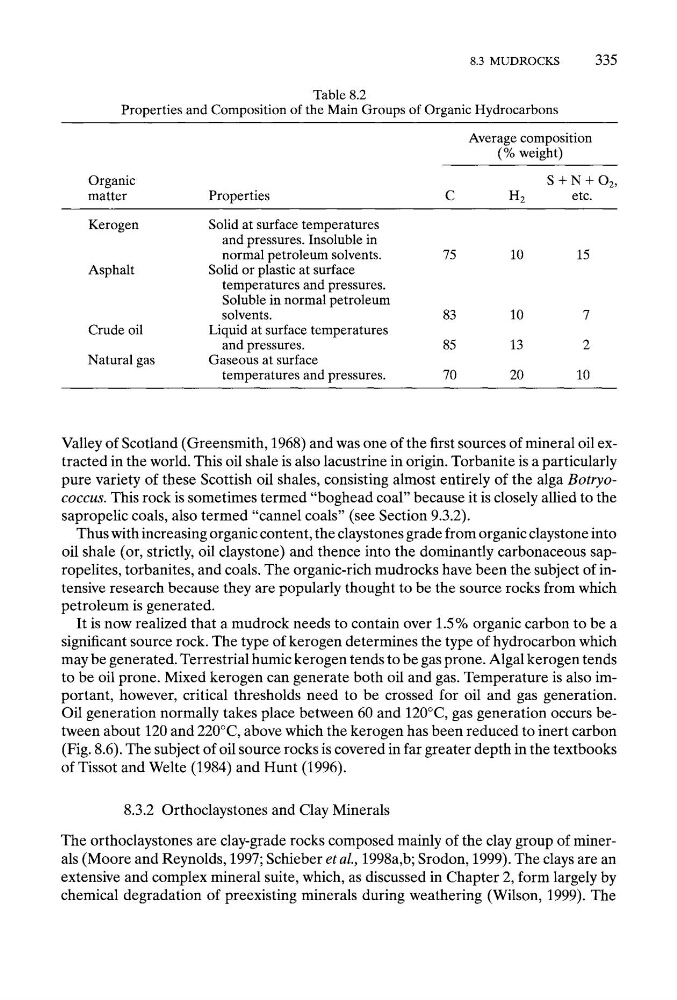
Table 8.2
Properties and Composition of the Main Groups of Organic Hydrocarbons
Organic
matter
Average composition
(% weight)
S+N+O 2,
Properties
C
H 2
etc.
Kerogen
Asphalt
Crude oil
Natural gas
Solid at surface temperatures
and pressures. Insoluble in
normal petroleum solvents.
75
10
15
Solid or plastic at surface
temperatures and pressures.
Soluble in normal petroleum
solvents.
83
10
7
Liquid at surface temperatures
and pressures.
85
13
2
Gaseous at surface
temperatures and pressures.
70
20
10
Valley of Scotland (Greensmith, 1968) and was one of the first sources of mineral oil extracted in the world. This oil shale is also lacustrine in origin. Torbanite is a particularly
pure variety of these Scottish oil shales, consisting almost entirely of the alga Botryococcus. This rock is sometimes termed "boghead coal" because it is closely allied to the
sapropelic coals, also termed "cannel coals" (see Section 9.3.2).
Thus with increasing organic content, the claystones grade from organic claystone into
oil shale (or, strictly, oil claystone) and thence into the dominantly carbonaceous sapropelites, torbanites, and coals. The organic-rich mudrocks have been the subject of intensive research because they are popularly thought to be the source rocks from which
petroleum is generated.
It is now realized that a mudrock needs to contain over 1.5 % organic carbon to be a
significant source rock. The type of kerogen determines the type of hydrocarbon which
may be generated. Terrestrial humic kerogen tends to be gas prone. Algal kerogen tends
to be oil prone. Mixed kerogen can generate both oil and gas. Temperature is also important, however, critical thresholds need to be crossed for oil and gas generation.
Oil generation normally takes place between 60 and 120~ gas generation occurs between about 120 and 220~ above which the kerogen has been reduced to inert carbon
(Fig. 8.6). The subject of oil source rocks is covered in far greater depth in the textbooks
of Tissot and Welte (1984) and Hunt (1996).
8.3.20rthoclaystones and Clay Minerals
The orthoclaystones are clay-grade rocks composed mainly of the clay group of minerals (Moore and Reynolds, 1997; Schieber et al., 1998a,b; Srodon, 1999). The clays are an
extensive and complex mineral suite, which, as discussed in Chapter 2, form largely by
chemical degradation of preexisting minerals during weathering (Wilson, 1999). The
335
Table 8.2
Properties and Composition of the Main Groups of Organic Hydrocarbons
Organic
matter
Average composition
(% weight)
S+N+O 2,
Properties
C
H 2
etc.
Kerogen
Asphalt
Crude oil
Natural gas
Solid at surface temperatures
and pressures. Insoluble in
normal petroleum solvents.
75
10
15
Solid or plastic at surface
temperatures and pressures.
Soluble in normal petroleum
solvents.
83
10
7
Liquid at surface temperatures
and pressures.
85
13
2
Gaseous at surface
temperatures and pressures.
70
20
10
Valley of Scotland (Greensmith, 1968) and was one of the first sources of mineral oil extracted in the world. This oil shale is also lacustrine in origin. Torbanite is a particularly
pure variety of these Scottish oil shales, consisting almost entirely of the alga Botryococcus. This rock is sometimes termed "boghead coal" because it is closely allied to the
sapropelic coals, also termed "cannel coals" (see Section 9.3.2).
Thus with increasing organic content, the claystones grade from organic claystone into
oil shale (or, strictly, oil claystone) and thence into the dominantly carbonaceous sapropelites, torbanites, and coals. The organic-rich mudrocks have been the subject of intensive research because they are popularly thought to be the source rocks from which
petroleum is generated.
It is now realized that a mudrock needs to contain over 1.5 % organic carbon to be a
significant source rock. The type of kerogen determines the type of hydrocarbon which
may be generated. Terrestrial humic kerogen tends to be gas prone. Algal kerogen tends
to be oil prone. Mixed kerogen can generate both oil and gas. Temperature is also important, however, critical thresholds need to be crossed for oil and gas generation.
Oil generation normally takes place between 60 and 120~ gas generation occurs between about 120 and 220~ above which the kerogen has been reduced to inert carbon
(Fig. 8.6). The subject of oil source rocks is covered in far greater depth in the textbooks
of Tissot and Welte (1984) and Hunt (1996).
8.3.20rthoclaystones and Clay Minerals
The orthoclaystones are clay-grade rocks composed mainly of the clay group of minerals (Moore and Reynolds, 1997; Schieber et al., 1998a,b; Srodon, 1999). The clays are an
extensive and complex mineral suite, which, as discussed in Chapter 2, form largely by
chemical degradation of preexisting minerals during weathering (Wilson, 1999). The