

322
7 THE SUBSURFACE ENVIRONMENT
Fig. 7.12. Photomicrograph of an authigenic quartz crystal with a fluid inclusion that contains a globule of
oil. (Courtesy of A. Rankin.) It is possible to analyse the inclusion to discover the temperature and chemistry
of the fluids in which the crystal grew.
Seawater, which may be taken as a benchmark, normally has a salinity of about 35,000
p.p.m. Subsurface waters range from 0.0 near the surface to more than 600,000 in exceptional cases. Normally salinity increases with depth. Anomalously high salinities are
recorded adjacent to evaporite formations. Anomalously low salinities are recorded
0
1 . 4 -
~ 1.0
~
._
N
- Rain water,
"5
_ meteoric water,
0
uranium roll-front
l
- reactions
0 . 2 - -
e~ -0.2
.c:
ississippi val ley
(9
P b - Z n brines
"13
rr - I . 0 -
- 1 . 4 -
pH
Acid
Alkaline
14
Water
unstable
Sea water
~ ~'~"
Oil field brines
Exhalalative
9 Water
~
meSstable
Water
unstable
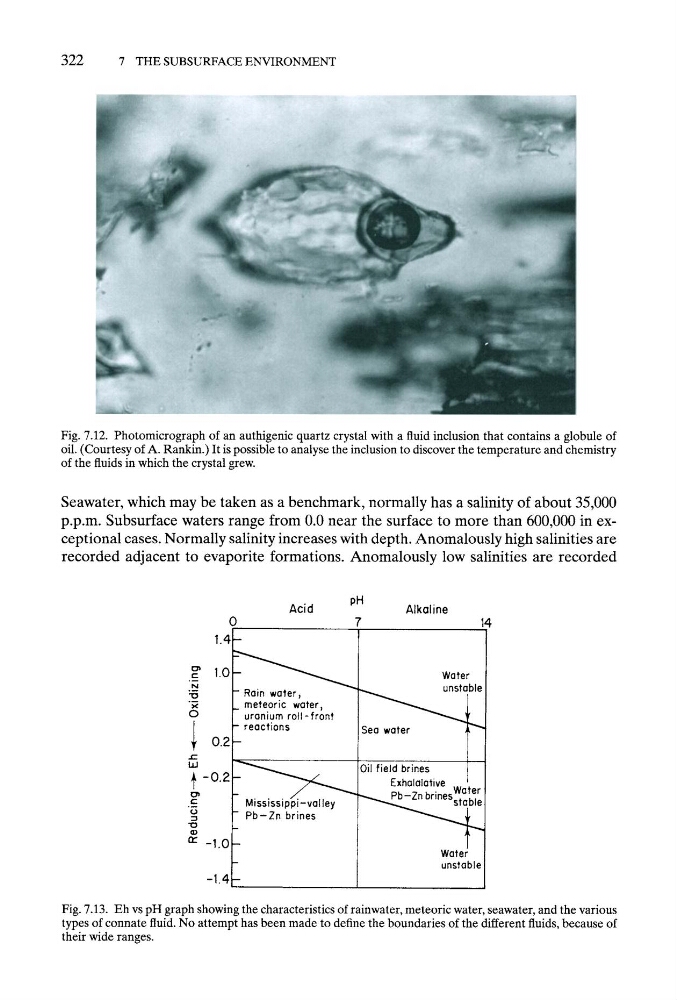
Fig. 7.13. Eh vs pH graph showing the characteristics of rainwater, meteoric water, seawater, and the various
types of connate fluid. No attempt has been made to define the boundaries of the different fluids, because of
their wide ranges.
7 THE SUBSURFACE ENVIRONMENT
Fig. 7.12. Photomicrograph of an authigenic quartz crystal with a fluid inclusion that contains a globule of
oil. (Courtesy of A. Rankin.) It is possible to analyse the inclusion to discover the temperature and chemistry
of the fluids in which the crystal grew.
Seawater, which may be taken as a benchmark, normally has a salinity of about 35,000
p.p.m. Subsurface waters range from 0.0 near the surface to more than 600,000 in exceptional cases. Normally salinity increases with depth. Anomalously high salinities are
recorded adjacent to evaporite formations. Anomalously low salinities are recorded
0
1 . 4 -
~ 1.0
~
._
N
- Rain water,
"5
_ meteoric water,
0
uranium roll-front
l
- reactions
0 . 2 - -
e~ -0.2
.c:
ississippi val ley
(9
P b - Z n brines
"13
rr - I . 0 -
- 1 . 4 -
pH
Acid
Alkaline
14
Water
unstable
Sea water
~ ~'~"
Oil field brines
Exhalalative
9 Water
~
meSstable
Water
unstable
Fig. 7.13. Eh vs pH graph showing the characteristics of rainwater, meteoric water, seawater, and the various
types of connate fluid. No attempt has been made to define the boundaries of the different fluids, because of
their wide ranges.