

7.3 SUBSURFACE FLUIDS
319
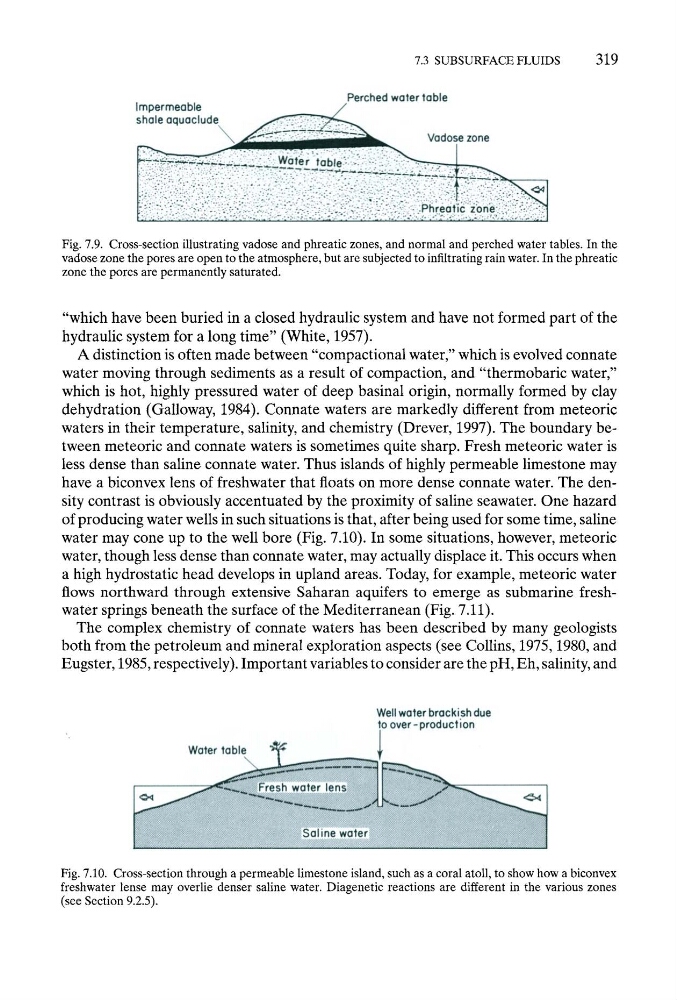
Fig. 7.9. Cross-section illustrating vadose and phreatic zones, and normal and perched water tables. In the
vadose zone the pores are open to the atmosphere, but are subjected to infiltrating rain water. In the phreatic
zone the pores are permanently saturated.
"which have been buried in a closed hydraulic system and have not formed part of the
hydraulic system for a long time" (White, 1957).
A distinction is often made between "compactional water," which is evolved connate
water moving through sediments as a result of compaction, and "thermobaric water,"
which is hot, highly pressured water of deep basinal origin, normally formed by clay
dehydration (Galloway, 1984). Connate waters are markedly different from meteoric
waters in their temperature, salinity, and chemistry (Drever, 1997). The boundary between meteoric and connate waters is sometimes quite sharp. Fresh meteoric water is
less dense than saline connate water. Thus islands of highly permeable limestone may
have a biconvex lens of freshwater that floats on more dense connate water. The density contrast is obviously accentuated by the proximity of saline seawater. One hazard
of producing water wells in such situations is that, after being used for some time, saline
water may cone up to the well bore (Fig. 7.10). In some situations, however, meteoric
water, though less dense than connate water, may actually displace it. This occurs when
a high hydrostatic head develops in upland areas. Today, for example, meteoric water
flows northward through extensive Saharan aquifers to emerge as submarine fleshwater springs beneath the surface of the Mediterranean (Fig. 7.11).
The complex chemistry of connate waters has been described by many geologists
both from the petroleum and mineral exploration aspects (see Collins, 1975, 1980, and
Eugster, 1985, respectively). Important variables to consider are the pH, Eh, salinity, and
Fig. 7.10. Cross-section through a permeable limestone island, such as a coral atoll, to show how a biconvex
freshwater lense may overlie denser saline water. Diagenetic reactions are different in the various zones
(see Section 9.2.5).
319
Fig. 7.9. Cross-section illustrating vadose and phreatic zones, and normal and perched water tables. In the
vadose zone the pores are open to the atmosphere, but are subjected to infiltrating rain water. In the phreatic
zone the pores are permanently saturated.
"which have been buried in a closed hydraulic system and have not formed part of the
hydraulic system for a long time" (White, 1957).
A distinction is often made between "compactional water," which is evolved connate
water moving through sediments as a result of compaction, and "thermobaric water,"
which is hot, highly pressured water of deep basinal origin, normally formed by clay
dehydration (Galloway, 1984). Connate waters are markedly different from meteoric
waters in their temperature, salinity, and chemistry (Drever, 1997). The boundary between meteoric and connate waters is sometimes quite sharp. Fresh meteoric water is
less dense than saline connate water. Thus islands of highly permeable limestone may
have a biconvex lens of freshwater that floats on more dense connate water. The density contrast is obviously accentuated by the proximity of saline seawater. One hazard
of producing water wells in such situations is that, after being used for some time, saline
water may cone up to the well bore (Fig. 7.10). In some situations, however, meteoric
water, though less dense than connate water, may actually displace it. This occurs when
a high hydrostatic head develops in upland areas. Today, for example, meteoric water
flows northward through extensive Saharan aquifers to emerge as submarine fleshwater springs beneath the surface of the Mediterranean (Fig. 7.11).
The complex chemistry of connate waters has been described by many geologists
both from the petroleum and mineral exploration aspects (see Collins, 1975, 1980, and
Eugster, 1985, respectively). Important variables to consider are the pH, Eh, salinity, and
Fig. 7.10. Cross-section through a permeable limestone island, such as a coral atoll, to show how a biconvex
freshwater lense may overlie denser saline water. Diagenetic reactions are different in the various zones
(see Section 9.2.5).